
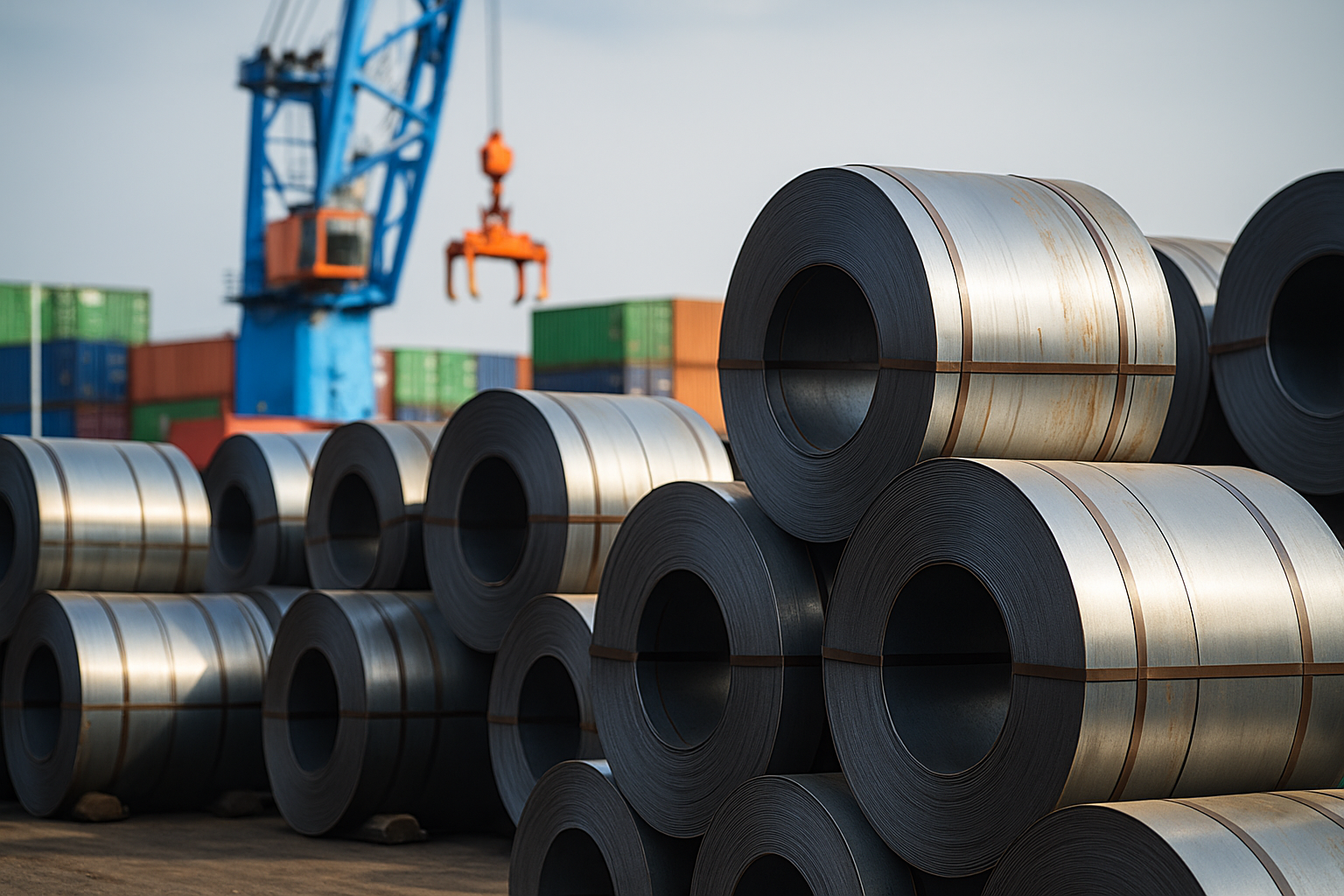
How Global Trade Policies Impact Steel Import and Export Costs
Steel is one of the world’s most internationally traded industrial materials. Coils, sheets, plates, bars, tubes, semi-finished products, scrap, and steel-containing manufactured goods move continuously between producers, processors, distributors, and industrial users across multiple countries.
But the final cost of imported steel is determined by much more than the price negotiated with the mill.
Tariffs, anti-dumping duties, countervailing measures, safeguards, quotas, rules of origin, customs classification, carbon regulations, exchange rates, freight, and documentation requirements can substantially change the economics of an international steel transaction.
For steel buyers and exporters, this means that a competitive mill price does not necessarily result in a competitive delivered price.
The correct question is therefore not simply:
“What is the price of the steel?”
It is:
“What will be the total landed cost of this steel after all trade, customs, logistics, regulatory, and financial effects are considered?”
This article explains how global trade policies affect steel import and export costs and how companies can incorporate these factors into sourcing, pricing, and supply-chain decisions.
1. Why Trade Policy Matters So Much in the Steel Industry
Steel has historically been one of the industrial sectors most exposed to trade-policy intervention.
Governments may introduce measures intended to protect domestic production, address unfair trade practices, respond to national-security concerns, manage import surges, or support environmental objectives.
These measures can affect:
- Import prices
- Export competitiveness
- Supplier selection
- Available steel grades
- Lead times
- Inventory requirements
- Customs procedures
- Cash flow
- Working capital
- Supply-chain risk
A sourcing strategy that appears economically attractive today can change rapidly if a new tariff, anti-dumping duty, quota, or regulatory requirement is introduced.
For this reason, trade policy should be treated as part of steel procurement strategy, not simply as a customs issue handled after the purchase order has already been issued.
2. Tariffs: The Most Visible Trade Cost
A tariff is a customs duty imposed on imported goods.
Steel tariffs can take several forms.
Ad valorem tariffs
These are calculated as a percentage of the customs value.
For example, if an imported steel product has a customs value of $1,000 per metric ton and is subject to a 20% tariff, the tariff alone would represent:
$1,000 × 20% = $200 per ton
The effective imported cost therefore begins at $1,200 per ton before considering freight, customs fees, inland transportation, financing, and other expenses.
Specific tariffs
Some duties may be calculated according to quantity, weight, or another physical unit.
Additional tariffs
A steel product may also be subject to additional trade measures beyond the ordinary customs tariff.
This is particularly important because companies sometimes evaluate an import using only the standard tariff rate and fail to identify additional duties applicable to the product, origin, producer, or exporter.
3. Section 232 and the U.S. Steel Market
The United States provides one of the clearest examples of how trade policy can alter steel economics.
Section 232 measures were originally introduced on steel imports in 2018 on national-security grounds.
The regime has subsequently been modified several times.
In June 2025, the United States increased additional Section 232 tariffs on many steel and aluminum imports from 25% to 50%. Further changes were introduced in 2026, including differentiated treatment for certain metal products and derivative products.
For steel companies, the important lesson extends beyond the specific tariff percentage.
Trade regimes can change:
- Tariff rates
- Product coverage
- Country treatment
- Derivative-product treatment
- Customs valuation rules
- Origin requirements
- Exemptions or special arrangements
Therefore, importers should verify the rules applicable at the time of the transaction and customs entry, rather than relying on historical tariff treatment.
This is especially important for long-term contracts where material may be ordered months before arrival.
4. Anti-Dumping Duties
Anti-dumping measures are among the most important risks in international steel trade.
Dumping generally refers to situations in which a product is exported at a price considered lower than its normal value under the applicable trade-remedy methodology.
When an importing country determines through an investigation that dumped imports are causing injury to its domestic industry, anti-dumping duties may be imposed.
The WTO maintains information on anti-dumping actions reported by its members, and steel products remain an important area of trade-remedy activity.
For buyers, this creates a major sourcing risk.
A supplier may offer:
Steel price: $700/t
But suppose the product becomes subject to a substantial anti-dumping duty.
The apparent $700/t sourcing opportunity may become significantly more expensive than a domestic or alternative international source.
Therefore, procurement teams should never evaluate an international steel quotation solely according to the supplier’s FOB or CFR price.
5. Countervailing Duties
Countervailing duties address a different trade issue.
They may be imposed when an importing country determines that foreign producers benefit from actionable government subsidies and that subsidized imports cause injury to the domestic industry under the applicable legal framework.
Steel products are frequently involved in such investigations.
WTO data, for example, show countervailing measures involving corrosion-resistant steel products from multiple exporting countries.
From a procurement perspective, the practical issue is similar to anti-dumping:
The country of origin and producer can materially change the final import cost.
Two technically equivalent steel products may therefore have very different landed costs depending on their origin and the trade measures applicable to each supplier.
6. Safeguard Measures and Import Quotas
Safeguards differ from anti-dumping and countervailing duties.
They are generally temporary measures designed to respond to increased imports that cause or threaten serious injury to a domestic industry. Under WTO rules, safeguards can take the form of quantitative restrictions or additional duties, subject to specific conditions.
In steel trade, safeguards can create quota systems.
This introduces an additional variable into purchasing decisions:
quota availability.
A shipment arriving while quota remains available may receive one tariff treatment.
A shipment arriving after the quota has been exhausted may face a different duty or other restriction, depending on the applicable system.
Therefore, the timing of customs clearance can become economically important.
7. Free Trade Agreements and Rules of Origin
Free Trade Agreements (FTAs) can reduce or eliminate customs duties between participating countries.
However, there is an important misconception:
Shipping steel from an FTA country does not automatically mean that the steel qualifies for preferential tariff treatment.
The product must normally comply with applicable rules of origin.
These rules may depend on:
- Where the steel was produced
- Where it was melted and poured
- Where transformation occurred
- Tariff-classification changes
- Regional-value requirements
- Product-specific origin rules
- Required origin documentation
This distinction becomes particularly important when steel passes through service centers, processors, or distributors located in several countries.
The country from which the material is shipped is not necessarily the same as its customs origin.
8. Customs Classification: A Critical Cost Variable
Correct customs classification is one of the foundations of international steel trade.
Steel products may be classified according to characteristics including:
- Chemical composition
- Alloy content
- Product form
- Width
- Thickness
- Surface treatment
- Coating
- Manufacturing process
- End configuration
- Intended function in certain classifications
The applicable Harmonized System (HS) classification can determine:
- Basic import duty
- Trade-remedy exposure
- Licensing requirements
- Statistical treatment
- Regulatory requirements
- Eligibility for preferential treatment
A classification error can therefore produce consequences far beyond an incorrect tariff percentage.
It can lead to:
- Underpayment of duties
- Additional tax assessments
- Penalties
- Customs delays
- Reclassification
- Documentation problems
- Compliance investigations
For technically complex steel products, customs classification should be supported by adequate technical documentation.
9. Technical Documentation Becomes a Trade Tool
International steel transactions increasingly require technical information capable of supporting customs and regulatory decisions.
Relevant documents may include:
- Material Test Certificates (MTCs)
- Chemical composition
- Mechanical properties
- Manufacturing process
- Product dimensions
- Coating specifications
- Technical drawings
- Product catalogs
- Supplier declarations
- Origin information
- Purchase specifications
This is particularly important for specialized products, coated steels, alloy steels, components, and steel-containing manufactured products.
Poor technical descriptions create customs uncertainty.
And customs uncertainty creates financial risk.
10. CBAM: Carbon Is Becoming a Trade-Cost Variable
Environmental regulation is creating a new dimension in steel trade.
The European Union’s Carbon Border Adjustment Mechanism (CBAM) entered its definitive regime on January 1, 2026.
Under the definitive regime, qualifying importers of covered goods must comply with CBAM requirements, with authorized CBAM declarants purchasing certificates under the applicable system. The European Commission also applies a mass-based threshold of 50 tonnes for the relevant authorization requirement.
For steel exporters supplying the European market, this means that carbon information is increasingly connected to commercial competitiveness.
Exporters may need reliable information regarding:
- Production route
- Embedded emissions
- Electricity-related emissions where applicable
- Production facility
- Verification requirements
- Supporting documentation
Consequently, two steel suppliers offering similar prices and mechanical properties may no longer have equivalent commercial positions.
Their carbon intensity and ability to document emissions can influence the real cost of supplying the European market.
11. From Purchase Price to Total Landed Cost
One of the most important disciplines in international steel procurement is calculating Total Landed Cost (TLC).
A simplified model is:
Total Landed Cost = Material Price + International Freight + Insurance + Customs Duties + Trade Remedies + Carbon Costs + Port Costs + Customs Clearance + Inland Logistics + Financing + Inventory Cost + Compliance Cost
Consider a hypothetical comparison.
Supplier A — Overseas
FOB steel price: $700/t
International freight and insurance: $80/t
Tariffs and duties: $210/t
Port and customs costs: $35/t
Inland transportation: $45/t
Financing/inventory impact: $25/t
Estimated landed cost = $1,095/t
Supplier B — Regional
Material price: $910/t
Transportation: $70/t
Other costs: $30/t
Estimated delivered cost = $1,010/t
Supplier A appeared to be $210/t cheaper when comparing material prices.
After considering landed cost, Supplier B becomes approximately $85/t cheaper.
This is why comparing steel suppliers exclusively on base price can lead to poor purchasing decisions.
12. Exchange Rates Can Change the Result
Currency risk adds another layer of complexity.
Steel contracts may be negotiated weeks or months before final payment.
During this period, exchange rates can change significantly.
A 5% currency movement on a large steel contract may exceed the purchasing savings originally obtained through supplier negotiation.
Companies should therefore consider:
- Contract currency
- Payment schedule
- Currency exposure
- Hedging strategy
- Import financing
- Exchange-rate scenarios
Trade policy and currency risk should be evaluated together when analyzing international sourcing.
13. Freight and Logistics Matter Too
International freight can materially alter the competitiveness of imported steel.
Relevant factors include:
- Ocean freight
- Port congestion
- Container availability
- Bulk shipping availability
- Fuel costs
- Canal disruptions
- War-risk premiums
- Insurance
- Inland transportation
- Port handling
- Demurrage
Steel is particularly sensitive to logistics because it is heavy and often relatively low in value per unit of weight compared with many manufactured products.
A modest change in freight per ton can therefore materially change the competitiveness of an import.
14. Trade Policy Also Affects Lead Time
The cost impact of trade policy is not limited to customs duties.
Regulatory requirements can increase lead time through:
- Licensing
- Inspections
- Customs reviews
- Origin verification
- Documentation requests
- Trade-remedy procedures
- Quota administration
- Carbon reporting
Longer lead times create secondary costs.
Companies may need:
- Larger safety stocks
- More warehouse space
- Additional working capital
- Alternative suppliers
- Emergency purchases
Therefore:
Trade-policy cost = direct customs cost + indirect supply-chain cost.
15. Diversification Is a Trade-Risk Strategy
Depending excessively on one country, mill, port, or trade route can expose a steel buyer to significant risk.
A more resilient sourcing strategy may include:
- Multiple qualified suppliers
- Multiple countries of origin
- Regional sourcing alternatives
- Domestic alternatives
- Technical-equivalent grades
- Alternative ports
- Safety-stock policies
However, diversification should not be based only on commercial availability.
Alternative steel grades must be technically validated before substitution.
Chemical composition alone does not establish equivalence.
Mechanical properties, dimensional tolerances, surface condition, manufacturing process, standards, certification, and application requirements must also be considered.
16. Nearshoring and Regionalization
Trade-policy uncertainty has increased interest in nearshoring and regional sourcing.
A nearby supplier may have a higher nominal steel price but offer advantages such as:
- Lower freight
- Shorter lead time
- Lower inventory
- Easier supplier audits
- Reduced currency exposure
- Faster technical support
- Lower geopolitical risk
- Greater supply-chain visibility
The correct comparison is therefore not:
Domestic steel vs. cheaper imported steel
but:
Total supply-chain economics and risk of each sourcing alternative.
17. How Steel Companies Should Monitor Trade Policy
Steel companies involved in international trade should establish a structured monitoring process.
Important variables include:
| Area | What to Monitor |
|---|---|
| Tariffs | New or modified customs duties |
| Anti-dumping | Investigations and measures |
| Countervailing duties | Subsidy-related measures |
| Safeguards | Quotas and additional duties |
| Classification | HS/HTS/NCM changes |
| Origin | Rules of origin and documentation |
| CBAM | Carbon reporting and certificate obligations |
| Freight | Ocean and inland logistics |
| Currency | Exchange-rate exposure |
| Sanctions | Restricted countries, companies, or products |
| Suppliers | Origin and production-route changes |
| Regulations | Import licenses and technical requirements |
The objective is not simply regulatory compliance.
It is early identification of cost and supply-chain risk.
18. Build a Steel Import Risk Matrix
A practical procurement tool is a sourcing risk matrix.
Each supplier or sourcing country can be evaluated according to:
- Material price
- Tariff exposure
- Anti-dumping exposure
- Countervailing-duty exposure
- Quota risk
- CBAM exposure
- Freight volatility
- Currency risk
- Lead time
- Supplier reliability
- Technical equivalence
- Certification
- Geopolitical risk
A supplier offering the lowest base price may not have the lowest overall risk-adjusted cost.
This type of analysis can improve purchasing decisions considerably.
19. Common Mistakes in International Steel Purchasing
Several mistakes repeatedly create unnecessary cost.
Comparing only FOB prices
This ignores most of the true import cost.
Assuming historical tariffs will continue
Trade measures can change.
Ignoring trade remedies
Anti-dumping or countervailing duties can completely change sourcing economics.
Confusing shipping country with country of origin
They are not necessarily the same.
Using HS classifications without technical validation
Incorrect classification can create significant customs exposure.
Assuming equivalent steel grades are automatically interchangeable
Technical equivalence requires engineering validation.
Ignoring carbon-related trade requirements
For markets such as the European Union, carbon data increasingly affect import compliance and cost.
Ignoring lead-time cost
Longer supply chains require additional inventory and working capital.
20. A Better Steel Import Decision Model
Before approving an international steel purchase, companies should answer five groups of questions.
Technical
Does the steel fully meet the required specification?
Customs
Is the classification technically supported and is the origin correctly established?
Trade policy
Are tariffs, quotas, safeguards, anti-dumping, countervailing, sanctions, or carbon requirements applicable?
Financial
What is the complete landed cost under different exchange-rate and freight scenarios?
Supply chain
What happens if the shipment is delayed, the tariff changes, the quota closes, or the supplier becomes unavailable?
Only after these questions are answered should the imported material be compared with alternative sources.
Frequently Asked Questions
How do tariffs affect steel import costs?
Tariffs increase the customs cost of imported steel and can change the relative competitiveness of domestic and foreign suppliers. The final impact depends on the applicable product classification, origin, customs value, and other trade measures.
Can anti-dumping duties make an import economically unviable?
Yes. Depending on the applicable measure, anti-dumping duties can materially increase landed cost and can eliminate the price advantage of an overseas supplier.
Does a Free Trade Agreement automatically eliminate steel tariffs?
No. Preferential treatment generally requires compliance with applicable rules of origin and documentation requirements.
Why is customs classification important for steel?
Classification can determine ordinary customs duties, trade remedies, regulatory requirements, and other import conditions. It should therefore be supported by the technical characteristics of the product.
How does CBAM affect steel trade?
For covered imports into the European Union, CBAM introduces carbon-related reporting and financial obligations under its definitive regime. This makes embedded emissions and reliable emissions documentation increasingly important commercial variables.
What is the best way to compare international steel suppliers?
Compare total landed cost and risk, not simply the quoted material price.
Conclusion: Trade Policy Is Now Part of Steel Procurement Strategy
Global steel trade has become increasingly complex.
Material price remains important, but it represents only one component of the real cost of international sourcing.
Tariffs, anti-dumping duties, countervailing measures, safeguards, customs classification, origin, exchange rates, logistics, CBAM requirements, financing, inventory, and geopolitical risk can all influence the final economic result.
For steel buyers, distributors, manufacturers, and exporters, the most effective approach is therefore to integrate technical analysis, customs compliance, trade policy, logistics, and financial analysis into the same sourcing decision.
The lowest quoted steel price is not necessarily the lowest-cost supply option.
The best sourcing decision is the one that provides the required technical performance at a competitive total landed cost, with an acceptable level of regulatory, financial, and supply-chain risk.
In today’s global steel market, understanding trade policy is no longer simply a compliance function.
It is a fundamental component of Steel Market Intelligence and strategic procurement.