
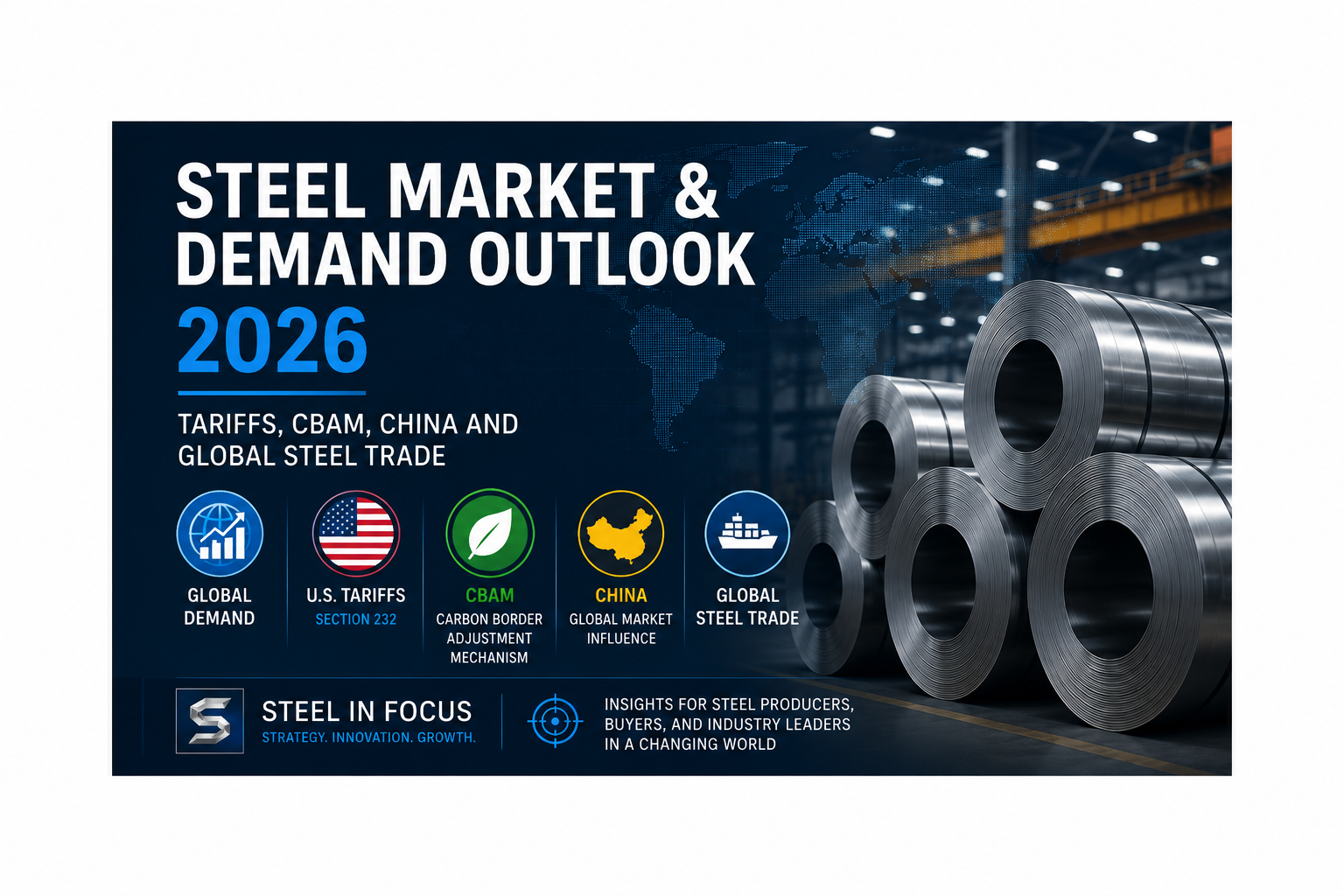
The global steel market has entered a period in which trade policy, carbon regulation, geopolitical risk and industrial strategy can influence competitiveness almost as much as traditional supply-and-demand fundamentals.
For steel producers, buyers, distributors and manufacturers, understanding the market therefore requires more than following steel prices.
Companies increasingly need to monitor tariffs, carbon costs, trade remedies, exchange rates, logistics, regional demand and the origin of the steel they purchase.
This shift became particularly visible during 2025 and has continued into 2026.
U.S. Section 232 tariffs have significantly changed access to the American market. The European Union’s Carbon Border Adjustment Mechanism has entered its definitive regime. China continues to exert enormous influence on global steel balances, while developing economies — particularly India — are becoming increasingly important sources of demand.
For Brazil, these changes create a complex combination of risks and opportunities.
Global Steel Demand Is Searching for a New Growth Cycle
The global steel industry entered 2026 after several years of weak demand and structural adjustment.
According to the World Steel Association’s April 2026 Short Range Outlook, global steel demand is expected to grow by approximately 0.3% in 2026, reaching about 1.724 billion tonnes, followed by stronger projected growth of 2.2% in 2027, when demand could reach approximately 1.762 billion tonnes.
This is important because it suggests that the global steel market may be approaching the end of a prolonged period of weak demand.
However, the recovery is far from uniform.
China is undergoing structural adjustment, India continues to expand rapidly, and several developing markets are becoming increasingly important sources of steel consumption.
For steel companies, this means that relying exclusively on global headline demand numbers can be misleading.
Regional analysis has become essential.
China Remains the Most Important Variable in the Global Steel Market
China remains the single most influential country in the global steel cycle.
Changes in Chinese construction activity, manufacturing output, infrastructure investment and steel exports can affect international steel prices, iron ore demand, freight flows and competitive conditions across multiple regions.
One particularly important development became visible when actual Chinese demand proved considerably weaker than earlier forecasts.
In October 2025, worldsteel had expected Chinese steel demand to decline by approximately 2% during 2025. By April 2026, however, published official data indicated a much larger contraction of approximately 7.1%.
This illustrates an important principle for steel market analysis:
Forecasts should be treated as scenarios, not certainties.
For steel buyers and producers outside China, weaker Chinese domestic demand can also create another challenge.
If domestic consumption falls while production capacity remains high, export pressure may increase.
That can intensify price competition in markets such as Southeast Asia, Latin America, the Middle East and Europe.
The U.S. Steel Tariff Environment Has Fundamentally Changed
The United States remains one of the world’s most strategically important steel markets.
In June 2025, the U.S. government increased the Section 232 additional tariff applicable to covered steel and aluminum imports from 25% to 50%, with specific treatment applying to certain countries and products.
This development materially changed the economics of exporting steel to the United States.
For exporters, the issue is no longer simply:
What is my FOB steel price?
The relevant question becomes:
What is the total landed and tariff-adjusted cost of placing this steel in the U.S. market?
That calculation can include:
- steel price;
- ocean freight;
- insurance;
- port costs;
- inland logistics;
- Section 232 duties;
- ordinary customs duties where applicable;
- other trade measures;
- financing costs;
- inventory carrying costs.
In April 2026, the U.S. government further modified the Section 232 regime for steel, aluminum and copper products. For covered steel articles, the general additional rate remained 50%, while the tariff methodology was modified so that the additional duty applies to the full customs value of the covered imported product under the new framework.
For steel exporters, this reinforces a fundamental lesson:
Trade regulation must now be treated as part of product costing.
Brazil and the U.S. Market: Do Not Confuse Different Tariff Measures
The Brazil-U.S. trade relationship became particularly complex during 2025.
Executive Order 14323, issued on July 30, 2025, established an additional 40% tariff on certain Brazilian products, subject to specified exceptions.
A separate Executive Order, EO 14326, issued the following day, modified the broader U.S. reciprocal tariff framework.
These measures should not be confused with the Section 232 steel tariff regime.
For steel companies, three questions therefore need to be separated:
1. Is the product covered by Section 232?
2. Is another country-specific tariff measure applicable?
3. Are there product-specific exclusions, exceptions or other trade remedies?
This distinction is critical when calculating the actual landed cost of steel entering the United States.
CBAM Has Moved From Preparation to Implementation
Another major structural change is occurring in Europe.
The European Union’s Carbon Border Adjustment Mechanism entered its definitive regime on January 1, 2026. Iron and steel are among the sectors covered.
The mechanism is designed to attach a carbon cost to embedded emissions in selected imported goods.
For steel producers outside the European Union, this means that carbon intensity increasingly has a direct commercial dimension.
EU importers exceeding the applicable 50-tonne mass-based threshold for covered CBAM goods generally need to obtain authorised CBAM declarant status. They must account for embedded emissions and surrender the corresponding CBAM certificates according to the applicable rules.
The first CBAM declaration covering imports made during 2026 must be submitted by 30 September 2027, together with the corresponding surrender of certificates.
For non-EU steel mills, accurate emissions data therefore becomes increasingly important.
Carbon Is Becoming Part of the Commercial Specification of Steel
Historically, a steel purchase specification focused primarily on parameters such as:
- grade;
- chemistry;
- mechanical properties;
- dimensions;
- tolerances;
- surface condition;
- coating;
- applicable standard.
That model is evolving.
For some markets and customers, another variable is becoming commercially relevant:
embedded carbon emissions.
This means that two technically equivalent steel products may eventually have different effective market costs depending on their carbon intensity.
A lower-carbon steel route can therefore create value not only from an environmental perspective but also through market access and regulatory competitiveness.
For Brazilian producers, this can create opportunities where electricity mix, renewable energy, biomass, scrap availability and future low-carbon ironmaking routes provide competitive advantages.
Brazil’s Domestic Steel Market: More Nuanced Than the 2025 Narrative Suggested
The Brazilian market also deserves a more careful interpretation.
Earlier concerns about weak industrial activity and import competition were legitimate. However, subsequent data showed stronger steel demand than some early forecasts suggested.
The October 2025 worldsteel outlook estimated Brazilian finished-steel demand at approximately 27.4 million tonnes in 2025, representing growth of about 5% over 2024.
This is an important reminder that steel-market analysis must distinguish between:
domestic demand growth
and
competitive pressure on domestic producers.
Both can occur simultaneously.
A market may consume more steel while domestic mills still face margin pressure from imports, product mix changes, exchange rates or aggressive international pricing.
Why Cheap Imported Steel Is Not Always the Lowest-Cost Steel
Steel buyers frequently compare suppliers primarily by price per tonne.
That approach can be misleading.
A more appropriate purchasing model is:
Total Supply Cost = Material Price + Freight + Duties + Inventory + Financing + Quality Risk + Production Risk + Lead-Time Risk
Suppose Supplier A offers steel at a lower FOB price than Supplier B.
If Supplier A also requires:
- larger minimum order quantities;
- longer lead times;
- higher safety stock;
- greater currency exposure;
- more difficult claims management;
- inconsistent mechanical properties;
the apparent saving per tonne can disappear.
The correct purchasing question is therefore not:
Which steel is cheaper?
It is:
Which steel produces the lowest total cost in my manufacturing system?
Different Steel Products Face Different Market Risks
Not all steel products react equally to global market changes.
Flat steels — including hot-rolled, cold-rolled and coated products — are strongly exposed to automotive, appliances, construction and manufacturing demand.
Long products, including rebar and structural products, are closely linked to construction and infrastructure cycles.
Electrical steels are strategically important for transformers, electric motors, generators and electrification.
Stainless steels are influenced not only by steel demand but also by alloy inputs such as nickel and chromium.
Tool and specialty steels typically involve smaller volumes but higher unit values and stricter technical requirements.
Therefore, a market outlook should always be interpreted in the context of the specific product family.
A Practical Risk Matrix for Steel Buyers
Steel procurement decisions can be evaluated through five dimensions.
| Risk | Key Question |
|---|---|
| Price | Could international steel prices move significantly before delivery? |
| Currency | How exposed is the purchase to FX volatility? |
| Trade policy | Could tariffs, anti-dumping measures or quotas affect landed cost? |
| Logistics | Could freight, ports or geopolitical disruptions delay supply? |
| Technical | Is the foreign material genuinely equivalent to the required specification? |
The last point is frequently underestimated.
A similar chemical composition does not automatically establish technical equivalence.
Standards, mechanical properties, delivery condition, coating requirements, dimensional tolerances and end-use performance must also be evaluated.
Seven Actions Steel Companies Should Take in 2026
Companies operating in the steel value chain should consider a structured response.
1. Calculate landed cost rather than FOB price.
Tariffs, freight, financing and inventory must be included.
2. Monitor trade remedies by HS code and country of origin.
Anti-dumping duties, safeguards and Section 232 measures can completely change sourcing economics.
3. Build alternative sourcing scenarios.
A company dependent on one country or supplier has greater geopolitical and logistics exposure.
4. Map CBAM exposure.
Companies exporting steel or steel-intensive products to Europe should understand which products are covered and what emissions information customers require.
5. Validate technical equivalence before changing suppliers.
Price savings should never override material performance requirements.
6. Monitor China as both a demand and supply variable.
Chinese domestic conditions can rapidly alter export availability and global prices.
7. Integrate procurement, engineering, finance and trade compliance.
Steel sourcing is increasingly multidisciplinary.
From Steel Price to Strategic Steel Intelligence
The most important change in today’s steel market may not be a particular price, tariff or demand forecast.
It is the way companies must make decisions.
Steel competitiveness increasingly depends on the interaction between:
material technology + sourcing + logistics + trade policy + carbon + finance.
A procurement team that monitors only price can miss regulatory risk.
An engineering team that considers only technical performance can overlook supply-chain exposure.
A financial team that focuses only on working capital can underestimate material-quality risk.
The companies best positioned for the next steel cycle will be those capable of integrating all these dimensions.
Frequently Asked Questions
What is the global steel demand outlook for 2026?
The World Steel Association’s April 2026 outlook forecasts global steel demand growth of approximately 0.3% in 2026, followed by 2.2% growth in 2027.
What is the U.S. Section 232 tariff on steel?
The United States increased the additional Section 232 tariff on covered steel imports to 50% in June 2025. The regime was modified again in April 2026, so exporters should verify the current treatment of the specific HTSUS product and origin before shipment.
Is CBAM already in force?
Yes. The definitive CBAM regime began on January 1, 2026, covering sectors including iron and steel.
Why does China have such a large influence on steel prices?
China’s enormous production and consumption base means changes in Chinese demand, production and exports can materially affect international supply balances and raw-material markets.
Should steel buyers select suppliers based on price per tonne?
No. The more appropriate metric is total supply cost, incorporating freight, tariffs, financing, inventory, quality risk, lead time and production consequences.
Conclusion
The global steel market in 2026 is not simply a commodity market.
It is increasingly a technology, trade-policy, carbon and supply-chain market.
Global demand is showing signs of stabilisation, but regional differences remain substantial. China continues to reshape international balances. U.S. tariffs have altered traditional trade economics. CBAM has transformed carbon emissions into a market-access issue.
For Brazil, this environment creates both risk and opportunity.
Brazilian steel companies, manufacturers, importers and exporters that combine technical knowledge with trade intelligence will be better positioned to manage volatility and identify opportunities.
In this new environment, the winning question is no longer simply:
“What is the price of steel?”
It is:
“What is the true technical, regulatory and financial cost of this steel decision?”