
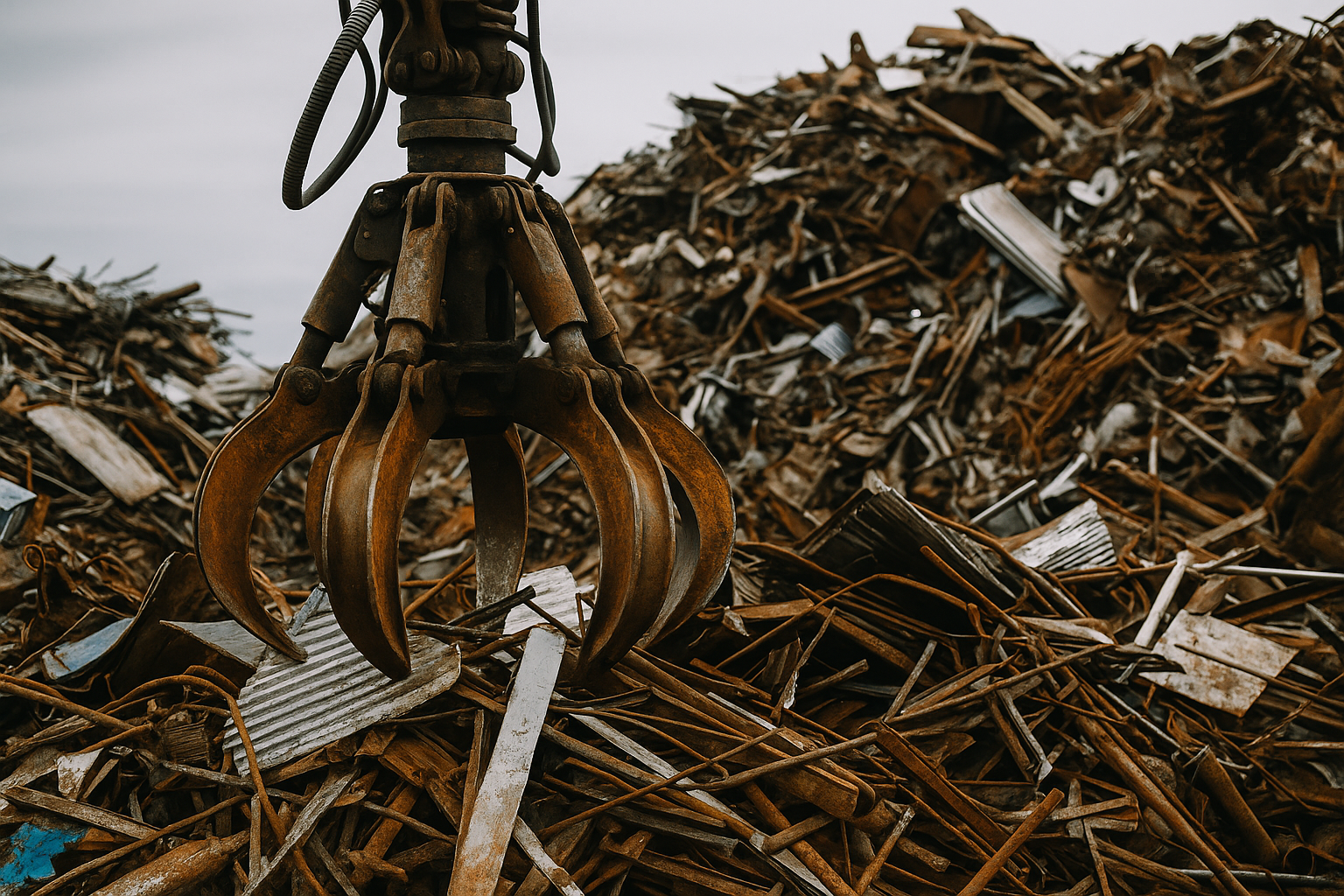
Steel is often described as one of the world’s most recyclable industrial materials. But in the transition toward a lower-carbon economy, steel scrap is becoming much more than a recyclable residue.
It is becoming a strategic metallic raw material.
The expansion of electric arc furnace (EAF) steelmaking, corporate decarbonization targets, tighter carbon policies and growing demand for lower-emission steel are increasing the strategic value of ferrous scrap across the global steel industry.
This changes the way scrap should be understood.
The traditional question was:
How much scrap can be recycled?
The more important questions today are:
How much scrap will be available, what will its metallurgical quality be, where will it be located, how efficiently can it be recovered, and which steel grades can be produced from it?
These questions connect circular economy principles directly with metallurgy, procurement, trade, industrial strategy and decarbonization.
Steel scrap is therefore not simply the end of a product’s life.
It is the beginning of another steelmaking cycle.
What Steel Scrap Actually Is
Steel scrap is ferrous metallic material that can be recovered and returned to steel production.
However, scrap is not a homogeneous commodity.
Its origin, chemical composition, physical dimensions, coatings, contamination and residual-element content determine its metallurgical and economic value.
Steel scrap is generally divided into three major categories.
| Scrap Type | Origin | Typical Quality | Main Advantage | Main Challenge |
|---|---|---|---|---|
| Home scrap | Steelmaking and rolling operations | Very high | Known origin and chemistry | Limited additional market supply |
| Prompt scrap | Manufacturing and fabrication | High | Relatively predictable composition | Coatings and alloy variation |
| Obsolete scrap | End-of-life products | Variable | Large long-term resource base | Sorting and residual elements |
Home Scrap
Home scrap is generated inside steel plants during steelmaking, casting, rolling and finishing.
Because its origin and chemical composition are generally well known, it can usually be returned rapidly to the production process.
From a circular-economy perspective, however, home scrap does not represent a large new external source of metallic units because steelmakers have already been recycling it internally for decades.
Prompt Scrap
Prompt scrap — sometimes called new scrap — comes from manufacturing operations.
Examples include:
- automotive stampings;
- sheet-metal offcuts;
- punching residues;
- tube manufacturing scrap;
- appliance production scrap;
- fabrication rejects.
Its relatively controlled origin often makes prompt scrap particularly valuable.
Obsolete Scrap
Obsolete or post-consumer scrap comes from products that have reached the end of their useful lives.
Sources include:
- vehicles;
- buildings;
- bridges;
- machinery;
- industrial equipment;
- appliances;
- rail infrastructure;
- containers.
This category represents one of the largest long-term opportunities for circular steelmaking — but also one of its greatest technical challenges.
The further scrap moves from a controlled industrial source toward mixed end-of-life material, the more important collection, separation, characterization and metallurgical control become.
Why Steel Is Particularly Suited to a Circular Economy
A circular economy attempts to preserve the value of materials and products for as long as technically and economically possible.
For steel, this should not be reduced to recycling alone.
A more complete hierarchy includes:
Reduce → Reuse → Remanufacture → Recycle
Reduce
Better engineering can reduce the amount of steel required to perform a function.
Examples include:
- optimized structural design;
- higher-strength steels;
- tighter thickness tolerances;
- improved yield;
- lightweighting;
- better nesting and cutting practices.
Using less steel to deliver the same performance can sometimes create greater environmental value than recycling additional material later.
Reuse
Steel components can sometimes be reused without remelting.
Structural members, rails, pipes and other products may retain substantial functional value after their original application ends.
Reuse preserves more of the energy and economic value already embedded in the product.
Remanufacture
Machinery, equipment and steel-intensive products can sometimes be rebuilt or refurbished rather than replaced.
Again, this extends material life before recycling becomes necessary.
Recycle
When reuse or remanufacturing is no longer practical, steel can return to the steelmaking cycle as scrap.
This hierarchy leads to an important principle:
Circular steel is not only about maximizing recycling. It is about maximizing the useful value obtained from every tonne of steel throughout its life cycle.
How Scrap Returns to Steel Production
The path from an obsolete product to a new steel coil, beam, bar or plate involves considerably more engineering than simply collecting metal.
A typical scrap value chain includes:
Collection → Classification → Processing → Sorting → Characterization → Transportation → Charge preparation → Melting → Refining → New steel
Each stage influences the quality and economics of the final metallic charge.
Scrap processors may use:
- shredders;
- shears;
- balers;
- magnetic separation;
- density separation;
- sensor-based sorting;
- spectroscopic analysis;
- radiation detection;
- visual inspection;
- chemical characterization.
The objective is not simply to produce smaller pieces of scrap.
It is to create a metallic raw material whose density, dimensions, chemistry and contamination level are compatible with the steelmaking process.
Scrap in Electric Arc Furnace Steelmaking
The Electric Arc Furnace is the production route most strongly associated with scrap recycling.
Electrical energy generates the heat required to melt the metallic charge.
Depending on the plant, product and metallic strategy, the charge can include:
- ferrous scrap;
- direct reduced iron (DRI);
- hot briquetted iron (HBI);
- pig iron;
- other metallic units.
This flexibility is strategically important.
A steelmaker does not necessarily need to choose between:
scrap OR virgin metallics.
The better question is often:
What combination of scrap, DRI, HBI and other metallic inputs provides the required chemistry, productivity, emissions profile and cost?
This is particularly relevant when producing demanding flat-steel grades.
Scrap in BF-BOF Steelmaking
Scrap is not exclusive to EAF plants.
Basic Oxygen Furnaces also use scrap as part of the metallic charge.
In BOF steelmaking, hot metal from the blast furnace supplies most of the metallic input and substantial thermal energy. Scrap can be added partly as a coolant and partly as an iron-bearing metallic resource.
The proportion is normally much lower than in scrap-based EAF production.
This distinction matters because discussions about “recycled steel” sometimes incorrectly imply that scrap is relevant only to electric furnaces.
In reality, scrap participates in multiple steelmaking routes — although its role, quantity and metallurgical constraints differ considerably.
The Carbon Advantage of Scrap-EAF Steelmaking
One reason scrap has become central to decarbonization strategies is that recycling metallic iron avoids the need to reduce iron oxide again.
Primary ironmaking requires removing oxygen from iron ore.
Conventional blast furnaces perform this reduction largely through carbon-based chemistry, generating substantial CO₂ emissions.
Scrap already contains metallic iron.
That fundamental metallurgical difference helps explain the large emissions gap between production routes.
World Steel Association sustainability indicators for 2024 show the following operational comparison:
| Production Route | CO₂ Emissions Intensity | Energy Intensity |
|---|---|---|
| BF-BOF | 2.34 t CO₂/t crude steel | 23.88 GJ/t |
| Scrap-EAF | 0.69 t CO₂/t crude steel | 9.84 GJ/t |
| DRI-EAF | 1.47 t CO₂/t crude steel | 23.30 GJ/t |
These figures should not be interpreted as universal values for every individual plant. Electricity mix, metallic charge, plant efficiency, DRI production route and system boundaries can materially change the carbon footprint.
Nevertheless, the strategic direction is clear:
Where suitable scrap is available and electricity emissions are controlled, scrap-EAF production can offer a major carbon advantage.
Recycling Steel Also Conserves Primary Resources
Scrap recycling reduces more than greenhouse-gas emissions.
According to worldsteel, using one tonne of steel scrap can avoid approximately:
- 1.4 tonnes of iron ore;
- 740 kg of coal;
- 120 kg of limestone.
Worldsteel also estimates approximately 1.5 tonnes of CO₂ emissions avoided per tonne of scrap used, although actual impacts depend on the production route and comparison methodology.
This illustrates why scrap links environmental performance with resource efficiency.
The value is not simply “waste reduction.”
It is avoided primary resource extraction and processing.
Why the World Cannot Simply Make All Steel From Scrap
If scrap-based steelmaking offers significant environmental advantages, an obvious question follows:
Why not produce all steel from scrap?
Because scrap availability is constrained by history.
Steel must first be produced, transformed into a product, used for years or decades and eventually recovered before it becomes obsolete scrap.
A building constructed today may not return its structural steel to the scrap market for many decades.
The same principle applies to:
- bridges;
- railways;
- machinery;
- industrial infrastructure;
- vehicles;
- pipelines.
Steel therefore operates with a long material cycle.
The amount of scrap available today depends partly on steel consumption that occurred many years ago.
The Scrap Availability Paradox
This creates what can be called the scrap availability paradox.
Regions undergoing rapid industrialization require enormous quantities of steel for new infrastructure.
But because much of their steel stock is still being accumulated rather than retired, they may not generate enough obsolete scrap domestically to supply their current steel demand.
Mature economies generally have larger stocks of steel reaching end of life.
Emerging economies may have rapidly growing steel demand but comparatively limited domestic obsolete scrap.
Over time, this situation changes.
As the global stock of steel in use increases and products reach the end of their service lives, obsolete scrap availability should also increase substantially.
But there will remain a fundamental constraint:
You cannot recycle steel that has not yet completed its useful life.
Therefore, primary metallic production will continue to be necessary.
The future steel industry is likely to require a portfolio of metallic routes rather than a single solution.
Scrap Quality Is Becoming as Important as Scrap Quantity
A tonne of scrap is not automatically equivalent to another tonne of scrap.
Consider two hypothetical loads.
Scrap A has:
- known origin;
- controlled chemistry;
- low residual elements;
- consistent density;
- minimal contamination.
Scrap B contains:
- mixed grades;
- copper wiring;
- coated components;
- unknown alloys;
- plastics;
- oils;
- variable dimensions.
Both may weigh one tonne.
Their metallurgical value can be dramatically different.
This is why the industry’s future challenge is not merely:
more scrap.
It is:
more recoverable scrap + better sorting + better characterization + better charge optimization.
Copper, Tin and Other Residual Elements
One of the most important technical issues in scrap recycling is the accumulation of residual or “tramp” elements.
Depending on the scrap source, these can include:
- copper (Cu);
- tin (Sn);
- nickel (Ni);
- chromium (Cr);
- molybdenum (Mo).
Some of these elements are intentionally valuable in certain alloy steels.
The problem arises when they enter a steel grade unintentionally and cannot be economically removed during conventional steelmaking.
Copper is a classic example.
It can enter obsolete scrap through:
- electric motors;
- wiring;
- electrical systems;
- vehicle components;
- mixed shredded material.
At excessive levels, copper can contribute to surface-quality problems during hot processing.
Tin from coated steel and other sources can create additional challenges.
| Residual Element | Possible Scrap Source | Potential Concern | Typical Control Strategy |
|---|---|---|---|
| Cu | Wiring, motors, mixed scrap | Hot-processing/surface problems | Better sorting and dilution |
| Sn | Tin-coated material | Surface and processing effects | Source separation |
| Ni | Alloy/stainless contamination | Chemistry deviation | Scrap classification |
| Cr | Stainless/alloy scrap | Grade chemistry deviation | Sorting and charge control |
| Mo | Alloy steels | Unwanted residual content | Chemical characterization |
This changes the economics of scrap.
The cheapest scrap per tonne may not be the lowest-cost metallic input for the steel grade being produced.
Advanced Scrap Sorting and Characterization
This metallurgical challenge is driving innovation in scrap processing.
Traditional magnetic separation remains highly effective for separating ferrous from non-ferrous materials.
But advanced scrap management increasingly involves technologies capable of identifying differences within the ferrous stream itself.
These may include:
- optical systems;
- X-ray technologies;
- laser-induced breakdown spectroscopy;
- automated material recognition;
- machine vision;
- AI-assisted sorting;
- digital traceability.
The objective is increasingly to move from:
scrap as waste
toward:
scrap as a characterized metallurgical feedstock.
That distinction will become more valuable as steelmakers increase recycled content while attempting to produce increasingly demanding grades.
DRI + Scrap: Why Hybrid Metallic Charges Matter
Direct Reduced Iron can play an important complementary role.
High-quality DRI or HBI generally contains lower levels of residual metallic contamination than many obsolete scrap streams.
This means EAF steelmakers can combine metallic inputs strategically.
For example:
Higher-quality scrap + DRI/HBI → demanding steel grades
while lower-grade scrap may be better suited to products with greater tolerance for residual elements.
The optimization problem therefore becomes multidimensional:
Cost + chemistry + yield + energy + productivity + carbon footprint + availability
rather than simply:
$/tonne of scrap.
This is one reason future EAF competitiveness will increasingly depend on sophisticated metallic-charge optimization.
Steel Scrap Is Becoming a Strategic Raw Material
The global expansion of lower-emission steelmaking is changing the geopolitical status of scrap.
Historically, many governments viewed scrap mainly as waste or a secondary commodity.
That perception is changing.
Scrap now intersects with:
- industrial policy;
- energy transition;
- carbon reduction;
- strategic raw-material security;
- domestic steel competitiveness.
The OECD Steel Outlook 2026 identifies ferrous scrap as an increasingly strategic steelmaking input and reports growing use of export restrictions.
That trend has important implications.
If more countries attempt to retain domestic scrap for their own EAF expansion, import-dependent steelmakers may face:
- tighter supply;
- greater price volatility;
- changed trade flows;
- stronger competition for high-quality grades.
Circular economy policy can therefore become trade policy.
Global Scrap Trade and Export Restrictions
Ferrous scrap is already a major internationally traded raw material.
OECD data for 2025 illustrate the scale of several major export sources:
| Economy | Scrap Exports | Share of Global Exports |
|---|---|---|
| European Union* | 22.9 Mt | 17.2% |
| United States | 21.4 Mt | 16.0% |
| Türkiye | 19.0 Mt | 14.3% |
| India | 11.8 Mt | 8.8% |
| United Kingdom | 7.5 Mt | 5.7% |
| Japan | 7.0 Mt | 5.2% |
| Canada | 5.6 Mt | 4.2% |
*EU figures exclude intra-EU trade.
The OECD reports that 42 economies applied some form of ferrous-scrap export restriction in 2023, although only about 15.2% of global scrap trade was actually subject to restrictions when measures were compared with traded volumes.
This distinction is important.
The number of restrictions sounds dramatic, but their actual impact on internationally traded tonnage is more limited.
Nevertheless, the direction deserves attention.
As more EAF capacity is developed, competition for scrap could intensify.
The Economics of Scrap-Based Steelmaking
Scrap economics cannot be evaluated using purchase price alone.
A more complete approach considers the effective metallic cost.
Important variables include:
- purchase price;
- freight;
- handling;
- bulk density;
- metallic yield;
- non-metallic contamination;
- moisture;
- chemistry;
- residual elements;
- energy consumption;
- electrode consumption;
- slag generation;
- furnace productivity;
- processing requirements.
Consider two scrap grades:
| Variable | Scrap A | Scrap B |
|---|---|---|
| Purchase price | Higher | Lower |
| Metallic yield | Higher | Lower |
| Residual risk | Low | High |
| Density | High | Variable |
| Processing requirement | Low | High |
| Final economic value | Potentially superior | Potentially inferior |
Therefore:
Purchase price per tonne ≠ effective cost per tonne of liquid steel.
This principle is essential for procurement teams.
How Steelmakers Should Evaluate Scrap Value
A useful procurement methodology begins with the steel grade to be produced.
Step 1 — Define Product Requirements
What chemistry and quality limits must the finished steel meet?
Step 2 — Define Residual Limits
Which tramp elements represent the greatest risk?
Step 3 — Characterize Available Scrap
What is the actual chemistry, density, yield and contamination of each scrap source?
Step 4 — Determine Metallic Alternatives
Can scrap be blended with DRI, HBI, pig iron or higher-quality scrap?
Step 5 — Calculate Effective Cost
Include yield, energy, processing and productivity effects.
Step 6 — Evaluate Supply Risk
How reliable is the supplier? How concentrated is the source? Is the material exposed to export restrictions?
Step 7 — Optimize the Charge
Select the metallic mix that meets the technical requirement at the lowest total process cost, not simply the lowest raw-material purchase price.
A Practical Scrap Procurement Framework
| Criterion | Key Question |
|---|---|
| Chemistry | Can this scrap meet the required residual limits? |
| Yield | How much liquid metallic value is recovered? |
| Density | How does it affect furnace charging and productivity? |
| Contamination | What non-metallic materials are present? |
| Consistency | Does quality vary significantly between loads? |
| Logistics | What is the delivered cost and supply reliability? |
| Processing | Is shredding, shearing or sorting required? |
| Carbon | What emissions benefit does the charge provide? |
| Trade risk | Could regulation restrict availability? |
| Price | What is the effective cost per useful metallic tonne? |
This framework converts scrap procurement from commodity purchasing into metallurgical supply-chain management.
Circular Steel and ESG Strategy
Scrap also plays an important role in corporate ESG strategies.
From an environmental perspective, increasing recycled content can contribute to:
- reduced primary resource extraction;
- lower production-route emissions;
- lower waste generation;
- greater material circularity.
But credible ESG claims require more than stating that a product “contains recycled steel.”
Companies increasingly need reliable information about:
- recycled content;
- production route;
- electricity source;
- product carbon footprint;
- traceability;
- lifecycle boundaries.
This becomes particularly important as customers, investors and regulators demand greater transparency.
The distinction between circularity and decarbonization must also remain clear.
They are related, but they are not identical.
A highly circular process can still use carbon-intensive electricity.
Conversely, primary iron production can potentially achieve much lower emissions through technologies such as hydrogen-based DRI combined with low-carbon electricity.
Therefore:
Recycled content is an important sustainability indicator, but it is not a complete carbon-footprint calculation.
Scrap, EAF and the Green Steel Transition
The steel industry’s decarbonization pathway will likely combine multiple technologies.
These include:
- increased scrap recycling;
- EAF expansion;
- natural-gas and hydrogen-based DRI;
- renewable and low-carbon electricity;
- process efficiency;
- carbon capture in selected routes;
- improved material efficiency;
- reuse and remanufacturing.
Scrap is therefore one pillar of the transition — an extremely important one — but not the only pillar.
This distinction prevents a common analytical mistake:
assuming that circular steel and zero-carbon steel are automatically the same thing.
They are not.
Common Mistakes When Evaluating Steel Scrap
Mistake 1 — Treating All Scrap as Equivalent
Scrap categories can differ dramatically in chemistry, density, contamination and yield.
Mistake 2 — Looking Only at Purchase Price
A cheaper scrap grade can increase energy consumption, slag generation, processing requirements or residual-element risk.
Mistake 3 — Assuming More Scrap Is Always Metallurgically Better
The optimum recycled content depends on the steel grade and available metallic quality.
Mistake 4 — Ignoring Residual Elements
Copper and other residuals can constrain the production of demanding grades.
Mistake 5 — Treating Scrap Availability as Unlimited
Scrap supply is constrained by historical steel consumption and product lifetimes.
Mistake 6 — Assuming EAF Automatically Means Low Carbon
The carbon intensity of electricity and metallic inputs matters.
Mistake 7 — Ignoring Logistics
Scrap is bulky, heterogeneous and often geographically dispersed. Transportation and processing can materially affect economics.
Mistake 8 — Ignoring Trade Policy
Export restrictions and industrial policies can alter regional scrap availability.
Mistake 9 — Measuring Circularity Only Through Recycling
Reduction, reuse and remanufacturing can preserve more economic and material value before remelting becomes necessary.
Mistake 10 — Treating Scrap Procurement Separately From Metallurgy
The purchasing decision directly affects furnace performance and final steel chemistry.
What Comes Next for Steel Scrap?
The role of scrap in steelmaking will almost certainly become more sophisticated.
The industry’s competitive frontier is moving toward:
better collection → better sorting → better characterization → better charge optimization → better traceability
Digital technologies will support this transition.
Future scrap supply chains may increasingly integrate:
- automated identification;
- AI-assisted sorting;
- real-time chemical analysis;
- digital material passports;
- supplier quality databases;
- carbon accounting;
- predictive charge optimization.
This could eventually change how scrap is priced.
Instead of broad commodity classifications, higher-value scrap markets may increasingly reward verified information about:
chemistry + residuals + yield + origin + carbon attributes.
In that environment, data itself becomes part of the value of scrap.
Frequently Asked Questions
Can steel be recycled indefinitely?
Steel can be repeatedly recycled because the metallic material can be remelted and transformed into new steel products. In practice, however, recovery losses, contamination, residual elements and scrap availability prevent a perfectly closed material loop.
Is recycled steel lower quality?
Not inherently.
Steel quality depends on chemistry, process control and metallurgical practice — not simply on whether scrap was used.
The challenge is ensuring that the metallic charge is suitable for the grade being produced.
Why isn’t all steel made from scrap?
Because there is not enough scrap available to satisfy total global steel demand, and some demanding steel grades require tight control of residual elements.
Primary iron production therefore remains necessary.
Is EAF steel always greener than BF-BOF steel?
Scrap-EAF generally has substantially lower direct production-route emissions, but actual carbon performance depends on electricity generation, metallic inputs, plant efficiency and accounting boundaries.
What is the difference between home, prompt and obsolete scrap?
Home scrap is generated inside steel plants. Prompt scrap comes from manufacturing and fabrication. Obsolete scrap comes from products that have reached the end of their useful lives.
Why is copper a problem in steel scrap?
Copper can enter mixed obsolete scrap through wiring, motors and other components. Because conventional steelmaking cannot easily remove it, excessive copper can create metallurgical and surface-quality problems in certain products.
Can DRI be mixed with scrap in an EAF?
Yes.
DRI and HBI are important complementary metallic inputs and can help dilute residual elements while providing controlled iron units.
Is steel scrap becoming a strategic raw material?
Increasingly, yes.
The expansion of EAF capacity and low-emission steelmaking is increasing competition for high-quality scrap, while several governments are introducing policies intended to preserve domestic supply.
Does more recycled content automatically mean lower CO₂ emissions?
Not necessarily.
Recycled content is important, but electricity source, production efficiency, metallic inputs and system boundaries must also be considered.
What is the most important future challenge for scrap-based steelmaking?
Not simply obtaining more scrap.
The larger challenge will be obtaining enough scrap of the right quality, characterizing it accurately and allocating it efficiently to steel grades that can use it without compromising performance.
Conclusion: Scrap Is No Longer Just Waste — It Is a Strategic Metallic Resource
Steel’s compatibility with circular-economy principles gives the industry an important advantage.
A steel beam, automobile, machine or appliance does not necessarily represent the final destination of the metal it contains.
At the end of one useful life, that steel can become a raw material for another.
But the next stage of circular steelmaking will require more than higher recycling rates.
It will require better engineering.
The steel industry must simultaneously improve:
material efficiency, product life, reuse, scrap collection, sorting, characterization, metallurgy, charge optimization and traceability.
At the same time, primary metallic production will remain necessary because global steel demand cannot be supplied exclusively from scrap.
This is why the future is unlikely to be simply:
primary steel versus recycled steel.
It will increasingly be about finding the optimum combination of:
scrap + DRI/HBI + primary metallics + low-carbon energy + intelligent process control.
For steelmakers, scrap is becoming a strategic resource.
For procurement teams, it is becoming a metallurgical purchasing decision.
For policymakers, it is becoming an industrial-policy issue.
And for the circular economy, steel scrap demonstrates one of the most important principles of sustainable manufacturing:
The end of a product’s useful life does not have to be the end of the material’s value.