
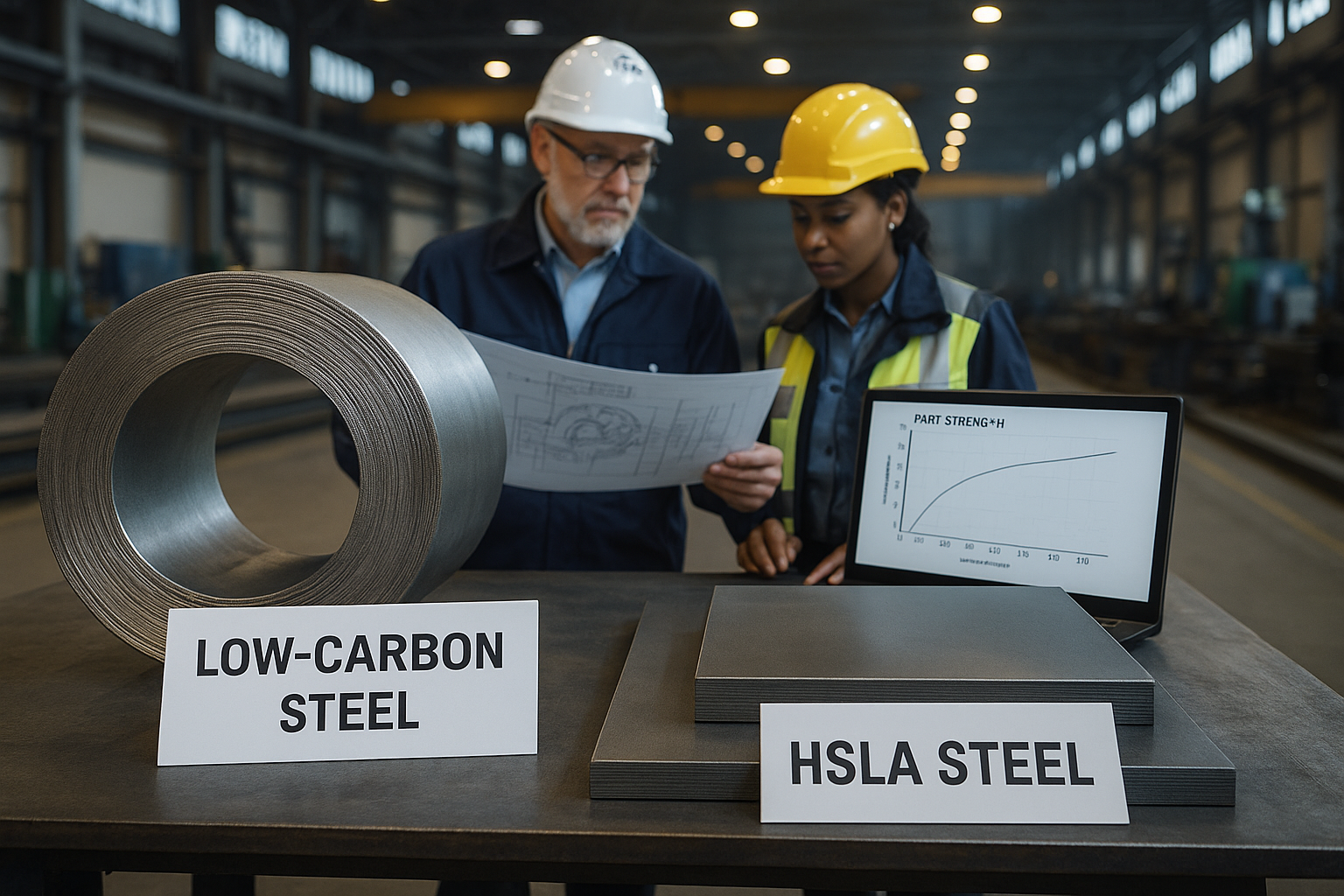
Low-carbon steels have supported industrial manufacturing for decades.
They are widely available, relatively easy to form and weld, and suitable for thousands of applications. For many products, they remain an excellent technical and economic solution.
The problem begins when a company continues using a conventional low-strength steel simply because “this is the material we have always used.”
In many industrial applications, the real opportunity is not simply to replace one steel grade with another.
The opportunity is to ask a more fundamental engineering question:
Is the company buying steel properties that the product does not need — or failing to use properties that would allow a more efficient design?
A steel with a higher yield strength may allow engineers to reduce thickness, weight, material consumption, welding volume, handling requirements, transportation costs, and sometimes manufacturing costs.
But higher strength alone does not guarantee a better product.
Formability, elongation, bending capability, weldability, fatigue performance, stiffness, buckling, geometry, surface requirements, manufacturing equipment, and the behavior of the finished component must also be evaluated.
This article presents a practical methodology for identifying and validating opportunities to migrate from conventional low-strength steels toward higher-strength steels in industrial applications.
1. The Real Objective Is Not to Use Stronger Steel
The objective of steel optimization should never be:
“Replace mild steel with high-strength steel.”
That approach is too simplistic.
The correct objective is:
Use the steel grade, mechanical properties, thickness, geometry, and manufacturing route that provide the required product performance at the lowest technically sustainable total cost.
Sometimes the answer will be a higher-strength steel.
Sometimes the existing material will remain the best solution.
And sometimes the greatest opportunity will come from combining a higher yield strength with reduced thickness and a redesigned component.
That distinction is fundamental.
2. Why Yield Strength Is So Important
For many structural and industrial applications, yield strength is one of the most important mechanical properties considered during material optimization.
Yield strength represents the stress level at which permanent plastic deformation begins.
When comparing steels for potential thickness reduction, increasing the available yield strength can provide designers with additional structural capacity.
Consider a simplified progression:
| Steel condition | Minimum/typical yield strength used for analysis |
|---|---|
| Conventional low-strength steel | ~200–280 MPa |
| Higher-strength structural/HSLA steel | ~300–420 MPa |
| Higher HSLA grades | ~420–550 MPa |
| High-strength structural steels | ~550–700 MPa or higher |
These ranges are illustrative, not material specifications.
Actual values must always be obtained from the applicable standard and the steel producer’s technical documentation.
Commercial HSLA families currently include products covering yield-strength levels from approximately 420 MPa to 800 MPa, illustrating the wide engineering range available to designers.
But yield strength cannot be analyzed alone.
3. Elongation Must Be Considered Together With Yield Strength
Increasing yield strength frequently changes the forming behavior of the material.
For this reason, designers and manufacturing engineers should evaluate at least:
- Yield strength
- Specified elongation
- Bendability
- Formability
- Springback
- Hole expansion when applicable
- Weldability
- Fatigue performance
- Surface condition
- Dimensional tolerances
For example, commercially available 420 MPa HSLA grades can provide specified minimum elongations around 17–22%, depending on product form and gauge, while 500 MPa grades may have lower specified elongation values.
This illustrates an important engineering principle:
The strongest steel is not necessarily the best steel for the application.
The correct material is the one that provides the appropriate combination of strength, formability, manufacturability, durability, and cost.
4. Start With the Product, Not With the Steel Grade
Before searching steel mill catalogs, analyze the product.
Determine:
- What does the component actually do?
- What loads does it support?
- Is stiffness critical?
- Is fatigue important?
- Is the component formed?
- Are there severe bends?
- Is it welded?
- Does it experience impact?
- Is corrosion relevant?
- Is dimensional stability critical?
- Is failure safety-critical?
- Is thickness determined by strength or by another functional requirement?
Only after answering these questions should alternative steel grades be investigated.
5. Build a Material-Application Matrix
A practical optimization project can begin with a matrix such as the following:
| Application | Current Steel | Current Yield Strength | Specified Elongation | Current Thickness | Higher-Yield-Strength Steel for Study/Analysis | Yield Strength for Study | Specified Elongation | Thickness for Study | Theoretical Weight Reduction | Mandatory Validations |
|---|---|---|---|---|---|---|---|---|---|---|
| Road trailer chassis | To be defined | — | — | — | HSLA/HSS | — | — | — | — | Fatigue, buckling, stiffness, bending, welding |
| Agricultural machinery | To be defined | — | — | — | HSLA/HSS | — | — | — | — | Impact, fatigue, bending, welding, wear |
| Steel structures | To be defined | — | — | — | Higher-strength structural steel | — | — | — | — | Buckling, deflection, connections, welding |
| Automotive components | To be defined | — | — | — | HSLA/AHSS according to component | — | — | — | — | Formability, springback, welding, fatigue/crash |
| Stamped components | To be defined | — | — | — | HSLA/AHSS | — | — | — | — | Formability, bending, springback, tooling |
| Steel furniture | To be defined | — | — | — | Higher-yield-strength formable steel | — | — | — | — | Stiffness, bending, welding, stability |
| Construction profiles | To be defined | — | — | — | Formable HSLA/HSS | — | — | — | — | Local/global buckling, forming, connections |
| General metalworking | To be defined | — | — | — | Higher-yield-strength steel | — | — | — | — | Stiffness, fatigue, welding, machining |
This table is not intended to prescribe substitutions.
It is a technical investigation framework.
6. Identify High-Consumption Components First
Do not begin with hundreds of parts.
Start with components representing the greatest steel consumption or economic opportunity.
An ABC analysis can be extremely useful.
Priority should normally be given to components with:
- High annual production volume
- High individual weight
- Significant steel purchasing value
- Relatively simple geometry
- Potentially oversized specifications
- Stable production processes
- Significant freight impact
A 10% optimization on a high-volume component can be considerably more valuable than a 30% reduction on a low-volume item.
7. Determine the Current Material Condition
For each selected component, record:
- Steel grade
- Applicable standard
- Nominal thickness
- Actual measured thickness
- Yield strength
- Specified elongation
- Chemical composition where relevant
- Surface coating
- Dimensional tolerances
- Supplier
- Annual consumption
- Price per tonne
- Freight cost
- Scrap generation
- Manufacturing route
This creates the technical and economic baseline.
Without a baseline, savings cannot be reliably measured.
8. Determine What Actually Limits the Design
This is one of the most important stages.
Ask:
Why is this component this thick?
The answer may be:
- Yield strength
- Stiffness
- Buckling
- Fatigue
- Impact
- Wear
- Corrosion allowance
- Formability
- Welding
- Fastening
- Manufacturing limitations
- Historical practice
- Customer specification
This distinction matters because increasing yield strength will not solve every design limitation.
For example, if deflection governs the design, increasing yield strength alone may provide much less thickness-reduction potential than expected.
Similarly, fatigue or buckling may become the governing criterion after thickness reduction.
Technical references on high-strength-steel design explicitly warn that deflection, fatigue and instability can constrain theoretical weight-reduction potential.
9. Select Candidate Steel Families
Only after understanding the application should candidate materials be selected.
For many industrial applications, HSLA steels provide a logical first step because they combine increased yield strength with useful formability and weldability.
Depending on the application, candidate families may include:
- HSLA steels
- High-strength structural steels
- Microalloyed steels
- Advanced High-Strength Steels for appropriate automotive applications
AHSS should not be treated simply as “stronger HSLA.”
It represents a different metallurgical and manufacturing universe and should be selected according to the requirements of the component.
Current automotive engineering guidance treats AHSS selection together with forming, joining, welding, crash performance and manufacturing considerations.
10. Do Not Mix Unrelated Steel Families
A common mistake in material optimization studies is to place HSLA, Dual Phase, martensitic, stainless, and tool steels into a single hierarchy.
That is technically misleading.
These steels were developed for different functions.
A stainless steel may be selected primarily for corrosion resistance.
A tool steel may be selected for hardness and wear.
A Dual Phase steel may offer a particular combination of strength and formability.
An HSLA steel may provide an attractive balance of yield strength, weldability, bendability, availability, and cost.
Therefore, the comparison should always begin with the functional requirements of the component.
11. Estimate the Initial Thickness-Reduction Potential
Once the current and candidate yield strengths are known, engineering can perform a preliminary screening calculation.
This is not the final design calculation.
It is a way to identify whether the opportunity deserves deeper investigation.
Suppose a component currently uses:
Current steel
- Yield strength: 250 MPa
- Thickness: 3.00 mm
A candidate steel provides:
Candidate steel
- Yield strength: 420 MPa
It would be incorrect simply to reduce thickness in direct proportion to the increase in yield strength.
Geometry, stiffness, fatigue, buckling, manufacturing requirements and safety factors must be considered.
The preliminary result should therefore be identified as:
Theoretical optimization potential — subject to engineering validation.
This wording is important throughout the article.
12. Calculate Weight Reduction Correctly
For components where area and density remain essentially constant, the theoretical mass reduction resulting solely from thickness reduction can be approximated by:
Weight Reduction (%) = (1 − New Thickness / Current Thickness) × 100
For example:
Current thickness = 3.00 mm
Proposed study thickness = 2.50 mm
Therefore:
Weight reduction ≈ 16.7%
If the component originally weighs 30 kg:
New theoretical weight ≈ 25 kg
Potential reduction ≈ 5 kg/component
If annual production is 20,000 units:
Potential steel reduction ≈ 100 tonnes/year
Again, this is a material-balance calculation, not engineering approval of the 2.50 mm thickness.
13. Convert Engineering Optimization Into a Business Case
The next step is to translate kilograms into money.
Suppose the hypothetical project saves:
100 tonnes/year
At a steel cost of:
US$900/tonne
The gross material opportunity would be:
US$90,000/year
But this is still incomplete.
The higher-strength steel may cost more per tonne.
Suppose it costs:
US$1,020/tonne
The economic calculation must therefore compare the cost per finished component, not merely price per tonne.
This is one of the central principles of the methodology.
14. Stop Managing Steel Only by Price per Tonne
Purchasing departments frequently compare steels using:
US$/tonne
But the lowest price per tonne does not necessarily produce the lowest product cost.
A more useful metric can be:
Steel cost per approved finished component
If a higher-strength steel costs 10% more per tonne but allows a 20% reduction in mass, the finished component may contain less steel cost.
Additional effects may include:
- Less handling weight
- Reduced freight
- Lower welding consumption
- Shorter welding length in redesigned components
- Faster processing
- Lower inventory mass
- Reduced painting or coating area in redesigned assemblies
- Increased payload in mobile equipment
The analysis must consider the entire system.
15. Road Trailers and Semi-Trailers
Road transport equipment represents an especially interesting application.
Potential candidates include:
- Chassis rails
- Cross-members
- Supports
- Brackets
- Reinforcements
- Structural profiles
Commercial high-strength steels with minimum yield strengths around 600–700 MPa are specifically offered for heavy-truck components such as frame rails and cross-members.
Reducing tare weight may produce two distinct economic effects:
Manufacturing benefit: less steel per vehicle.
Operating benefit: potentially greater payload or lower vehicle mass.
However, chassis optimization requires careful evaluation of fatigue, torsional behavior, welding, local buckling and structural stiffness.
16. Agricultural Machinery
Agricultural equipment provides another strong opportunity because machines frequently combine:
- Heavy structural components
- Cyclic loading
- Impact
- Vibration
- Welding
- Abrasion
- Severe field conditions
Potential applications include frames, supports, structural profiles, guards and selected chassis components.
The objective should not be to maximize strength.
It should be to identify where higher yield strength can safely permit lower material consumption while maintaining the required field durability.
17. Automotive Components
Automotive lightweighting represents one of the most technically advanced applications of higher-strength steels.
HSLA and AHSS can be used in applications such as:
- Chassis components
- Seat structures
- Reinforcements
- Cross-members
- Brackets
- Suspension components
- Body structures
HSLA grades are commercially promoted specifically for increasing strength-to-weight ratios in chassis and body-in-white applications, while modern AHSS portfolios provide designers with a much broader range of strength/formability combinations.
For stamped automotive parts, however, material substitution must include detailed forming validation.
18. Stamped Components
Increasing yield strength changes forming behavior.
The project may require evaluation of:
- Forming forces
- Tool loads
- Springback
- Bend radii
- Edge cracking
- Hole expansion
- Surface quality
- Dimensional repeatability
- Lubrication
- Tool wear
This is why engineering, tooling, quality and production must participate from the beginning.
A theoretically attractive material can become economically unattractive if it requires excessive tooling modifications or creates unstable production.
19. Steel Furniture
Steel furniture can provide surprisingly attractive optimization opportunities because many products are manufactured in high volumes.
Potential applications include:
- Cabinets
- Shelving
- Lockers
- Tables
- Frames
- Storage systems
- Office furniture
Here, the limiting factor may often be stiffness, local buckling, appearance or forming rather than simple static strength.
Consequently, increasing yield strength does not automatically justify proportional thickness reduction.
Prototype testing becomes particularly valuable.
20. Construction Profiles and Light Structural Components
Cold-formed profiles and other construction products can also benefit from higher-strength steels.
However, thinner sections are more sensitive to:
- Local buckling
- Distortional buckling
- Global buckling
- Deflection
- Connection behavior
Therefore, the designer must evaluate the structural system rather than comparing only material strength.
The potential remains significant, but the engineering analysis must reflect the actual failure mode.
21. General Metalworking Applications
General metalworking companies manufacture an enormous variety of steel components.
Examples include:
- Frames
- Supports
- Industrial structures
- Machine components
- Enclosures
- Platforms
- Conveyors
- Equipment structures
These companies can create a systematic material-review program rather than waiting for individual cost-reduction initiatives.
Every major steel-consuming item can be periodically evaluated according to:
function → current material → actual requirement → candidate material → redesign potential → industrial validation → economic result.
This converts material engineering into a continuous-improvement process.
22. Steel Distributors Have a Special Opportunity
Distributors and service centers occupy a unique position in this value chain.
They can help customers migrate from commodity steel purchasing toward application-based steel selection.
And there is an additional economic effect that is frequently overlooked:
Freight.
Steel freight is commonly related to transported mass.
If a customer’s component can be manufactured with less steel mass, the logistics benefit can occur at more than one stage:
Steel mill → distributor
and
Distributor → customer
Therefore, the economic benefit may include:
Material saving + inbound freight saving + outbound freight saving + inventory effects + handling effects.
This makes higher-strength-steel optimization potentially valuable not only to manufacturers but also to technically oriented steel distributors.
23. The Distributor Should Sell Performance, Not Tonnes
Traditional distribution tends to focus on:
- Grade
- Thickness
- Width
- Quantity
- Price per tonne
A technically differentiated distributor can instead ask:
- What is the final application?
- Which property governs the component?
- Could a higher yield strength reduce thickness?
- Does the customer need better bendability?
- What elongation is required?
- Can coil specifications be optimized?
- Could logistics cost fall with lower mass?
This changes the commercial conversation.
The distributor is no longer simply selling steel.
It is helping the customer optimize the cost of the finished product.
24. Mandatory Validation Before Implementation
No material change should be approved solely from a spreadsheet.
Depending on the component, validation may include:
- Tensile properties
- Dimensional verification
- Bending tests
- Forming trials
- Welding procedure validation
- Fatigue tests
- Impact tests
- Prototype production
- Load testing
- Dimensional inspection
- Surface evaluation
- Assembly trials
- Field tests
Safety-critical products require particularly rigorous engineering validation.
The material certificate confirms properties of the steel.
It does not automatically validate the finished product.
25. Create a Controlled Industrial Trial
A practical industrial trial should compare:
Current condition
versus
Proposed condition
under controlled manufacturing conditions.
Monitor:
- Material consumption
- Scrap
- Cycle time
- Tool behavior
- Forming performance
- Welding
- Dimensional stability
- Rework
- Product performance
- Production losses
- Finished component weight
Only after the technical and economic results are confirmed should full implementation proceed.
26. From Material Substitution to Industrial Optimization
The greatest opportunity is not simply replacing one grade with another.
It is building a repeatable methodology.
The process becomes:
Identify → Measure → Understand → Select → Calculate → Prototype → Test → Validate → Implement → Monitor
Over time, this creates an internal database connecting:
- Products
- Steel grades
- Yield strengths
- Elongation
- Thicknesses
- Manufacturing performance
- Suppliers
- Costs
- Test results
- Savings
That knowledge becomes a competitive asset.
Frequently Asked Questions
Does higher yield strength always allow lower thickness?
No. Thickness may be governed by stiffness, buckling, fatigue, impact, forming, wear, corrosion or other requirements.
Is tensile strength the main property for this methodology?
Not normally. For the type of optimization discussed here, yield strength is generally the primary strength parameter used for initial material comparison, while elongation and other properties provide essential information about manufacturability and performance. Final design criteria depend on the application.
Should elongation always be checked?
Yes. Higher strength can affect formability. The applicable minimum — and maximum where actually specified — should be obtained from the relevant standard or steel producer.
Can a higher-strength steel cost more per tonne and still reduce total cost?
Yes. This is precisely why cost per component is more informative than price per tonne.
Can distributors benefit from this methodology?
Yes. Reduced steel consumption can lower transported tonnage, affecting freight from mill to distributor and from distributor to customer, in addition to inventory and handling.
Can the material be changed without testing the final product?
That should not be assumed. The extent of validation depends on the application, but the finished component and manufacturing process must be evaluated.
Conclusion: Stop Buying Steel by Habit
Industrial companies frequently carry historical material specifications for years or even decades.
Some remain technically optimal.
Others do not.
New steel grades, improved production consistency, better forming technology, simulation tools and modern manufacturing processes can create opportunities that did not exist when the original product was designed.
The correct question is therefore not:
“Which stronger steel can replace the current material?”
It is:
“What combination of steel properties, thickness, design and manufacturing process delivers the required product performance at the lowest sustainable total cost?”
That question changes material substitution into engineering.
And when engineering, purchasing, quality, production and steel suppliers work together, higher-strength steels can become much more than premium materials.
They can become a practical tool for reducing weight, reducing steel consumption, lowering logistics costs, improving product performance and increasing industrial competitiveness.