
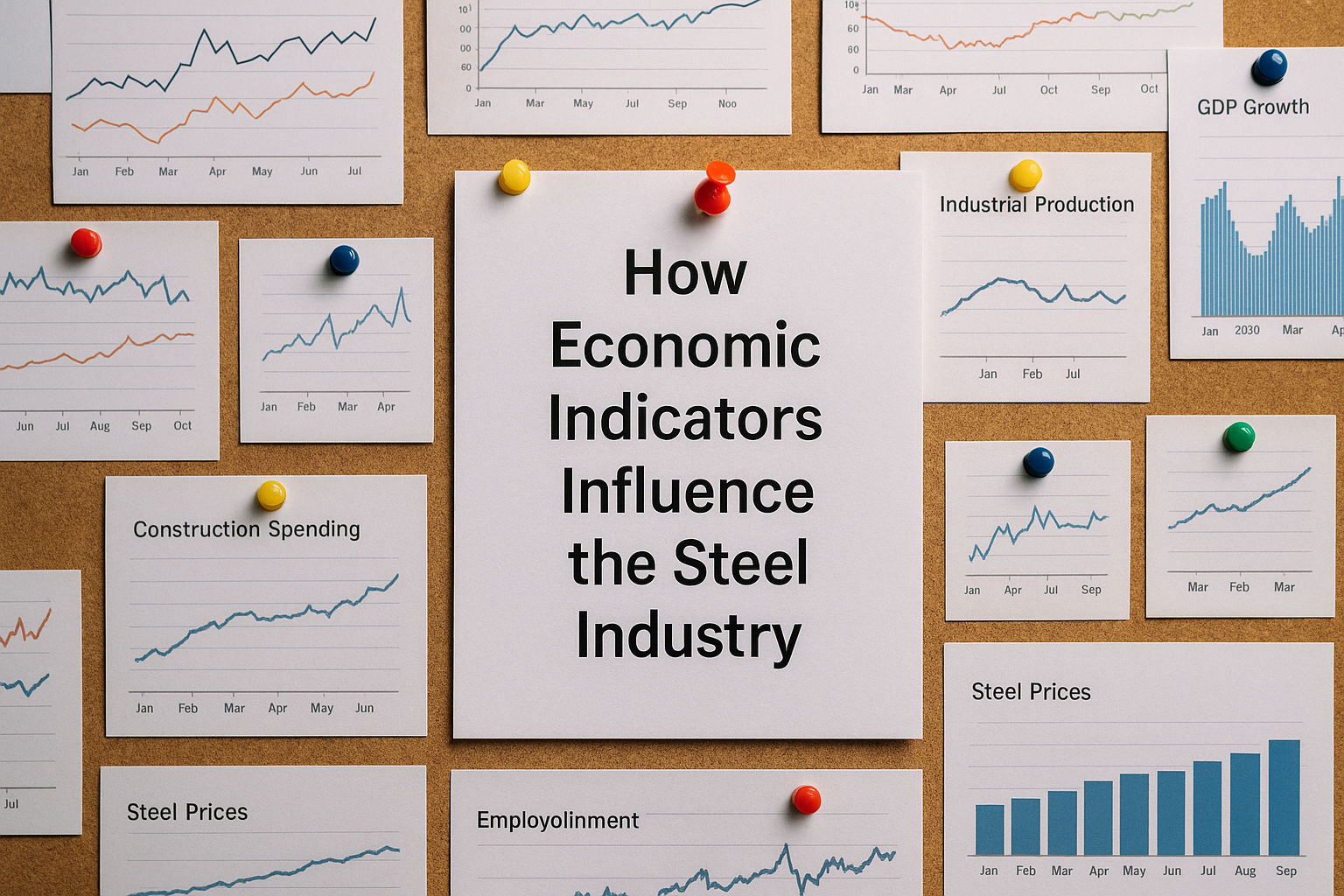
The steel industry is a fundamental component of the global economy. As a key input for construction, manufacturing, infrastructHow Economic Indicators Influence the Steel Industry
The steel industry is one of the most important industrial sectors in the global economy. Steel is essential to construction, infrastructure, transportation, energy, machinery, and manufacturing, making steel demand closely connected to broader economic activity.
Steel prices, however, do not move according to a single economic variable. Demand, production, raw material costs, interest rates, exchange rates, trade policies, inventories, and geopolitical conditions interact continuously to influence the steel market.
For steel producers, distributors, buyers, investors, and industrial decision-makers, understanding these relationships can provide an important competitive advantage.
This article explains the economic indicators that matter most to the steel industry, how they influence steel demand and prices, and how professionals can use them to support better purchasing, pricing, inventory, and strategic decisions.
1. Why Economic Indicators Matter to the Steel Industry
Economic indicators are statistics that provide information about the current condition or future direction of an economy.
For the steel industry, they can provide signals about:
- Future steel demand
- Industrial production
- Construction activity
- Infrastructure investment
- Raw material costs
- Interest rates and financing conditions
- Currency movements
- International trade
- Consumer and business confidence
- Potential supply-chain disruptions
However, economic indicators should not be interpreted individually.
For example, a strong GDP growth rate does not automatically mean that steel prices will increase. If steel inventories are already high, imports are rising, or production capacity is expanding faster than demand, prices may remain under pressure.
The most useful approach is therefore to analyze several indicators together and identify whether they are pointing toward stronger or weaker steel market conditions.
2. GDP and Economic Growth
Gross Domestic Product (GDP) measures the value of goods and services produced within an economy.
Because steel is widely used in construction, infrastructure, manufacturing, transportation, and energy projects, changes in economic activity can have a significant impact on steel consumption.
Why GDP matters
Stronger economic growth can stimulate:
- Construction activity
- Industrial production
- Automotive manufacturing
- Infrastructure investment
- Machinery production
- Energy projects
- Commercial investment
These activities generally require significant quantities of steel.
However, the relationship between GDP and steel demand varies by country and by economic structure.
A developing economy investing heavily in infrastructure may consume considerably more steel for each percentage point of GDP growth than a mature service-oriented economy.
What steel professionals should monitor
Rather than looking only at headline GDP growth, it is useful to examine:
- Quarterly GDP growth
- Industrial investment
- Construction investment
- Manufacturing activity
- Infrastructure spending
- Fixed-asset investment
These indicators often provide more direct information about potential steel consumption.
3. Purchasing Managers’ Index (PMI)
The Purchasing Managers’ Index (PMI) is one of the most useful high-frequency indicators for monitoring manufacturing activity.
A PMI above 50 generally indicates expansion, while a reading below 50 indicates contraction.
For steel professionals, the manufacturing PMI can provide an early indication of changes in industrial demand.
Why PMI matters
A strengthening manufacturing sector can increase demand for steel in:
- Automotive production
- Machinery
- Appliances
- Industrial equipment
- Energy equipment
- Fabricated metal products
A declining PMI, on the other hand, may signal weaker future demand.
PMI data can be particularly useful because they are generally released more frequently than GDP data.
A practical approach
Rather than looking at one monthly PMI number, monitor the trend.
For example:
PMI rising + industrial production rising + steel inventories falling = potentially stronger steel demand.
Conversely:
PMI falling + industrial production declining + inventories rising = potentially weaker market conditions.
The combination is often more informative than any individual indicator.
4. Construction Activity and Infrastructure Investment
Construction is one of the largest steel-consuming sectors worldwide.
Indicators such as housing starts, building permits, construction spending, infrastructure investment, and public works programs can therefore provide valuable information about future steel demand.
Why construction data matter
Steel is extensively used in:
- Buildings
- Bridges
- Industrial facilities
- Railways
- Ports
- Airports
- Energy infrastructure
- Transmission systems
- Water infrastructure
Construction indicators are particularly important for producers and distributors of structural steel, rebar, beams, plates, sections, and related products.
Regional differences
The most relevant construction indicators vary by market.
In the United States, for example, housing starts and building permits can provide useful signals.
In emerging economies, infrastructure investment and public-sector construction programs may be more important.
For steel market analysis, the key is to identify which construction indicators have the strongest relationship with local steel consumption.
5. Industrial Production
The Industrial Production Index measures changes in output from manufacturing, mining, and utilities.
Because steel is an essential input for many industrial sectors, industrial production can be closely related to steel consumption.
When industrial activity increases, demand for steel products may increase across:
- Machinery
- Automotive
- Industrial equipment
- Energy
- Appliances
- Metal fabrication
A sustained decline in industrial production can have the opposite effect.
Industrial production data are therefore particularly useful when evaluating short- and medium-term demand conditions.
6. Iron Ore and Coking Coal Prices
For integrated steelmakers using blast furnaces and basic oxygen furnaces, iron ore and metallurgical coal are major raw material inputs.
Changes in these commodity prices can significantly affect steel production costs.
However, an important distinction must be made:
Higher raw material prices do not automatically produce higher steel prices.
Steel prices are determined by the interaction of production costs, market demand, inventories, capacity utilization, trade flows, and competitive conditions.
For example, if iron ore prices increase while steel demand remains weak, steelmakers may experience margin compression rather than successfully transferring the entire cost increase to customers.
What to monitor
Steel professionals should consider:
- Iron ore prices
- Metallurgical coal prices
- Freight rates
- Steel prices
- Steel mill margins
- Production levels
- Inventory trends
The relationship between these variables can provide valuable information about the health of the steel market.
7. Steel Scrap and Electric Arc Furnace Economics
Scrap steel is a fundamental raw material for Electric Arc Furnace (EAF) steelmaking.
Scrap prices therefore have a direct influence on the production economics of many EAF-based steelmakers.
The importance of scrap has increased as EAF production expands in several regions and as the steel industry continues to focus on circularity and lower-carbon production routes.
Why scrap prices matter
Changes in scrap prices can affect:
- EAF production costs
- Regional steel prices
- Mill margins
- Recycling economics
- Availability of metallic inputs
For a complete analysis, scrap should be evaluated together with electricity prices, electrode costs, logistics, steel prices, and competing metallic inputs.
8. Employment and Unemployment
Employment indicators provide information about economic activity and consumer confidence.
Although the relationship with steel demand is indirect, employment conditions can influence:
- Housing demand
- Consumer spending
- Automotive purchases
- Construction activity
- Business investment
For steel professionals, employment data are therefore more useful as part of a broader economic picture than as a standalone steel-demand indicator.
9. Inflation and Producer Prices
Inflation affects the entire steel value chain.
Higher inflation can increase:
- Energy costs
- Labor costs
- Transportation costs
- Financing costs
- Maintenance costs
- Construction costs
Consumer Price Index (CPI) data provide information about consumer inflation, while Producer Price Index (PPI) data can provide useful information about changes in industrial input and output prices.
For steel companies, producer-price trends can sometimes be particularly relevant because they help reveal cost pressure within industrial supply chains.
Important distinction
Inflation does not necessarily mean that steel prices will increase by the same amount.
Steel prices remain dependent on supply and demand conditions.
Therefore, inflation should be considered a cost and purchasing-power indicator rather than a direct predictor of steel prices.
10. Interest Rates and Monetary Policy
Interest rates can have a significant influence on steel-consuming industries.
Higher interest rates increase the cost of financing and can reduce investment in:
- Housing
- Commercial real estate
- Infrastructure
- Machinery
- Industrial expansion
- Capital-intensive projects
Lower interest rates can have the opposite effect by improving access to financing and encouraging investment.
Steel professionals should therefore monitor decisions and forward guidance from major central banks, including the Federal Reserve, European Central Bank, Bank of Japan, People’s Bank of China, and other institutions relevant to their markets.
The effect on steel demand is usually indirect and may occur with a time lag.
11. Exchange Rates
Currency movements are particularly important in international steel trade.
Steel, iron ore, coal, scrap, energy, and freight are frequently traded internationally, with many transactions denominated in U.S. dollars.
A depreciation of a country’s currency can make imported steel and raw materials more expensive in local currency.
At the same time, it can improve the price competitiveness of exports.
Why exchange rates matter
Currency movements can affect:
- Import costs
- Export competitiveness
- Raw material costs
- Freight costs
- Steel margins
- Purchasing decisions
For companies involved in steel imports, exchange-rate monitoring should therefore be incorporated into purchasing and cost-management strategies.
12. Trade Flows, Tariffs, and Trade Policy
International trade data provide important information about steel market balances.
Monitor:
- Steel imports
- Steel exports
- Trade balances
- Import penetration
- Anti-dumping measures
- Tariffs
- Quotas
- Safeguard measures
- Trade agreements
Changes in trade policy can rapidly alter regional supply and demand.
For example, restrictions on imports may reduce available supply in a domestic market and increase the importance of local production.
Conversely, increased imports can place pressure on domestic producers and prices.
For international steel buyers, trade policy should therefore be treated as an integral component of procurement strategy.
13. Geopolitical Risk and Supply-Chain Disruptions
Steel markets are also affected by geopolitical events.
Conflicts, sanctions, trade restrictions, transportation disruptions, and political instability can affect:
- Raw material supply
- Energy availability
- Shipping routes
- Insurance costs
- Production capacity
- International trade flows
The impact can extend far beyond the country directly involved.
For this reason, steel market intelligence should include monitoring of geopolitical developments affecting major steel-producing and raw-material-producing regions.
The objective is not simply to predict a price increase.
It is to identify potential changes in supply availability, lead times, freight costs, and purchasing risk.
14. Steel Inventories and Capacity Utilization
Economic indicators are important, but steel-specific market indicators are often even more useful when assessing short-term conditions.
Two particularly important variables are:
Steel inventories
Rising inventories combined with weak demand can indicate downward pressure on prices.
Declining inventories combined with improving demand can indicate a tightening market.
Capacity utilization
High utilization rates can indicate stronger demand and limited spare production capacity.
Low utilization may indicate weaker demand, excess capacity, or unfavorable production economics.
These indicators help connect the broader economic environment to the actual condition of the steel market.
15. How Steel Professionals Can Use Economic Indicators
Economic indicators become valuable when they support concrete decisions.
1. Demand Forecasting
If manufacturing, construction, infrastructure investment, and PMI indicators are improving simultaneously, companies may prepare for stronger steel demand.
2. Purchasing Decisions
Buyers can monitor raw materials, freight, exchange rates, inventories, and demand indicators when determining purchasing timing and contract strategies.
3. Price Negotiations
Economic and steel-market data can provide objective support for negotiations between buyers, distributors, and producers.
4. Inventory Management
Companies can adjust inventory levels according to expected changes in demand, lead times, import availability, and price risk.
5. Capacity Planning
Steel producers and processors can use economic trends to evaluate production schedules, maintenance plans, investment decisions, and market expansion.
6. Risk Management
Monitoring economic and geopolitical indicators can help companies identify potential supply disruptions and develop alternative sourcing strategies.
16. Which Indicators Should Be Monitored Together?
A practical steel-market dashboard should combine different types of indicators.
| Indicator | What it helps identify |
|---|---|
| GDP | Overall economic activity |
| PMI | Manufacturing direction |
| Construction data | Building and infrastructure demand |
| Industrial production | Industrial steel consumption |
| Iron ore | Integrated mill input costs |
| Metallurgical coal | Blast-furnace input costs |
| Scrap | EAF production economics |
| Energy prices | Production-cost pressure |
| Steel inventories | Market balance |
| Capacity utilization | Supply availability |
| Interest rates | Investment conditions |
| Inflation/PPI | Cost pressure |
| Exchange rates | Import/export competitiveness |
| Trade flows | Regional supply balance |
| Tariffs and quotas | Trade-policy effects |
| Freight rates | Delivered material costs |
The greatest value comes from analyzing these indicators together rather than attempting to predict the steel market using a single variable.
17. Reliable Sources of Economic and Steel Market Data
Professionals should prioritize primary or highly reputable sources whenever possible.
Useful sources include:
- National statistical agencies
- Central banks
- International organizations
- Government trade databases
- Industry associations
- Steel producers
- Commodity exchanges
- PMI providers
- Specialized steel-market data providers
Organizations such as the World Bank, International Monetary Fund (IMF), OECD, and national statistical agencies can provide valuable macroeconomic information.
For steel-specific analysis, production, trade, inventory, raw-material, and price data should be combined with macroeconomic indicators.
Frequently Asked Questions
Which economic indicator is most important for the steel industry?
There is no single indicator that works for every market.
PMI, construction activity, industrial production, inventories, steel prices, raw material costs, and trade flows are particularly useful when analyzed together.
How often should steel professionals monitor economic indicators?
Monthly monitoring is generally appropriate for strategic planning.
Companies involved in procurement, trading, or price-sensitive operations may need weekly or even daily monitoring of selected steel, commodity, currency, freight, and inventory indicators.
Does GDP growth always increase steel demand?
No.
The relationship depends on the structure of the economy, the intensity of construction and industrial investment, steel intensity, inventories, imports, exports, and other market conditions.
Do higher iron ore prices always lead to higher steel prices?
No.
Higher iron ore prices increase production costs, but steel prices ultimately depend on the balance between supply and demand and on the ability of producers to transfer higher costs to customers.
Are the most important indicators the same in every country?
No.
The most relevant indicators depend on the structure of each economy.
Housing activity may be particularly important in one market, while infrastructure investment, manufacturing, exports, or energy projects may be more important in another.
Conclusion: Turning Economic Data into Steel Market Intelligence
The steel industry is closely connected to economic activity, but the relationship is complex.
GDP, PMI, construction activity, industrial production, raw material prices, inflation, interest rates, exchange rates, trade flows, inventories, and geopolitical conditions can all influence the steel market.
The key is not to monitor more indicators simply for the sake of collecting data.
The objective is to understand how different indicators interact and what they collectively suggest about future steel demand, supply, costs, prices, and risks.
For steel producers, distributors, buyers, and investors, this approach can improve:
- Demand forecasting
- Purchasing decisions
- Inventory management
- Price negotiations
- Cost control
- Supply-chain resilience
- Risk management
- Strategic planning
In an increasingly volatile global steel market, economic indicators are more than statistics.
When properly interpreted, they become a practical tool for transforming economic information into Steel Market Intelligence.