
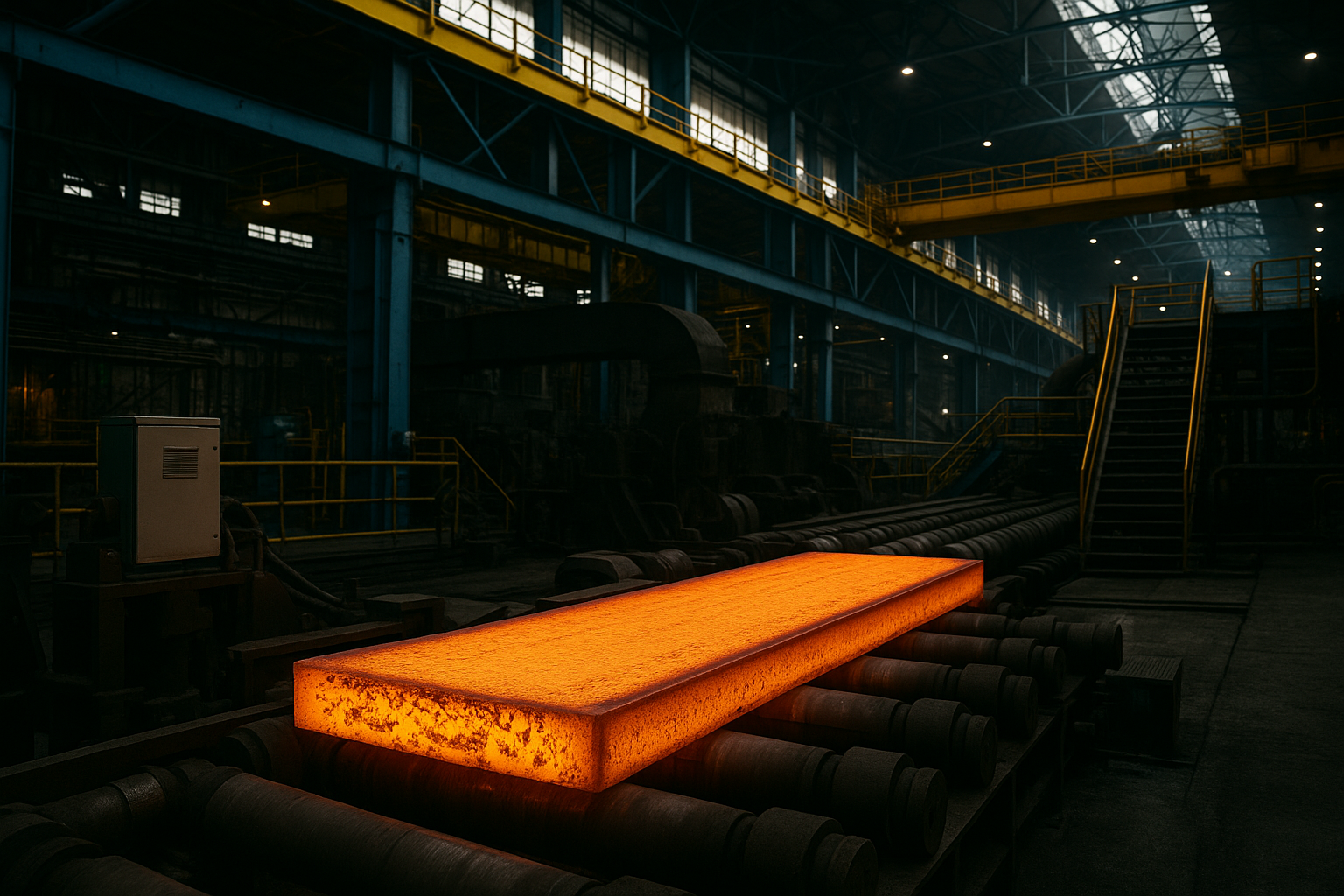
Steel plants depend on assets that operate under some of the most demanding conditions in manufacturing. Furnaces, rolling mills, continuous casters, cranes, conveyors, pumps, fans, gearboxes, hydraulic systems and large electrical drives may remain in service for decades while being exposed to heat, vibration, dust, water, cyclic loading, abrasive materials and continuous production demands.
Keeping these assets running is essential. But maintenance alone is not enough.
Every industrial asset passes through a series of decisions long before its first maintenance intervention and long after its first major overhaul. Equipment must be specified, purchased, installed, commissioned, operated, maintained, modified, modernized and eventually replaced or retired.
Each decision affects future cost, reliability, production capacity, safety and technical risk.
This is the domain of Asset Lifecycle Management.
The objective is not simply to extend equipment life for as long as physically possible. It is to realize value from assets while balancing performance, cost and risk throughout their life cycles.
For steel manufacturers, this changes an important question.
Instead of asking:
“How long can we keep this equipment running?”
management should ask:
“What lifecycle decision creates the greatest value at an acceptable level of risk?”
That decision may involve continued operation.
But it may also involve maintenance, modification, refurbishment, modernization, replacement or retirement.
1. What Is Asset Lifecycle Management?
Asset Lifecycle Management is the coordinated management of physical assets across the stages through which they create value for an organization.
A practical industrial lifecycle can be represented as:
Business Need → Asset Strategy → Specification → Acquisition → Installation & Commissioning → Operation → Maintenance → Modification / Life Extension → Renewal / Replacement → Decommissioning
The sequence is not always perfectly linear.
An asset may undergo several major overhauls, control-system upgrades, capacity modifications or partial replacements before final retirement.
The important principle is that decisions made in one lifecycle stage influence later stages.
A poorly specified pump may consume excessive energy throughout its operating life.
A gearbox selected only for minimum purchase price may create higher maintenance costs.
A rolling-mill modernization may extend productive life by years.
A control platform that becomes obsolete may force replacement even when the mechanical equipment remains physically sound.
Lifecycle management therefore considers the complete economic and technical consequences of asset decisions.
2. Asset Management Is Broader Than Maintenance
Maintenance is one component of asset management.
Maintenance asks questions such as:
- What work should be performed?
- When should the intervention occur?
- What failure mode is developing?
- Which spare parts are required?
- How can reliability be restored?
Asset management asks broader questions:
- Why does the organization need this asset?
- What performance must it deliver?
- What risks does it create?
- How should it be acquired?
- How should it be operated?
- How should its condition be managed?
- When should it be modernized?
- When is refurbishment economically justified?
- When should it be replaced?
- How should it ultimately be decommissioned?
A plant can therefore have an excellent maintenance department and still make poor lifecycle decisions.
The two disciplines must work together.
3. The Central Principle: Value, Performance, Cost and Risk
The lowest-cost asset is not necessarily the asset with the lowest purchase price.
Likewise, the asset with the longest physical life is not necessarily the asset that creates the most value.
Lifecycle decisions should consider four interacting dimensions:
Value → Performance → Cost → Risk
Value
What contribution does the asset make to organizational objectives?
Performance
Does it deliver the required capacity, quality, availability, efficiency and functionality?
Cost
What expenditure is required throughout its remaining life?
Risk
What are the consequences and likelihood of failure, obsolescence, safety events, environmental impact or inability to support production?
Good asset management balances these factors rather than optimizing one in isolation.
4. Start With the Business Need
Lifecycle management should begin before equipment is purchased.
The first question is not:
Which machine should we buy?
It is:
What capability does the business require?
For example, a steel plant may need:
- greater rolling capacity;
- tighter dimensional tolerances;
- reduced energy intensity;
- improved product mix flexibility;
- increased equipment availability;
- replacement of obsolete automation;
- improved environmental performance.
Once the business requirement is understood, engineers can define the asset capabilities required to support it.
This avoids a common procurement error: selecting equipment before defining the operational problem.
5. Asset Strategy and Criticality
Not every asset deserves the same lifecycle strategy.
A critical main drive on a rolling mill requires different management from a low-consequence auxiliary pump with installed redundancy.
Asset criticality should consider consequences such as:
- production loss;
- safety;
- environmental impact;
- product quality;
- repair duration;
- spare-part availability;
- downstream effects;
- regulatory consequences.
A practical model can be expressed as:
Asset Criticality = Probability of Failure × Consequence of Failure
In practice, organizations often use multidimensional scoring rather than a single mathematical product.
The purpose is prioritization.
Criticality should influence:
- monitoring intensity;
- maintenance strategy;
- spare-parts policy;
- redundancy;
- inspection frequency;
- contingency planning;
- replacement planning.
6. Build a Reliable Asset Hierarchy
Lifecycle management becomes difficult when the organization does not know exactly which assets it owns or how they relate to production.
An asset hierarchy may follow:
Plant → Area → Production Line → System → Equipment → Subassembly → Component
For example:
Hot Rolling Mill → Finishing Mill → Stand F3 → Main Drive → Gearbox → Bearing
This structure allows maintenance history, condition data, cost and failure information to be assigned to the correct physical asset.
Without a consistent hierarchy, lifecycle cost becomes fragmented across different names, codes and databases.
7. Specification Determines Future Performance
Many lifecycle problems originate during specification.
Technical specifications should consider more than nominal capacity.
Depending on the equipment, requirements may include:
- operating load;
- duty cycle;
- environmental conditions;
- temperature;
- contamination;
- water quality;
- vibration;
- maintainability;
- access;
- redundancy;
- instrumentation;
- automation interfaces;
- cybersecurity;
- spare parts;
- documentation;
- energy efficiency;
- expected service life.
A cheaper initial specification can become expensive if it creates poor reliability or difficult maintenance for the next 20 years.
8. Procurement Should Consider Total Cost, Not Purchase Price Alone
Traditional procurement can overemphasize CAPEX.
Lifecycle procurement considers costs that occur after acquisition.
These may include:
Acquisition Cost + Installation + Energy + Consumables + Maintenance + Spare Parts + Downtime + Upgrades + Disposal
This is the basis of Life Cycle Cost (LCC) or Total Cost of Ownership (TCO) analysis.
For energy-intensive or maintenance-intensive equipment, the purchase price may represent only part of the economic exposure.
The technically cheapest bid and the economically best bid are therefore not necessarily the same.
9. FAT, SAT and Commissioning Are Lifecycle Activities
Factory Acceptance Testing (FAT), Site Acceptance Testing (SAT) and commissioning should not be treated as administrative formalities.
They establish whether the delivered asset actually satisfies the technical requirements.
Commissioning should verify, where applicable:
- mechanical installation;
- electrical installation;
- instrumentation;
- control logic;
- interlocks;
- safety functions;
- operating ranges;
- performance;
- communication interfaces;
- documentation.
A weak commissioning process can transfer hidden defects into decades of operation.
10. Establish a Baseline at the Beginning of Life
New or refurbished equipment provides an important opportunity to establish baseline condition.
Depending on the asset, baseline information may include:
- vibration;
- temperature;
- electrical signatures;
- lubricant condition;
- alignment;
- clearances;
- pressures;
- flows;
- dimensional measurements;
- performance curves.
Future measurements become more meaningful when compared with a known healthy condition.
Baseline data should therefore become part of the asset record.
11. Operate Within the Intended Operating Envelope
Equipment life depends strongly on how the asset is operated.
Repeated operation outside design conditions can accelerate degradation.
Examples include:
- overload;
- excessive temperature;
- inadequate lubrication;
- excessive starts and stops;
- hydraulic contamination;
- cavitation;
- poor alignment;
- abnormal vibration;
- excessive electrical loading.
Lifecycle management should therefore connect equipment condition with operating history.
An asset that is ten years old but lightly loaded may have a different remaining life from an identical asset exposed to severe duty.
Calendar age alone is a weak indicator of asset condition.
12. Maintenance Strategy Must Match the Failure Mode
Different assets require different maintenance approaches.
These may include:
- run-to-failure;
- preventive maintenance;
- condition-based maintenance;
- predictive maintenance;
- reliability-centered strategies.
The appropriate strategy depends on:
- failure consequence;
- failure behavior;
- detectability;
- intervention cost;
- asset criticality.
Predictive maintenance is particularly valuable when degradation can be detected with sufficient warning to support a planned intervention.
For the complete reliability-engineering treatment, see Predictive Maintenance in Steel Plants: A Practical Engineering Guide to Equipment Reliability.
Lifecycle management uses this information as one input into broader asset decisions.
13. Condition Monitoring Supports Lifecycle Decisions
Condition monitoring can reveal whether deterioration is accelerating, stable or negligible.
Relevant technologies may include:
- vibration analysis;
- thermography;
- oil analysis;
- ultrasound;
- electrical signature analysis;
- dimensional inspection;
- process-performance monitoring.
But condition data becomes more valuable when integrated with:
- maintenance history;
- operating hours;
- production conditions;
- failure history;
- spare-parts availability;
- lifecycle cost.
This allows engineers to move from:
“The vibration increased.”
to:
“The asset is degrading, the failure mode is understood, intervention is technically justified, and we know whether repair or replacement creates greater value.”
14. Real-Time Data Adds Operating Context
Modern assets generate increasing volumes of operational information.
Real-time monitoring can provide:
- load;
- temperature;
- current;
- pressure;
- speed;
- process state;
- alarm history;
- production conditions.
This information can help explain why an asset deteriorates.
Our guide to Real-Time Data Monitoring in Steel Plants examines the architecture from sensors through SCADA, historians and operational decision-making.
In lifecycle management, these data should support decisions rather than simply create more dashboards.
15. CMMS and EAM Systems: Different Roles
Computerized Maintenance Management Systems (CMMS) commonly manage activities such as:
- work orders;
- preventive maintenance;
- maintenance history;
- labor;
- spare parts;
- maintenance scheduling.
Enterprise Asset Management (EAM) platforms may extend the scope to broader lifecycle information, including:
- asset hierarchy;
- financial information;
- contracts;
- condition;
- risk;
- lifecycle planning;
- replacement decisions.
The terminology varies between software vendors, so the label alone is less important than system capability.
The essential requirement is consistent information throughout the asset lifecycle.
16. Data Quality Is an Asset Management Issue
Poor asset information produces poor lifecycle decisions.
Common problems include:
- duplicate equipment records;
- inconsistent asset names;
- missing serial numbers;
- incomplete maintenance history;
- obsolete drawings;
- incorrect BOMs;
- undocumented modifications;
- disconnected financial and technical data.
The 2024 ISO 55000 series places increased emphasis on information, data and knowledge in asset management.
For industrial organizations, data governance should therefore be treated as part of asset governance.
17. Spare Parts Are Part of Lifecycle Strategy
A spare-part decision is an asset decision.
Holding every possible spare is expensive.
Holding no critical spares can expose production to unacceptable downtime.
Spare strategy should consider:
- asset criticality;
- failure probability;
- supplier lead time;
- repair time;
- interchangeability;
- storage requirements;
- obsolescence;
- production consequence.
A component with a 12-month procurement lead time may justify inventory even if it fails infrequently.
Conversely, inexpensive locally available components may not require large inventories.
18. Obsolescence Can End an Asset’s Economic Life
Equipment does not need to be mechanically worn out to become obsolete.
Obsolescence can affect:
- PLCs;
- drives;
- HMIs;
- industrial computers;
- communication networks;
- sensors;
- software;
- electronic boards;
- proprietary systems.
Problems arise when:
- manufacturer support ends;
- spare parts disappear;
- technicians with relevant expertise become scarce;
- cybersecurity requirements cannot be met;
- integration with newer systems becomes impractical.
Therefore:
Physical Life ≠ Technological Life ≠ Economic Life
This distinction is increasingly important in steel plants containing mechanical assets designed for decades of operation but control technologies with much shorter support cycles.
19. Modification and Modernization Can Extend Useful Life
Replacement is not the only response to aging.
An asset may remain economically attractive after:
- mechanical refurbishment;
- drive replacement;
- control-system modernization;
- instrumentation upgrades;
- lubrication improvements;
- cooling-system upgrades;
- structural reinforcement.
The decision should compare the expected performance and risk after modernization with alternative investment options.
20. Configuration Management Is Essential
Industrial equipment changes throughout its life.
Examples include:
- PLC logic modifications;
- drive replacement;
- sensor changes;
- piping modifications;
- structural changes;
- safety-system modifications.
If documentation does not follow the physical asset, the plant eventually operates equipment that differs from its drawings and records.
Configuration management should therefore maintain alignment between:
Physical Asset ↔ Drawings ↔ Software ↔ BOM ↔ Procedures ↔ Asset Records
This becomes particularly important during troubleshooting, modernization and replacement.
21. Remaining Useful Life Is Not a Fixed Number
Remaining Useful Life (RUL) is sometimes treated as though every asset has an expiration date.
Real equipment is more complicated.
Remaining life depends on:
- accumulated damage;
- operating conditions;
- degradation mechanisms;
- maintenance history;
- future duty;
- uncertainty.
A bearing, refractory lining, structural component and PLC platform all age differently.
RUL should therefore be interpreted as an estimate under defined assumptions rather than a guaranteed date.
22. Physical Life and Economic Life Are Different
An asset may remain physically operable after it stops being economically attractive.
Replacement can become justified because of:
- rising maintenance cost;
- poor availability;
- energy inefficiency;
- capacity limitation;
- quality limitation;
- obsolescence;
- safety risk;
- unavailable spare parts;
- excessive downtime.
Conversely, old equipment should not automatically be replaced simply because of age.
A well-maintained older machine with available parts and adequate performance may remain economically attractive.
Age should inform the decision, not determine it.
23. Repair, Refurbish or Replace?
This is one of the central lifecycle decisions.
A structured comparison should include:
| Decision Factor | Repair / Continue | Refurbish / Modernize | Replace |
|---|---|---|---|
| Technical condition | Acceptable | Recoverable | Poor or fundamentally inadequate |
| Reliability | Adequate | Can be restored | Structurally insufficient |
| Obsolescence | Low | Manageable through upgrade | Severe |
| Capacity | Adequate | Upgrade possible | Insufficient |
| Energy efficiency | Acceptable | Improvement possible | Major disadvantage |
| Spare parts | Available | Alternatives possible | Critical scarcity |
| Capital requirement | Low | Medium | High |
| Expected remaining life | Limited to moderate | Extended | New lifecycle |
| Implementation disruption | Low | Medium | Potentially high |
The table does not produce the decision automatically.
It creates a disciplined framework for comparing alternatives.
24. Life Cycle Cost Analysis
A simplified lifecycle cost model can be represented as:
LCC = CAPEX + Installation + Operating Cost + Maintenance Cost + Downtime Cost + Upgrade Cost + Disposal Cost − Residual Value
For rigorous investment analysis, future cash flows should be considered on an appropriate discounted basis.
This matters because costs occur at different times.
A replacement requiring high CAPEX today may reduce energy and maintenance expenditure over future years.
A repair may appear inexpensive immediately but generate repeated downtime later.
The analysis should therefore compare alternatives over a defined economic horizon.
25. Downtime Cost Changes the Replacement Equation
Maintenance expenditure alone can underestimate the economic impact of aging equipment.
Suppose two alternatives have similar maintenance costs.
If one generates frequent production interruptions, the real economic difference may be substantial.
Downtime cost may include:
- lost contribution margin;
- idle labor;
- production rescheduling;
- startup losses;
- quality losses;
- downstream disruption;
- contractual impact.
For critical steelmaking assets, the cost of lost production can be more important than the direct repair invoice.
26. Risk Must Be Included in Economic Decisions
A purely deterministic financial comparison can miss low-frequency, high-consequence events.
Consider an aging transformer.
Historical maintenance cost may remain modest.
But catastrophic failure could create:
- long outage;
- replacement lead time;
- secondary damage;
- safety consequences.
Lifecycle decisions should therefore combine economic analysis with risk.
A simplified decision framework is:
Lifecycle Decision = Performance + Cost + Risk + Opportunity
Opportunity matters because replacement may enable benefits unavailable with the current asset.
27. Energy Performance Can Influence Asset Renewal
Older equipment may remain reliable but consume more energy than modern alternatives.
Examples may include:
- motors;
- pumps;
- fans;
- compressors;
- drives;
- combustion systems.
Energy savings alone do not automatically justify replacement.
The correct comparison includes:
- operating hours;
- load profile;
- efficiency difference;
- energy price;
- maintenance cost;
- investment;
- expected life.
Lifecycle analysis integrates these variables rather than using efficiency in isolation.
28. Sustainability and Asset Life Extension
Extending asset life can reduce the need for new equipment and the material and energy associated with replacement.
But life extension is not automatically the most sustainable choice.
An inefficient or high-emission asset may impose larger operating impacts than a modern replacement.
Sustainability assessment should therefore consider the lifecycle consequences of both:
continued operation and replacement.
This is another reason why “keep equipment as long as possible” is not a universal asset-management strategy.
29. Decommissioning Should Be Planned Before Failure Forces It
Asset retirement is part of the lifecycle.
Decommissioning planning may involve:
- production transition;
- isolation;
- energy removal;
- hazardous materials;
- dismantling;
- disposal;
- recycling;
- site restoration;
- data and documentation;
- spare-part recovery.
Waiting until catastrophic failure to decide how an asset should be retired is usually poor lifecycle management.
30. KPIs for Asset Lifecycle Management
No single KPI adequately measures lifecycle performance.
A balanced set may include:
Reliability
- MTBF;
- failure frequency;
- unplanned downtime.
Maintainability
- MTTR;
- maintenance backlog;
- planned versus emergency work.
Availability
- equipment availability;
- production availability.
Cost
- maintenance cost by asset;
- lifecycle cost;
- cost per operating hour;
- cost per tonne where meaningful.
Condition
- critical assets with current condition assessment;
- unresolved condition alerts.
Risk
- critical assets above risk threshold;
- overdue risk treatments.
Obsolescence
- unsupported systems;
- critical components without viable spares.
Renewal
- replacement backlog;
- asset renewal forecast;
- capital-plan compliance.
The objective is not to maximize every KPI independently.
It is to support better decisions.
31. Common Asset Lifecycle Management Failures
Managing assets only after they fail
Lifecycle decisions begin at specification, not breakdown.
Buying only on lowest CAPEX
Purchase price may represent only a fraction of total ownership cost.
Treating age as condition
Old does not necessarily mean bad; new does not necessarily mean healthy.
Extending life without assessing risk
Life extension must be technically justified.
Replacing equipment without analyzing alternatives
Refurbishment or modernization may sometimes create greater value.
Ignoring obsolescence
Control-system obsolescence can become the limiting factor even when mechanical systems remain sound.
Poor asset data
Incomplete history undermines lifecycle analysis.
Maintenance and CAPEX planning operating separately
Replacement decisions require technical and financial alignment.
No documented decision criteria
Lifecycle investments become inconsistent when each decision uses a different logic.
32. A Practical Asset Lifecycle Management Roadmap
Step 1 — Establish the asset hierarchy
Know what assets exist and how they support production.
Step 2 — Determine criticality
Prioritize according to consequence and risk.
Step 3 — Define required performance
Establish capacity, quality, reliability, efficiency and safety expectations.
Step 4 — Establish condition and history
Combine inspections, monitoring, maintenance and operating information.
Step 5 — Identify lifecycle risks
Include failure, obsolescence, spare parts, safety and production consequences.
Step 6 — Develop intervention alternatives
Examples:
Continue → Repair → Refurbish → Modernize → Replace
Step 7 — Compare lifecycle economics
Use TCO/LCC rather than purchase price alone.
Step 8 — Evaluate risk
Consider probability and consequence, including uncertainty.
Step 9 — Select the lifecycle intervention
Choose the alternative that best supports organizational objectives.
Step 10 — Document the decision
Record assumptions, criteria and expected results.
Step 11 — Measure actual performance
Verify whether the intervention delivered the expected benefits.
Step 12 — Feed lessons into future specifications
Lifecycle management should be a learning system.
33. Digitalization as an Enabler, Not the Strategy
Modern asset management increasingly uses:
- IIoT;
- condition monitoring;
- historians;
- CMMS/EAM;
- analytics;
- AI;
- digital twins.
These technologies can improve visibility and decision quality.
But technology does not determine the asset strategy.
A plant with sophisticated dashboards can still make poor replacement decisions.
Likewise, an organization can implement disciplined lifecycle management without applying AI to every asset.
Digitalization should strengthen the decision framework rather than replace it.
34. The Future: From Maintenance Decisions to Asset Decisions
Manufacturing systems are gradually integrating more condition, operational, financial and risk information.
NIST’s work on Asset Condition Management describes the integration of current and future asset-health knowledge with enterprise applications to support manufacturing operations.
The important evolution is therefore not merely:
Reactive → Preventive → Predictive Maintenance
It is also:
Maintenance Data → Condition Knowledge → Asset Decision → Lifecycle Value
The most mature organizations will increasingly connect engineering and financial decisions around the same physical assets.
35. Final Perspective
Asset Lifecycle Management changes the way steel plants think about equipment.
The objective is not:
Maximum equipment age.
It is not:
Minimum maintenance cost.
And it is not:
Minimum CAPEX.
The objective is to obtain the required performance and value while managing cost and risk throughout the asset lifecycle.
That requires coordination across:
Engineering → Operations → Maintenance → Reliability → Procurement → Finance → Safety → Management
The strongest lifecycle decisions answer five questions:
What performance do we require?
What is the actual condition of the asset?
What will it cost to continue operating?
What risks are we accepting?
Which intervention creates the greatest lifecycle value?
When steel plants can answer those questions consistently, asset management becomes more than maintenance planning.
It becomes a framework for allocating capital, protecting production capacity and making better long-term industrial decisions.
Frequently Asked Questions
What is Asset Lifecycle Management in a steel plant?
It is the coordinated management of industrial assets from initial business need and specification through acquisition, operation, maintenance, modernization, replacement and decommissioning, with decisions based on value, performance, cost and risk.
Is Asset Lifecycle Management the same as maintenance management?
No. Maintenance management focuses primarily on maintaining or restoring equipment function. Asset Lifecycle Management includes maintenance but also covers specification, acquisition, operation, modernization, investment, replacement and retirement decisions.
Should steel plants replace equipment after a fixed number of years?
Not necessarily. Calendar age alone is insufficient. Condition, reliability, performance, obsolescence, operating cost, risk, spare-parts availability and economic alternatives should all influence replacement decisions.
What is the difference between physical life and economic life?
Physical life is the period during which equipment can continue functioning technically. Economic life ends when continued ownership is no longer the preferred economic alternative because of cost, risk, inefficiency, obsolescence or performance limitations.
What is Life Cycle Cost?
Life Cycle Cost evaluates costs associated with an asset over a defined lifecycle, potentially including acquisition, installation, operation, energy, maintenance, downtime, upgrades and disposal, less residual value where applicable.
Is extending equipment life always better than replacing it?
No. Life extension can create value when condition and risk remain acceptable, but replacement may be preferable when reliability, efficiency, capacity, obsolescence or safety become limiting factors.
How does predictive maintenance support asset lifecycle management?
Predictive maintenance provides information about developing degradation and expected asset condition. Lifecycle management uses that information together with cost, risk, performance and business requirements to determine the appropriate intervention.
What is the role of CMMS or EAM software?
These systems organize asset and maintenance information. Depending on capability, they may support work management, maintenance history, costs, asset hierarchy, condition, risk and lifecycle planning. Software supports the process but does not replace engineering decision-making.
Why is obsolescence important in steel plants?
Mechanical equipment may remain usable for decades while PLCs, drives, electronics and software become unsupported much earlier. Technological obsolescence can therefore determine replacement or modernization timing even when the mechanical asset remains functional.
What is the main objective of Asset Lifecycle Management?
The objective is to realize value from assets by balancing required performance, lifecycle cost, opportunity and risk rather than simply maximizing equipment life or minimizing short-term expenditure.
Technical References
ISO — ISO 55000:2024, Asset management — Vocabulary, overview and principles
Foundational terminology and principles for systematic management of assets over their life cycles and realization of value.
ISO — ISO 55000:2024
ISO/TC 251 — ISO 55001:2024, Asset management — Asset management system — Requirements
Requirements for establishing, implementing, maintaining and improving an asset management system.
ISO — ISO 55001:2024
ISO/TC 251 — Key Changes in ISO 55001:2024
Technical guidance on the revised standard, including decision-making and value, lifecycle management, risk and predictive action.
ISO — Key Changes in ISO 55001:2024
NIST — Asset Condition Management: A Framework for Smart, Health-Ready Manufacturing Systems
Framework connecting condition awareness, diagnostics and future asset health with manufacturing and enterprise decision-making.
NIST — Asset Condition Management
NIST — A Review of Diagnostic and Prognostic Capabilities and Best Practices for Manufacturing
Technical treatment of diagnostics, prognostics, condition information and actionable manufacturing decisions.
NIST — Diagnostic and Prognostic Best Practices
U.S. Department of Energy — Operations & Maintenance Best Practices Guide
Reference covering maintenance strategies, operational efficiency and maintenance economics.
DOE — Operations & Maintenance Best Practices Guide