
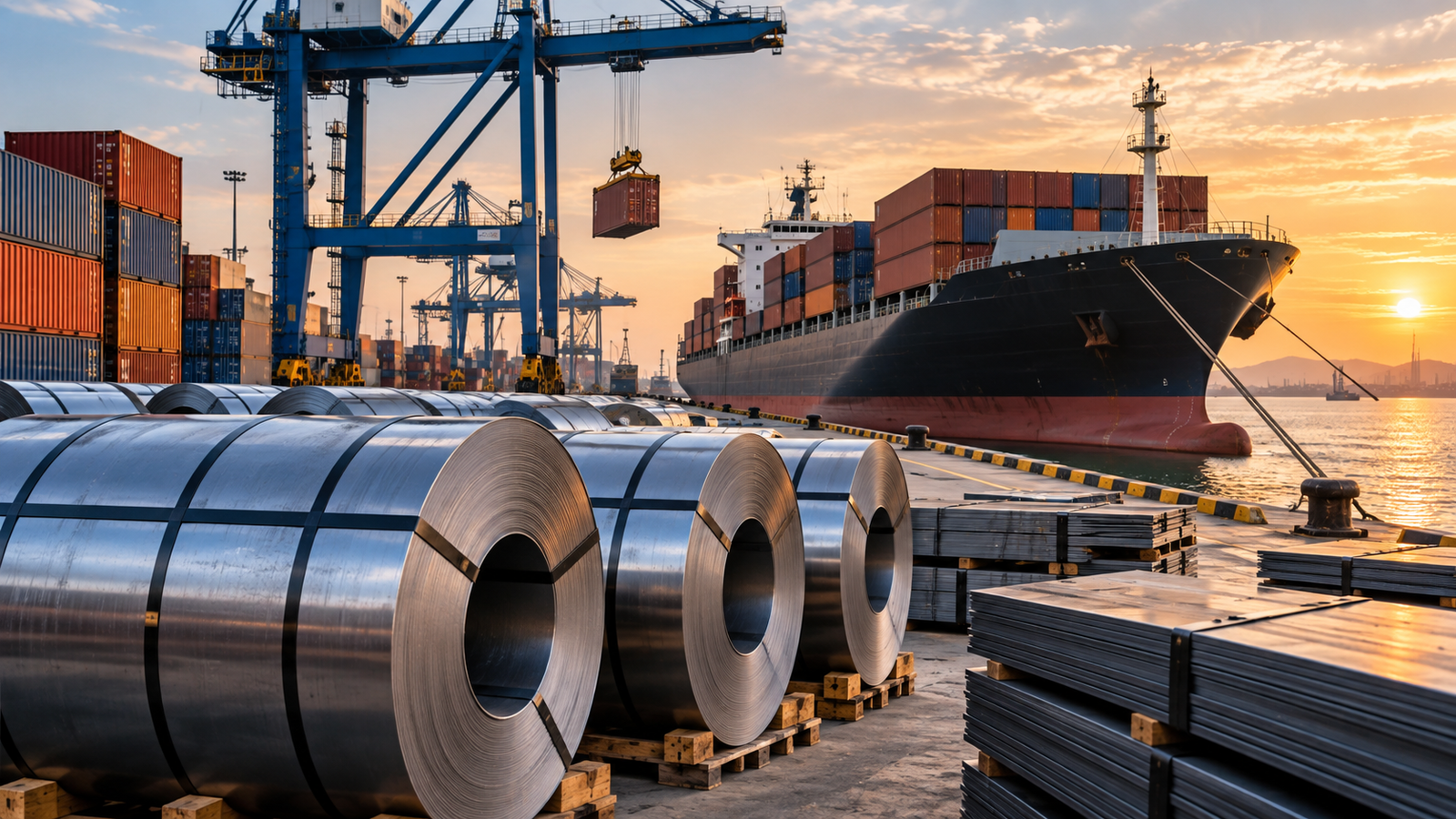
Steel exporters increasingly operate in a world where market access is determined not only by steel prices, freight costs and product specifications, but also by the architecture of regional trade agreements.
A shipment that appears commercially competitive at the mill gate can become unattractive after tariffs, trade-remedy duties, origin requirements, customs procedures, carbon costs and compliance obligations are incorporated into the landed cost.
At the same time, two exporters offering technically equivalent steel may face very different market-access conditions simply because their products originate in different countries.
For procurement teams, traders, service centers and steel producers, this changes the commercial question.
The objective is no longer simply to identify the lowest FOB price.
The more important question is:
Which combination of origin, tariff treatment, trade agreement, logistics route, regulatory compliance and product specification produces the most competitive risk-adjusted landed cost?
Regional trade agreements can provide significant advantages, but those advantages are conditional.
Preferential tariffs normally depend on compliance with specific rules of origin. Steel may also remain exposed to anti-dumping measures, safeguards, quotas, technical regulations or carbon-related requirements even where preferential trade arrangements exist.
In 2026, these issues have become even more important as governments seek to strengthen regional supply chains, increase traceability and reduce circumvention of trade measures.
This article develops a practical framework for evaluating how regional trade agreements affect steel export opportunities.
1. Why Regional Trade Agreements Matter to Steel
Steel is one of the most internationally traded industrial materials, but it is also one of the most politically sensitive.
Governments frequently intervene in steel markets through:
- import tariffs;
- anti-dumping duties;
- countervailing measures;
- safeguards;
- tariff-rate quotas;
- local-content requirements;
- rules of origin;
- technical standards;
- environmental requirements;
- customs controls; and
- government procurement policies.
Regional trade agreements operate inside this broader policy environment.
Their primary commercial value is that they can create preferential conditions between participating economies.
Those conditions may include lower customs duties, simplified origin procedures, improved customs cooperation and more predictable market-access rules.
But preferential access should never be confused with unrestricted access.
For steel exporters, the agreement is only one layer of the market-access analysis.
2. What Is a Regional Trade Agreement?
A regional trade agreement establishes preferential trade conditions between two or more economies.
The arrangement may take different forms, including:
- free trade agreements;
- customs unions;
- economic partnership agreements;
- preferential trade agreements; or
- broader regional integration frameworks.
The precise legal structure matters because different agreements create different rights and obligations.
Some primarily reduce tariffs.
Others also address:
- rules of origin;
- customs procedures;
- technical barriers to trade;
- investment;
- government procurement;
- services;
- intellectual property;
- sustainability; and
- dispute settlement.
From a steel-export perspective, however, four questions are particularly important:
- What is the normal tariff applicable to the product?
- Is a preferential tariff available under the agreement?
- Does the steel qualify as originating?
- Are there other measures that remain applicable despite the preference?
This distinction is fundamental.
A trade agreement does not automatically make every shipment between member countries duty-free.
3. The Commercial Logic of Preferential Tariffs
Consider two potential suppliers of the same steel product.
| Supplier | Customs treatment | FOB price | Commercial implication |
|---|---|---|---|
| Supplier A | Preferential origin | Higher | May remain competitive after importation |
| Supplier B | Non-preferential origin | Lower | Tariff may eliminate FOB advantage |
The correct comparison is therefore not simply:
FOB A versus FOB B
but rather:
Total landed cost A versus total landed cost B
A simplified landed-cost structure can include:
FOB price + ocean freight + insurance + customs duty + trade-remedy duties + port charges + inland freight + financing + compliance costs + inventory carrying cost
Regional agreements can change one or several components of this equation.
That is why origin itself can become an economic variable.
4. Rules of Origin: The Critical Qualification Test
Preferential tariffs are normally available only for goods that satisfy the agreement’s rules of origin.
Rules of origin determine the economic nationality of a product.
This is particularly important in steel because supply chains may involve several countries.
For example:
- iron ore may originate in one country;
- slabs may be produced in another;
- hot-rolled coil may be rolled elsewhere;
- galvanizing may occur in a fourth country; and
- final processing may occur near the customer.
The location of the final commercial operation does not necessarily determine preferential origin.
Depending on the agreement and product, origin may be determined through criteria such as:
- wholly obtained or produced requirements;
- tariff classification changes;
- regional value content;
- specific production processes;
- product-specific rules;
- cumulation provisions; or
- combinations of these criteria.
The WTO’s database of regional trade agreements itself identifies mechanisms including change-of-tariff-classification criteria, regional-value-content criteria, de minimis rules and cumulation provisions across different agreements.
5. Why Simple Processing May Not Confer Origin
One of the most dangerous assumptions in international steel trade is that performing some processing in a member country automatically creates preferential origin.
It may not.
Operations such as:
- cutting;
- slitting;
- packaging;
- labeling;
- warehousing;
- sorting; or
- other limited transformations
must be assessed against the specific origin rule applicable to the HS classification of the product.
A steel coil imported from outside a preferential region does not automatically become originating merely because it was slit or repacked inside that region.
Similarly, routing non-originating steel through an agreement member normally does not transform it into preferential-origin steel.
This distinction is essential for both exporters and importers.
6. Documentation Is Part of the Product
In international steel transactions, origin cannot be treated as an administrative issue that is addressed after production.
Origin documentation must be supported by the underlying supply chain.
Depending on the agreement, evidence may involve:
- certificates of origin;
- origin declarations;
- supplier declarations;
- production records;
- bills of materials;
- invoices;
- mill test certificates;
- heat numbers;
- manufacturing records; and
- customs documentation.
For high-risk steel transactions, traceability should connect the commercial invoice to the physical material.
A strong system may link:
Purchase order → production order → heat/coil → MTC → invoice → transport document → proof of origin
The stronger this chain is, the easier it becomes to defend preferential treatment during a customs verification.
7. MERCOSUR: A Relevant Case for Steel Trade
MERCOSUR provides an important example of how regional origin rules affect industrial trade.
Its current Regime of Origin was established under CMC Decision No. 05/2023 and entered into force on July 18, 2024.
The revised regime introduced product-specific origin requirements across the tariff universe and modernized several procedures, including provisions concerning proof of origin and verification.
This is particularly relevant for steel because simply purchasing or processing imported material within a member state does not necessarily establish MERCOSUR origin.
When non-originating materials are used, the product must satisfy the applicable specific origin requirement.
Therefore, companies trading steel within MERCOSUR should verify origin at the specific NCM/product level rather than assuming eligibility based on the country of shipment.
8. MERCOSUR Origin Modernization
The new regime also introduced greater flexibility in proof-of-origin procedures.
MERCOSUR officially recognizes the Certificate of Origin and provides for an Origin Declaration/self-certification mechanism subject to implementation conditions by member states.
For exporters, this modernization can reduce administrative friction.
But simplification does not eliminate responsibility.
Self-certification makes internal origin controls even more important because the exporter may become directly responsible for supporting the origin declaration.
Companies should therefore maintain auditable evidence before claiming preferential treatment.
9. EU–MERCOSUR Changes the 2026 Trade Landscape
One of the most important developments for regional trade in 2026 is the EU–MERCOSUR relationship.
The European Union and MERCOSUR signed the Partnership Agreement and the Interim Trade Agreement on January 17, 2026.
The Interim Trade Agreement has been provisionally applied since May 1, 2026.
This creates a new strategic dimension for companies operating between Europe and Argentina, Brazil, Paraguay and Uruguay.
The agreement addresses areas including:
- tariffs;
- rules of origin;
- customs and trade facilitation;
- technical barriers to trade;
- government procurement; and
- sustainable development.
However, exporters should not interpret the agreement as an immediate universal elimination of duties.
Tariff treatment depends on the product and the applicable liberalization schedule.
For steel companies, the correct approach is therefore product-specific analysis.
10. The European Union: Tariff Preference Is Only Part of Market Access
The EU demonstrates why tariff analysis alone is increasingly insufficient.
Steel entering the European market may be affected by:
- customs tariffs;
- preferential origin rules;
- trade-defense measures;
- technical standards;
- sanctions or trade restrictions;
- safeguard mechanisms; and
- carbon-related requirements.
In 2026, the Carbon Border Adjustment Mechanism adds another important layer.
The definitive CBAM regime began on January 1, 2026, and iron and steel are among the sectors covered.
Consequently, an exporter may satisfy preferential origin requirements and still face separate CBAM obligations.
This illustrates an important principle:
Preferential tariff treatment does not eliminate regulatory compliance.
11. CBAM Changes the Meaning of Competitiveness
Historically, steel export competitiveness was often modeled primarily through:
- mill conversion cost;
- raw-material cost;
- energy cost;
- exchange rate;
- freight; and
- customs duties.
For certain EU-bound steel products, embedded emissions now form part of the market-access equation.
CBAM requires a carbon price to be associated with embedded emissions in covered imports, subject to the mechanism’s rules.
As a result, two mills producing the same grade at similar FOB prices may have different effective competitiveness in the European market.
The sourcing decision increasingly becomes:
Price + logistics + tariff + trade defense + carbon + compliance
rather than simply:
Price + freight
This is a structural change in steel trade economics.
12. USMCA and North American Steel Supply Chains
The United States–Mexico–Canada Agreement illustrates another form of regional industrial integration.
The USMCA contains particularly significant automotive rules of origin.
Passenger vehicles and light trucks must meet a 75% regional value-content requirement, while vehicle producers also face specific North American steel and aluminum purchasing requirements. USTR documentation states that at least 70% of relevant steel and aluminum purchases must originate in North America.
These rules affect steel demand indirectly by encouraging regional sourcing for automotive supply chains.
The commercial opportunity is therefore broader than simply exporting steel across a tariff-free border.
It can influence:
- mill location;
- automotive steel sourcing;
- service-center investment;
- processing capacity;
- inventory positioning; and
- supplier qualification.
13. USMCA Is Also a Moving Policy Environment
Trade agreements should never be treated as static documents.
In 2026, the USMCA is undergoing its joint review process.
Recent negotiations between the United States and Mexico have explicitly included automotive rules of origin, steel and aluminum, supply-chain resilience and economic security.
For steel companies, this means that long-term sourcing strategies should not rely only on today’s tariff schedule.
They should also monitor:
- proposed rule changes;
- origin enforcement;
- anti-circumvention policy;
- local-content requirements;
- trade-remedy actions; and
- broader industrial policy.
Policy risk should be incorporated into sourcing decisions before contracts are signed.
14. ASEAN and the Importance of Product-Specific Rules
Southeast Asia is another important steel-trade region.
Under ASEAN trade arrangements, rules of origin are supported by product-specific rules and formal proof-of-origin mechanisms.
ASEAN documentation includes the ATIGA Rules of Origin framework, Product Specific Rules and Certificate of Origin Form D, together with ASEAN-wide self-certification mechanisms.
This matters because ASEAN contains both major steel-producing economies and rapidly growing steel-consuming markets.
Regional integration can therefore influence:
- raw-material flows;
- flat-steel sourcing;
- processing investment;
- automotive supply chains;
- construction steel trade; and
- distribution strategies.
But again, tariff preference depends on actual origin qualification.
15. RCEP and Asian Supply-Chain Integration
The Regional Comprehensive Economic Partnership adds another layer to Asian trade architecture.
RCEP links major economies across Asia-Pacific and provides a framework for tariff commitments and rules of origin.
Its strategic importance is not simply the size of the agreement.
The more significant supply-chain feature is the potential for regional production networks to operate under a common origin framework.
For steel-intensive manufacturing, this can affect sourcing decisions for:
- automotive components;
- machinery;
- appliances;
- fabricated steel products; and
- industrial equipment.
Exporters should nevertheless evaluate the specific tariff line, origin rule and implementation schedule rather than assuming that all steel trade within RCEP receives identical treatment.
16. AfCFTA and the Development of African Regional Value Chains
The African Continental Free Trade Area represents a major long-term attempt to integrate African markets.
For steel, the potential significance is substantial.
African industrialization requires large volumes of:
- structural steel;
- rebar;
- flat products;
- coated steel;
- pipes and tubes;
- rails; and
- fabricated steel products.
Regional trade integration can support larger supply chains linking mining, steel production, fabrication, construction and infrastructure.
However, market opportunity should not be evaluated from tariff policy alone.
Exporters must also consider:
- port infrastructure;
- inland logistics;
- foreign-exchange availability;
- payment risk;
- local standards;
- project financing;
- customs capacity; and
- country-specific trade measures.
A high-growth market is not automatically a low-risk market.
17. Preferential Tariffs Do Not Override Trade Remedies
This point deserves particular emphasis.
A regional trade agreement and a trade-remedy measure operate under different legal mechanisms.
Depending on the jurisdiction and measure, steel may still be subject to:
- anti-dumping duties;
- countervailing duties;
- safeguards;
- quotas;
- surveillance mechanisms; or
- other restrictions.
Therefore, the following assumption is dangerous:
“The exporting country has a trade agreement with the importing country, so the steel is duty-free.”
A proper analysis asks two separate questions:
Question 1 — Does the product qualify for preferential customs treatment?
Question 2 — Are any additional trade-defense or regulatory measures applicable?
Both must be answered before the landed cost is finalized.
18. Anti-Circumvention Risk
Steel trade is especially sensitive to origin manipulation.
Authorities increasingly examine whether processing in an intermediate country represents genuine manufacturing or an attempt to circumvent trade measures.
Potential warning signs include:
- sudden changes in trade flows;
- minimal processing;
- unexplained changes in declared origin;
- mismatches between mill certificates and commercial documents;
- unusual transshipment patterns; and
- sourcing structures created immediately after trade measures are imposed.
For buyers, origin risk is therefore supplier risk.
An unexpectedly low quotation may create substantial downstream exposure if the declared origin cannot be supported.
19. Origin and Mill Identity Are Different Concepts
Steel buyers should distinguish between:
- country of shipment;
- seller location;
- trader location;
- processing country;
- mill location; and
- preferential origin.
These are not necessarily the same.
For example, a trading company located in Country A may sell steel manufactured in Country B, processed in Country C and shipped from Country D.
The commercial invoice alone does not resolve the origin question.
A robust procurement process should identify:
- actual steel mill;
- melt/cast location where relevant;
- rolling location;
- coating or downstream processing location;
- applicable origin criterion;
- proof-of-origin documentation; and
- consistency with the MTC.
This becomes particularly important when trade-defense measures apply to specific origins.
20. Standards Are Not the Same as Origin Rules
Another common mistake is confusing product-standard compliance with preferential origin.
A coil produced to ASTM, EN or JIS specifications does not acquire the origin of the country or region associated with that standard.
For example:
- ASTM compliance does not make steel American;
- EN compliance does not make steel European;
- JIS compliance does not make steel Japanese.
Standards describe technical requirements.
Rules of origin determine economic nationality for customs purposes.
Both may be necessary for market access, but they answer completely different questions.
21. The Role of the Mill Test Certificate
The Mill Test Certificate is a critical technical document in steel trade.
It can provide information such as:
- heat number;
- grade;
- chemical composition;
- mechanical properties;
- dimensions;
- manufacturing standard; and
- producer identity.
However, an MTC should not automatically be treated as sufficient proof of preferential origin.
Origin qualification depends on the applicable trade agreement and customs rules.
The MTC is therefore best viewed as one element of a broader traceability system.
22. How Trade Agreements Affect Landed Cost
The commercial impact can be illustrated through a simplified example.
Assume two suppliers offer identical steel:
| Cost element | Supplier A | Supplier B |
|---|---|---|
| FOB price | $700/t | $680/t |
| Freight and insurance | $70/t | $70/t |
| Preferential tariff | 0% | Not eligible |
| Normal tariff | — | 8% |
| Indicative landed basis before local costs | $770/t | $804/t |
Supplier B appears cheaper at FOB level.
After tariff treatment, Supplier A becomes more competitive.
The example is intentionally simplified, but it demonstrates why procurement decisions based solely on FOB price can be misleading.
The same analysis can be expanded to include:
- anti-dumping duties;
- safeguard duties;
- CBAM;
- financing;
- port costs;
- inland freight;
- inventory carrying cost; and
- foreign-exchange risk.
23. The Value of Cumulation
Some regional agreements allow forms of cumulation.
Cumulation can permit originating inputs from one agreement partner to count toward origin requirements when incorporated into goods produced by another partner, subject to the agreement’s rules.
This can materially affect supply-chain design.
A manufacturer may be able to source eligible materials from several participating economies while preserving preferential status for the final product.
For steel-intensive manufacturing, cumulation can influence where companies locate:
- component production;
- stamping;
- fabrication;
- assembly;
- coating; and
- final manufacturing.
But the precise cumulation provisions must always be verified under the applicable agreement.
24. Regional Agreements and Steel Processing Centers
Service centers occupy an important position between steel mills and final users.
Typical operations include:
- slitting;
- cut-to-length;
- blanking;
- leveling;
- coating;
- profiling; and
- fabrication.
Regional agreements may influence where these operations are located.
However, companies should never assume that moving a processing step into a preferential region automatically creates origin.
Before investing in a regional processing operation, the company should determine whether the contemplated transformation satisfies the relevant product-specific rule.
This turns origin analysis into an investment-planning tool.
25. Strategic Sourcing Under Regional Agreements
A sophisticated sourcing strategy should evaluate suppliers across several dimensions simultaneously.
| Dimension | Key question |
|---|---|
| Technical | Does the material meet the specification? |
| Commercial | Is the mill price competitive? |
| Origin | Does the product qualify for preference? |
| Trade defense | Are AD/CVD/safeguards applicable? |
| Logistics | What are freight and transit risks? |
| Regulatory | What compliance requirements apply? |
| Carbon | Are carbon-related costs relevant? |
| Financial | What are FX, financing and payment risks? |
| Traceability | Can origin and mill identity be demonstrated? |
The lowest-cost supplier on one dimension may not be the optimal supplier overall.
26. Export Strategy: Start With the Destination Market
Exporters often begin with the question:
Where can we sell this steel?
A stronger approach is:
Where does our origin create a structural market-access advantage?
The analysis should begin with:
- HS classification;
- destination-country tariff;
- applicable trade agreements;
- preferential tariff;
- product-specific origin rule;
- trade-remedy exposure;
- technical requirements;
- logistics cost;
- carbon or sustainability requirements; and
- buyer qualification requirements.
Only then should the exporter compare market prices.
This prevents commercial teams from pursuing opportunities that disappear after import costs are calculated.
27. Procurement Strategy: Verify Origin Before Awarding the Order
Importers face the opposite risk.
A supplier may quote a preferential duty rate without fully understanding the applicable origin rule.
The importer should therefore verify origin eligibility before issuing the purchase order.
Useful questions include:
- Who is the actual steel mill?
- Where was the steel melted and cast?
- Where was it rolled?
- Where was it coated or processed?
- What HS code is being used?
- Which preferential agreement is being claimed?
- What product-specific origin rule applies?
- What proof of origin will be provided?
- Does the MTC identify the producing mill?
- Are any anti-dumping or safeguard measures applicable?
These questions should form part of supplier qualification.
28. Build an Origin Matrix
For companies importing or exporting multiple steel products, an origin matrix can substantially improve decision quality.
A practical structure is:
Table 1 — Product and Trade Structure
| Product | HS Code | Mill Country | Destination | Agreement |
|---|---|---|---|---|
| HRC | — | Country A | Market X | Agreement 1 |
| CRC | — | Country B | Market Y | Agreement 2 |
| Coated coil | — | Country C | Market Z | None |
Table 2 — Origin and Compliance Status
| Product | Preferential Tariff | Origin Rule | Trade Remedy | Documentation |
|---|---|---|---|---|
| HRC | — | Verify | Verify | Pending |
| CRC | — | Verify | Verify | Complete |
| Coated coil | MFN | N/A | Verify | Complete |
This matrix should be maintained as a living compliance document. Trade rules change.
A sourcing decision that was optimal last year may no longer be optimal today.
29. Scenario Analysis Is Better Than a Single Tariff Assumption
Long-term steel contracts should incorporate policy scenarios.
For example:
| Scenario | Trade assumption | Procurement response |
|---|---|---|
| Base | Current preferential treatment remains | Maintain sourcing |
| Upside | Additional tariff liberalization | Increase allocation |
| Downside | Preference removed or remedy imposed | Activate alternative origin |
| Severe downside | Trade restriction or logistics disruption | Diversify region and inventory |
This approach is especially useful for contracts lasting six months or more.
Trade policy can change faster than industrial supply chains.
30. Supplier Diversification by Origin
Traditional supplier diversification often means buying from multiple mills.
That may not be enough.
If all suppliers are located in the same country, they may share the same trade-policy exposure.
A more resilient model diversifies by:
- supplier;
- mill;
- country of origin;
- trade bloc;
- shipping route; and
- currency.
This creates origin diversification.
For international steel buyers, origin diversification can be as important as supplier diversification.
31. When a Regional Strategy Creates Competitive Advantage
Regional trade agreements become strategically valuable when companies integrate them into commercial planning rather than treating them as customs paperwork.
The strongest advantages typically appear when:
- tariff differences are significant;
- products have high value per tonne;
- volumes are large;
- trade-remedy exposure differs by origin;
- logistics within the region are efficient;
- rules of origin can be reliably satisfied; and
- the customer values shorter or more predictable supply chains.
In those cases, regionalization can improve both margin and resilience.
32. When Regionalization Does Not Make Sense
Regional sourcing is not automatically superior.
A non-preferential supplier may still win when it offers:
- significantly lower production cost;
- better quality;
- superior technical capability;
- shorter lead time;
- better payment terms;
- larger available capacity; or
- lower logistics cost.
The decision must therefore remain economic.
Trade agreements change the cost structure; they do not replace commercial analysis.
33. A Practical Decision Framework for Steel Exporters
Before entering a new market, exporters can follow a ten-step process.
Step 1 — Classify the product correctly
Determine the appropriate HS code.
Step 2 — Identify the normal tariff
Establish the MFN or standard customs treatment.
Step 3 — Identify applicable trade agreements
Determine whether preferential access exists.
Step 4 — Check the product-specific rule of origin
Do not rely on general assumptions.
Step 5 — Validate the production route
Confirm that manufacturing actually satisfies the rule.
Step 6 — Verify proof-of-origin requirements
Determine who must issue or certify the documentation.
Step 7 — Screen trade remedies
Check anti-dumping, countervailing and safeguard exposure.
Step 8 — Check regulatory requirements
Include standards, environmental obligations and other import controls.
Step 9 — Calculate full landed cost
Model the complete commercial transaction.
Step 10 — Stress-test the strategy
Evaluate tariff, FX, freight and policy-change scenarios.
This process converts trade agreements from abstract legal instruments into commercial decision tools.
34. Common Errors in Steel Trade Agreement Analysis
Several mistakes repeatedly create avoidable risk.
Assuming member-country shipment equals preferential origin
It does not.
Assuming minor processing changes origin
It may not.
Confusing technical standards with customs origin
They are separate concepts.
Ignoring anti-dumping duties because an FTA exists
Preferential tariffs and trade remedies must be analyzed separately.
Relying only on the supplier’s declaration
Origin should be supported by auditable evidence.
Comparing suppliers only on FOB price
The correct comparison is landed cost.
Treating trade agreements as permanent
Tariffs, origin rules and enforcement practices evolve.
35. Frequently Asked Questions
Does a free trade agreement mean all steel is duty-free?
No. Preferential treatment depends on the agreement, tariff schedule, product classification, origin rules and implementation stage.
Can imported steel become originating after processing in an FTA country?
Potentially, but only if the processing satisfies the applicable rule of origin. Simple routing or limited processing may be insufficient.
Does an MTC prove preferential origin?
Not necessarily. It is valuable technical and traceability evidence, but customs origin must satisfy the relevant legal requirements.
Can preferential steel still be subject to anti-dumping duties?
Potentially yes. Trade-remedy exposure must be assessed separately from preferential tariff eligibility.
Does compliance with EN standards give EU origin?
No. Technical-standard compliance and customs origin are different issues.
Is the lowest FOB offer normally the best sourcing option?
Not necessarily. The appropriate comparison is total risk-adjusted landed cost.
Why is CBAM important to steel exporters in 2026?
Because the EU’s definitive CBAM regime has applied since January 1, 2026, and iron and steel are among the covered sectors.
36. Final Perspective
Regional trade agreements are becoming increasingly important to the economics of international steel trade.
But their value does not come simply from the existence of an FTA.
Competitive advantage emerges when companies understand how tariff treatment, rules of origin, trade remedies, technical requirements, carbon regulation and logistics interact.
For exporters, origin can determine whether a market is commercially accessible.
For importers, origin can determine whether an apparently attractive quotation remains competitive after customs clearance.
For producers, origin rules can influence where capacity and downstream processing should be located.
And for procurement teams, regional agreements can reshape the entire supplier portfolio.
The strategic principle is straightforward:
Do not optimize steel sourcing around mill price alone. Optimize around compliant, risk-adjusted landed cost and sustainable market access.
In an increasingly fragmented steel market, understanding origin is no longer merely a customs function.
It is part of commercial strategy.
Technical References
European Commission — EU–Mercosur: Text of the Agreement
Official documentation on the EU–Mercosur Partnership Agreement and Interim Trade Agreement, including their 2026 implementation status.
European Commission — CBAM Definitive Regime
Official information on the definitive Carbon Border Adjustment Mechanism applicable from January 1, 2026, including iron and steel.
MERCOSUR — New MERCOSUR Origin Regime
Official overview of the Regime of Origin established by CMC Decision No. 05/2023 and effective since July 18, 2024.
MERCOSUR — Regime of Origin, Decision CMC No. 05/2023
Official consolidated rules defining when products qualify as originating within MERCOSUR.
USTR — USMCA Automotive Rules of Origin
Official U.S. documentation covering regional value-content and North American steel and aluminum requirements under USMCA.
ASEAN — Rules of Origin
Official ASEAN material covering ATIGA rules of origin, product-specific rules, Form D and origin-certification mechanisms.