
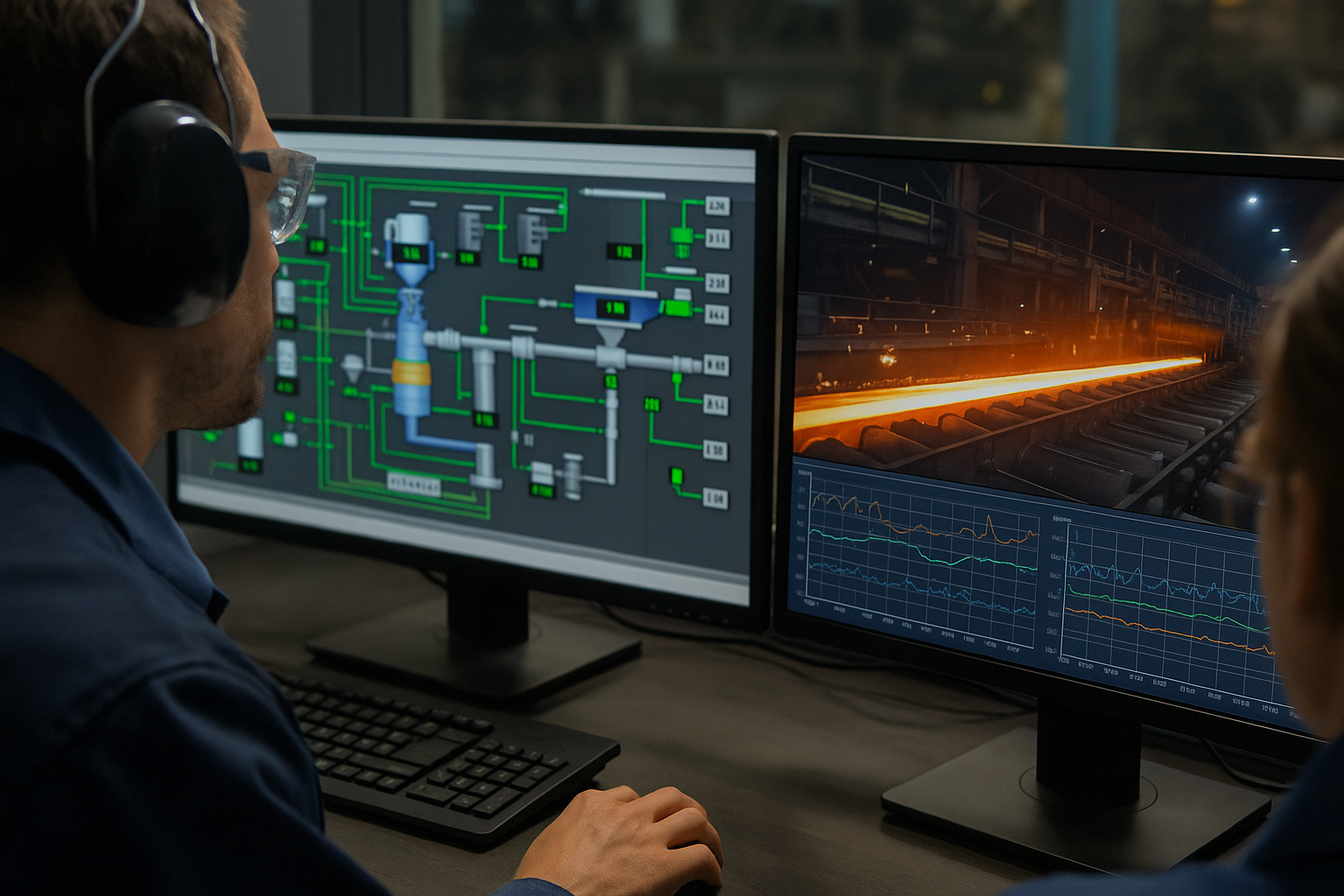
Steel plants depend on continuous visibility into processes that combine high temperatures, heavy mechanical loads, rotating equipment, material handling, electrical systems, hydraulic systems and complex production sequences.
Historically, much of that visibility was concentrated inside local control rooms or obtained through physical inspections in the field.
Modern industrial networks have changed this model.
Process variables, alarms, equipment conditions, production information and diagnostic data can increasingly be accessed from centralized control rooms, engineering stations, maintenance centers and, under controlled conditions, locations outside the plant.
This creates significant operational opportunities.
Specialists can support troubleshooting without being physically beside the equipment. Maintenance teams can review equipment condition before entering hazardous areas. Multiple production units can be supervised from centralized operations centers. OEMs can provide technical assistance without always traveling to the plant.
But remote connectivity also creates a fundamental engineering problem:
The ability to access industrial information remotely does not automatically justify the ability to control the industrial process remotely.
A steel plant must distinguish between:
Remote Visibility → Remote Diagnosis → Remote Engineering Access → Remote Control
Each step introduces different operational, cybersecurity and safety consequences.
The objective of remote monitoring is therefore not simply to connect more equipment to more users.
It is to deliver the right operational information to authorized people, at the right time and with the right level of control authority, without compromising process safety, equipment reliability or operational technology security.
1. What Is Remote Monitoring in a Steel Plant?
Remote monitoring is the ability to observe industrial processes, equipment conditions, alarms and operational information from a location physically separated from the monitored asset or process.
The remote location may be:
- another room within the same production facility;
- a centralized control room;
- a maintenance office;
- an engineering center;
- another plant within the same company;
- a corporate operations center;
- an authorized external service location.
The physical distance is less important than the architecture through which information is accessed.
Remote monitoring may include information such as:
- temperature;
- pressure;
- flow;
- vibration;
- electrical variables;
- motor status;
- valve position;
- equipment operating state;
- alarms;
- production rate;
- process trends;
- equipment diagnostics;
- energy consumption;
- maintenance indicators.
But monitoring is fundamentally an information function.
It should not automatically be confused with remote control.
2. Remote Monitoring Is Not the Same as Remote Control
This distinction is central to industrial system design.
Remote Monitoring
The user can observe information but cannot directly modify the physical process.
Typical functions include:
- viewing dashboards;
- reviewing trends;
- acknowledging information where appropriate;
- analyzing alarms;
- accessing equipment diagnostics;
- reviewing historical data.
Remote Advisory Access
A remote specialist can analyze information and recommend actions to local operators.
Typical logic:
Remote Diagnosis → Recommendation → Local Verification → Local Action
Remote Engineering Access
Authorized personnel may access engineering systems for activities such as:
- diagnostics;
- configuration review;
- software maintenance;
- approved engineering changes.
This level requires substantially stronger controls than simple monitoring.
Remote Control
The remote user can cause physical process changes.
Examples include:
- changing setpoints;
- starting equipment;
- stopping equipment;
- opening or closing valves;
- changing operating modes;
- modifying controller logic.
These actions can directly affect machinery, production and personnel.
Therefore:
Remote visibility does not automatically justify remote control.
The control authority must be explicitly engineered.
3. Why Steel Plants Benefit From Remote Monitoring
Steel manufacturing combines large physical areas with highly interconnected operations.
Examples include:
- raw-material handling;
- coke and sinter operations;
- ironmaking;
- steelmaking;
- continuous casting;
- reheating furnaces;
- hot rolling;
- cold rolling;
- coating;
- finishing;
- utilities;
- water treatment;
- power distribution.
Equipment may be separated by hundreds of meters or several kilometers.
Remote monitoring allows information from distributed assets to be consolidated into operational environments where specialists can interpret it more efficiently.
Potential benefits include:
- faster detection of abnormal conditions;
- better operational visibility;
- centralized supervision;
- improved troubleshooting;
- reduced unnecessary field exposure;
- more efficient use of specialists;
- improved coordination between operations and maintenance;
- better access to historical information;
- faster escalation of technical problems.
The value comes from better information flow, not merely from connectivity itself.
4. The Architecture Behind Remote Monitoring
A simplified industrial monitoring architecture may be represented as:
Physical Process → Sensors / Instruments → PLC or DCS → HMI / SCADA → Historian → Monitoring Applications → Authorized Remote Users
Each layer performs a different function.
Physical Process
The equipment, material and process being monitored.
Sensors and Instruments
Convert physical conditions into usable signals.
PLC or DCS
Processes signals and performs control logic.
HMI / SCADA
Provides operational visualization and supervisory functions.
Historian
Stores time-series process information.
Monitoring Applications
Provide dashboards, analytics, reporting or specialized diagnostics.
Remote Access Layer
Controls how authorized users reach permitted resources.
The remote user should not automatically receive direct network access to every layer.
A well-designed architecture determines which information is exposed, through which path, and with what privileges.
5. Remote Monitoring Builds on Real-Time Data Infrastructure
Remote monitoring depends on reliable industrial data.
Before information can be viewed remotely, it must first be:
- measured;
- acquired;
- timestamped;
- contextualized;
- transmitted;
- stored where necessary;
- presented meaningfully.
This relationship is important.
The engineering foundations of acquisition, SCADA, historians, MES, latency and data contextualization are addressed in Real-Time Data Monitoring in Steel Plants: From Sensors to Operational Decisions.
Remote monitoring begins where that article largely ends:
How should that operational information be made available beyond its original local environment?
This is the editorial boundary between the two subjects.
6. Smart Sensors Are the Physical Foundation
Remote monitoring is only as reliable as the measurements feeding it.
Sensors may monitor:
- temperature;
- pressure;
- position;
- speed;
- vibration;
- current;
- voltage;
- flow;
- level;
- force;
- dimensional variables.
A sophisticated remote dashboard cannot compensate for poor measurement quality.
Sensor selection, installation, calibration, environmental suitability and signal integrity remain fundamental.
For a deeper discussion of instrumentation, see How Smart Sensors Are Enhancing Process Control in Steel Plants.
7. Local Control Must Remain a Deliberate Design Decision
Remote monitoring should not undermine local operational authority.
A useful design principle is:
The closer an action is to changing the physical process, the stronger the justification and controls required for remote execution.
A remote engineer viewing a motor-current trend presents a very different risk from the same engineer being able to start that motor.
Control authority should therefore consider:
- personnel location;
- machine state;
- operating mode;
- interlocks;
- permissives;
- communication status;
- local awareness;
- emergency conditions.
Remote access architecture must respect the physical reality of the plant.
8. Read-Only Access Can Reduce Risk
Many remote-monitoring objectives can be achieved without allowing process modification.
Read-only access may support:
- production supervision;
- performance analysis;
- alarm review;
- engineering diagnosis;
- maintenance preparation;
- management reporting.
This can reduce the consequences associated with unauthorized or accidental commands.
Read-only does not eliminate cybersecurity risk because sensitive information and system access still require protection.
But it creates an important separation between:
seeing the process and changing the process.
9. Centralized Operations Centers
Large industrial organizations may consolidate monitoring functions into centralized operations centers.
These environments can combine information from:
- multiple production lines;
- utilities;
- energy systems;
- maintenance systems;
- quality systems;
- multiple plants.
Potential advantages include:
- consolidated expertise;
- standardized monitoring;
- faster escalation;
- cross-site comparison;
- improved specialist utilization.
But centralization can also create dependencies.
If many operational decisions depend on a centralized facility or communication path, resilience becomes essential.
The architecture must consider what happens if the central center becomes unavailable.
10. Remote Monitoring for Maintenance
Maintenance teams can use remote information to determine whether field intervention is necessary and what preparation may be required.
Examples include:
- reviewing vibration trends;
- checking temperatures;
- analyzing motor currents;
- reviewing alarm history;
- examining operating states;
- comparing conditions before and after an event.
This can improve maintenance preparation.
But remote monitoring should not be confused with predictive maintenance.
Predictive maintenance uses condition and degradation information to support maintenance timing and prognostic decisions.
Remote monitoring defines where information can be accessed and supervised.
For the maintenance decision framework itself, see Predictive Maintenance in Steel Plants: A Practical Engineering Guide to Equipment Reliability.
11. Remote Monitoring Can Reduce Unnecessary Field Exposure
Steel plants contain environments where personnel exposure should be minimized where reasonably practicable.
Potential hazards may include:
- heat;
- moving equipment;
- molten material;
- high voltage;
- confined areas;
- elevated locations;
- dust;
- noise;
- rotating machinery.
If a condition can be verified remotely with sufficient reliability, some physical inspections may become unnecessary or less frequent.
Examples may include:
- temperature observation;
- equipment-status confirmation;
- remote camera inspection;
- thermal imaging;
- process trend analysis.
The safety benefit comes from avoiding unnecessary exposure, not from eliminating field work indiscriminately.
12. Remote Monitoring Does Not Replace Physical Verification
Not every equipment condition can be represented adequately by digital information.
Physical inspection may still be necessary for:
- structural damage;
- leakage;
- unusual sound;
- odor;
- contamination;
- housekeeping;
- mechanical looseness;
- physical guarding;
- local environmental conditions.
The correct question is not:
“Can we eliminate inspection rounds?”
It is:
“Which observations can be performed remotely with sufficient reliability, and which still require physical verification?”
Remote monitoring should complement field knowledge rather than disconnect operators from the physical process.
13. Cameras and Thermal Monitoring
Visual monitoring can extend operational visibility.
Industrial cameras may support:
- material-flow observation;
- equipment movement verification;
- restricted-area monitoring;
- process observation.
Thermal systems can help identify:
- abnormal heating;
- refractory-related temperature patterns;
- electrical hot spots;
- thermal asymmetry.
However, cameras are sensors too.
Their limitations include:
- field of view;
- resolution;
- contamination;
- lighting;
- thermal reflections;
- environmental protection;
- network availability.
Remote visual information must therefore be interpreted within its technical limitations.
14. Alarm Management Becomes More Important Remotely
Remote operators and specialists may have access to large numbers of alarms from multiple systems.
This creates the risk of:
- alarm flooding;
- duplicate alarms;
- nuisance alarms;
- poor prioritization;
- information overload.
A remote-monitoring environment should not simply transmit every available alarm to every user.
Alarms should be:
- relevant;
- prioritized;
- actionable;
- contextualized.
The objective is not maximum notification.
It is effective abnormal-condition awareness.
15. Dashboards Must Support Decisions
A remote dashboard should answer operational questions.
Examples:
- Which asset requires attention?
- What changed?
- When did it change?
- Is the condition worsening?
- What production state was active?
- Which alarm occurred first?
- Is local intervention required?
A dashboard overloaded with gauges and charts may appear sophisticated while providing little decision value.
Remote visualization should therefore prioritize:
Situation → Deviation → Context → Action
16. Historical Context Is Essential for Remote Diagnosis
A single current value may be misleading.
Consider a bearing temperature of 75°C.
Without context, the number alone may not indicate whether the condition is normal.
Useful context may include:
- previous temperature;
- load;
- speed;
- ambient conditions;
- production state;
- alarm history;
- similar assets.
Historians therefore play an important role in remote troubleshooting because they allow specialists to reconstruct what happened before an abnormal condition.
17. Remote Troubleshooting Can Reduce Response Time
When abnormal conditions occur, specialists may not be physically located near the affected equipment.
Remote access to appropriate information can accelerate:
- initial diagnosis;
- failure classification;
- maintenance preparation;
- specialist escalation;
- spare-part identification;
- decision-making.
A remote specialist may help determine whether:
- production can continue;
- equipment should be inspected;
- maintenance should be prepared;
- an OEM should be contacted.
But remote diagnosis should remain within defined authority and competence boundaries.
18. OEM and Vendor Remote Support
Modern industrial equipment frequently includes specialized:
- drives;
- automation systems;
- measurement systems;
- control platforms;
- proprietary diagnostics.
External OEM or vendor expertise may therefore be valuable.
Remote support can reduce:
- travel delay;
- diagnostic time;
- dependency on on-site specialist availability.
But vendor access creates an external pathway toward the OT environment.
It must never be treated as an informal convenience.
19. Vendor Access Should Be Temporary and Controlled
A strong remote-access policy should avoid permanent unrestricted vendor connectivity.
Controls may include:
- explicit authorization;
- defined access window;
- named user;
- approved destination;
- minimum required privileges;
- authentication;
- session monitoring;
- logging;
- termination after work completion.
The principle is:
Access should exist because a defined task requires it—not simply because it might be convenient someday.
20. Remote Connectivity Changes the OT Attack Surface
Industrial control systems historically benefited from greater physical and logical separation.
Increasing connectivity changes this environment.
NIST notes that OT security must account for systems that interact directly with the physical environment and therefore have unique performance, reliability and safety requirements.
A cybersecurity event in OT may therefore affect more than information.
Potential consequences can include:
- process interruption;
- equipment damage;
- unsafe operating states;
- quality losses;
- production losses.
Remote monitoring architecture must be designed as an OT-security issue from the beginning.
21. IT Security and OT Security Are Related but Not Identical
Traditional IT security frequently prioritizes:
Confidentiality → Integrity → Availability
Industrial environments often place particularly strong emphasis on:
- availability;
- integrity;
- deterministic behavior;
- safety;
- operational continuity.
A security measure appropriate for an office environment may not automatically be appropriate for a running process-control system.
NIST SP 800-82 specifically addresses this distinction by providing OT security guidance while considering operational performance, reliability and safety requirements.
22. Network Segmentation Is Fundamental
Remote users should not normally receive unrestricted connectivity into the entire OT environment.
Network segmentation can help separate:
- enterprise IT;
- OT supervisory systems;
- control systems;
- safety-related systems;
- remote-access infrastructure.
The architecture should restrict communication to required paths.
A remote maintenance user needing access to a diagnostic server should not automatically gain access to unrelated PLCs.
Segmentation helps reduce the consequences of compromised credentials, devices or applications.
23. Defense in Depth
No single cybersecurity control is sufficient.
A remote-monitoring architecture should use multiple layers of protection.
These may include:
- segmentation;
- firewalls;
- authentication;
- authorization;
- secure remote-access infrastructure;
- logging;
- endpoint controls;
- monitoring;
- backups;
- incident-response procedures.
If one layer fails, other layers should continue reducing risk.
CISA includes defense-in-depth among its recommended practices for industrial control systems.
24. Authentication Answers “Who Are You?”
Remote access should be tied to identifiable users rather than generic shared accounts wherever practical.
Authentication mechanisms verify the claimed identity.
Strong authentication becomes particularly important because remote access removes some of the physical barriers associated with local access.
The authentication strategy should reflect the risk associated with the permitted functions.
25. Authorization Answers “What Are You Allowed to Do?”
Authentication alone is not enough.
An authenticated user should receive only the permissions necessary for the authorized task.
Different roles may require different privileges.
For example:
Production Manager
May need dashboards and KPIs.
Reliability Engineer
May need trends and diagnostic information.
Automation Engineer
May require controlled engineering access.
OEM Technician
May require temporary access to one specific system.
This is the principle of least privilege.
26. Multi-Factor Authentication Strengthens Remote Access
Remote access protected only by a password creates significant dependence on a single credential.
Multi-factor authentication can add another verification factor.
But MFA should be part of a broader architecture.
It does not replace:
- segmentation;
- authorization;
- endpoint security;
- logging;
- controlled access paths.
Cybersecurity controls should work together.
27. Jump Servers and Controlled Access Paths
Rather than allowing remote users to connect directly to control assets, organizations may use controlled intermediate systems such as jump servers or bastion hosts.
A simplified architecture may look like:
Remote User → Secure Access Gateway → Controlled Intermediate Environment → Authorized OT Resource
This creates a location where access can be:
- authenticated;
- restricted;
- monitored;
- logged.
The exact architecture depends on plant requirements and risk assessment.
28. VPN Is a Transport Mechanism, Not a Complete Security Strategy
Virtual Private Networks can provide encrypted remote connectivity.
But the existence of a VPN does not automatically make remote access secure.
Security still depends on:
- credentials;
- endpoint condition;
- VPN configuration;
- software vulnerabilities;
- authorization;
- segmentation;
- destination controls.
CISA has repeatedly emphasized that VPNs themselves may have vulnerabilities and that their security depends partly on the connected devices.
Therefore:
VPN ≠ Complete OT Remote-Access Security
29. Remote Endpoints Matter
A secure plant network can still be exposed through an insecure remote endpoint.
Potential endpoints include:
- engineering laptops;
- vendor computers;
- corporate devices;
- remote workstations.
Relevant controls may include:
- managed devices;
- software updates;
- malware protection;
- configuration control;
- approved applications;
- access restrictions.
Remote access security must consider both sides of the connection.
30. Session Logging Improves Accountability
Remote sessions may need to be recorded through logs containing information such as:
- user identity;
- connection time;
- destination;
- duration;
- actions where technically available.
This supports:
- troubleshooting;
- auditing;
- incident investigation;
- accountability.
High-risk engineering access may justify stronger session monitoring than ordinary read-only dashboard access.
31. Remote Engineering Changes Require Configuration Control
Remote engineering access may allow modification of:
- PLC programs;
- DCS configurations;
- drive parameters;
- HMI configurations;
- network settings.
These changes can affect the physical process.
Therefore, remote engineering should remain subject to normal management-of-change and configuration-control processes.
Remote connectivity should not become a shortcut around engineering governance.
32. Process Automation and Remote Access Must Remain Distinct
Process automation determines how equipment and processes respond automatically according to control logic.
Remote access determines how people or external systems reach information and functions from another location.
For a detailed treatment of automation, see How Process Automation Improves Quality and Consistency in Steel Production.
The distinction matters because cybersecurity architecture should not inadvertently create new uncontrolled paths into the automation layer.
33. Communication Failure Must Be Expected
Industrial networks can fail.
Possible causes include:
- switch failure;
- fiber damage;
- power loss;
- server failure;
- software failure;
- configuration error;
- cybersecurity incident.
Remote monitoring must therefore answer:
What happens when communication disappears?
The physical process should not depend on remote visibility in a way that creates an unsafe state when connectivity is lost.
34. Local Operations Must Have a Fallback
If a remote monitoring center becomes unavailable, the plant should know how operations continue.
Fallback may involve:
- local HMI;
- local control room;
- manual procedures;
- defined degraded operating modes;
- local alarm capability.
The appropriate arrangement depends on the process.
The general principle is:
Remote monitoring should improve resilience, not create a new single point of operational failure.
35. Fail-Safe Design Is a Physical Engineering Requirement
Cybersecurity cannot replace process safety.
Equipment must still rely on appropriate:
- interlocks;
- protective systems;
- emergency stops;
- permissives;
- safety systems;
- local procedures.
If a remote command is permitted, the underlying equipment protections must remain effective.
A remote user should not become the primary protective layer preventing hazardous physical behavior.
36. Remote Control Requires Stronger Governance Than Remote Monitoring
The risk changes significantly when the remote user can initiate physical action.
Before remote control is permitted, the plant should consider:
- who has authority;
- whether personnel are near the equipment;
- how local and remote control modes are indicated;
- how control ownership is transferred;
- what interlocks remain active;
- what happens during communication loss;
- how emergency intervention occurs;
- how commands are logged.
Remote control should therefore be an explicit engineering decision rather than a feature enabled because the technology makes it possible.
37. Human Factors Remain Critical
Remote operators may have less direct sensory information than personnel in the field.
They may not hear:
- abnormal mechanical noise;
- local alarms;
- equipment impact.
They may not see conditions outside camera coverage.
They may also monitor multiple assets simultaneously.
This can create:
- information overload;
- reduced situational awareness;
- excessive dependence on dashboards.
Human-machine interface design and operating procedures therefore remain important.
38. Remote Monitoring and Emergency Response
Remote monitoring can support emergency response by providing:
- process state;
- equipment status;
- alarm sequence;
- trend history;
- visual information.
But emergency authority must remain clearly defined.
The system should establish:
- who makes decisions;
- who has control authority;
- who communicates with field personnel;
- what happens if remote information conflicts with local observations.
Technology should support command structure, not create ambiguity.
39. Remote Monitoring and Asset Lifecycle Management
Remote connectivity should be considered throughout the equipment lifecycle.
Questions may arise during:
- specification;
- procurement;
- commissioning;
- operation;
- maintenance;
- modernization;
- replacement.
For example, a new machine may arrive with a vendor remote-access function enabled by default.
The plant should decide whether that function is:
- required;
- acceptable;
- properly secured;
- compatible with site architecture.
This connects remote monitoring with the broader framework discussed in Asset Lifecycle Management in Steel Plants: From Acquisition to Replacement.
40. Legacy Equipment Requires Special Attention
Steel plants often contain equipment from multiple generations.
Legacy control systems may have been designed before modern remote connectivity became common.
Potential limitations include:
- obsolete operating systems;
- unsupported software;
- weak authentication;
- limited logging;
- insecure protocols;
- restricted patching options.
Connecting legacy systems remotely without compensating controls can create disproportionate risk.
Modern connectivity should not be assumed to make legacy equipment secure.
41. Edge Computing Can Support Remote Monitoring
Edge systems can process information closer to the production environment.
Potential functions include:
- data aggregation;
- protocol conversion;
- filtering;
- local analytics;
- buffering during network interruptions.
This can reduce unnecessary traffic and support continued local functionality when higher-level connectivity is interrupted.
But edge devices themselves become part of the OT architecture and must be managed accordingly.
42. Cloud Connectivity Requires Explicit Risk Assessment
Some industrial monitoring applications may use cloud platforms for:
- dashboards;
- analytics;
- fleet comparison;
- long-term data processing.
Cloud use is not automatically good or bad.
The engineering question is:
Which data and functions should leave the plant environment, under what controls and for what operational purpose?
Considerations include:
- data sensitivity;
- availability requirements;
- latency;
- authentication;
- architecture;
- vendor dependency;
- incident response.
Critical control functions should not be moved simply because cloud connectivity is technically possible.
43. Remote Monitoring Can Support Multi-Site Expertise
A steel producer with several plants may not have every specialist permanently available at every location.
Remote monitoring can allow centralized experts to support:
- automation;
- drives;
- reliability;
- energy;
- process engineering.
This can improve specialist utilization.
But local operational competence remains essential.
Remote expertise should reinforce plant capability rather than create complete dependence on distant personnel.
44. Performance KPIs for Remote Monitoring
Useful indicators may include:
- abnormal-condition detection time;
- alarm response time;
- remote diagnostic resolution rate;
- avoided specialist travel;
- field inspections avoided where technically justified;
- remote-access incidents;
- unauthorized-access attempts;
- communication availability;
- remote-session failures.
The objective is to measure whether remote monitoring improves operational decisions and risk management.
Counting connected devices alone is not a performance metric.
45. Do Not Justify Remote Monitoring With Generic Savings Percentages
Remote monitoring benefits depend on:
- plant layout;
- automation maturity;
- specialist availability;
- existing control architecture;
- network infrastructure;
- equipment criticality;
- cybersecurity maturity.
A plant with centralized control and strong diagnostics may obtain different benefits from a plant with highly distributed legacy systems.
Claims such as “remote monitoring reduces costs by X%” should therefore be treated cautiously unless supported by a specific and comparable operating context.
The business case should be calculated from the plant’s own baseline.
46. A Practical Remote Monitoring Implementation Roadmap
Step 1 — Define the Operational Need
Identify the problem remote monitoring is intended to solve.
Step 2 — Identify Assets and Information
Determine which equipment and variables need remote visibility.
Step 3 — Classify Required Access
Separate:
- monitoring;
- advisory access;
- engineering access;
- control.
Step 4 — Assess Operational and Cybersecurity Risk
Evaluate consequences of unauthorized, incorrect or unavailable access.
Step 5 — Design Network Architecture
Define segmentation, access paths and boundaries.
Step 6 — Define Users and Roles
Establish who needs access and why.
Step 7 — Apply Least Privilege
Provide only the minimum required functionality.
Step 8 — Secure Remote Connections
Implement appropriate authentication, authorization and access infrastructure.
Step 9 — Establish Local Fallback
Define operation during communication or remote-system failure.
Step 10 — Test Before Deployment
Verify functionality, cybersecurity and operational behavior.
Step 11 — Train Users
Remote users and local operators must understand authority and procedures.
Step 12 — Monitor and Improve
Review access logs, incidents, operational benefits and architecture periodically.
47. Questions to Ask Before Enabling Remote Access
Before approving a remote connection, the plant should be able to answer:
Who needs access?
Why is the access necessary?
Which system must be reached?
Is read-only access sufficient?
How will the user authenticate?
Which privileges are required?
Is the access permanent or temporary?
How will the session be logged?
What happens if communication fails?
Can the remote user cause physical process changes?
Who retains local control authority?
If these questions do not have clear answers, the remote-access design is not mature enough.
48. Common Remote Monitoring Mistakes
Mistake 1 — Treating Monitoring and Control as the Same Thing
They have different risk profiles.
Mistake 2 — Giving Remote Users Excessive Privileges
Access should match the task.
Mistake 3 — Leaving Permanent Vendor Connections Open
Vendor access should be controlled and justified.
Mistake 4 — Assuming a VPN Solves Cybersecurity
A VPN is only one component.
Mistake 5 — Connecting Legacy Systems Without Risk Assessment
Older systems may lack modern security capabilities.
Mistake 6 — Ignoring Communication Failure
Remote services must have fallback strategies.
Mistake 7 — Replacing Physical Inspection Indiscriminately
Some conditions still require field observation.
Mistake 8 — Collecting Too Much Information
More data can increase complexity without improving decisions.
Mistake 9 — Ignoring Human Factors
Remote visibility can create information overload.
Mistake 10 — Allowing Technology to Define Control Authority
Operational authority must be established by engineering and procedures.
49. Remote Monitoring Maturity Model
Remote monitoring can evolve through several levels.
Level 1 — Local Visibility
Information is available only near the equipment or local control room.
Level 2 — Centralized Plant Visibility
Multiple systems feed a plant-level monitoring environment.
Level 3 — Remote Engineering Visibility
Authorized specialists can securely access diagnostic information from other locations.
Level 4 — Integrated Remote Operations
Information, alarms, maintenance and operational workflows are coordinated across locations.
Level 5 — Selective Remote Control
Specific remote-control functions are permitted under engineered authority, cybersecurity and safety controls.
The highest maturity level is not automatically the best target for every process.
A plant may intentionally stop at Level 3 or 4 because the additional risk of remote control is not justified.
Maturity means appropriate capability—not maximum connectivity.
50. Cybersecurity Must Be Part of Operational Resilience
Remote monitoring systems should be included in:
- cybersecurity risk assessments;
- incident-response plans;
- backup strategies;
- recovery procedures;
- configuration management.
This has become increasingly important as manufacturing OT becomes more interconnected with IT environments.
NIST’s manufacturing cybersecurity work emphasizes that cyber incidents affecting ICS can affect factory operations, safety and property, making response and recovery part of operational resilience rather than merely an IT issue.
51. The Future of Remote Steel Plant Operations
Remote industrial operations are likely to become more capable as plants deploy:
- better sensors;
- industrial wireless technologies;
- edge computing;
- advanced analytics;
- AI-assisted diagnostics;
- centralized operations centers;
- digital twins;
- secure remote engineering environments.
But technological capability should not determine operational authority.
The central engineering question will remain:
Which decisions can safely and reliably be made remotely, and which must remain local?
Plants that answer this question deliberately will obtain more value from connectivity than plants that simply maximize the number of connected systems.
52. Final Perspective
Remote monitoring can improve steel plant performance by extending operational visibility beyond the physical location of equipment and local control rooms.
It can help specialists diagnose problems faster, improve maintenance preparation, centralize expertise and reduce unnecessary personnel exposure to hazardous environments.
But connectivity changes risk.
The architecture must distinguish between:
Visibility → Diagnosis → Engineering Access → Control
As the ability to influence the physical process increases, requirements for authorization, cybersecurity, local coordination and safety must increase as well.
The strongest remote-monitoring strategy is therefore not the one that allows the greatest possible access.
It is the one that provides the minimum access necessary to support the required operational decision safely and reliably.
Remote monitoring should extend human visibility.
It should not weaken operational authority, cybersecurity or physical safeguards.
That is the difference between simply connecting a steel plant and engineering secure remote industrial operations.
Frequently Asked Questions
What is remote monitoring in a steel plant?
Remote monitoring allows authorized personnel to observe process variables, equipment conditions, alarms and operational information from a location physically separated from the monitored equipment or process.
What is the difference between remote monitoring and remote control?
Remote monitoring provides visibility into process or equipment information. Remote control allows a user to initiate actions that can change the physical process, such as modifying setpoints or starting and stopping equipment. Remote control therefore requires stronger operational, cybersecurity and safety controls.
Can remote monitoring improve worker safety?
Yes, when reliable remote information reduces the need for unnecessary exposure to hazardous environments. However, it does not eliminate physical inspections, local safeguards or established safety procedures.
Should remote monitoring systems have read-only access?
Read-only access is appropriate for many monitoring and diagnostic applications because users can obtain operational visibility without being able to modify the physical process. Higher privileges should be provided only when technically justified.
Can equipment vendors remotely access steel plant control systems?
They can where the plant explicitly authorizes and secures such access. Vendor access should be limited to required systems, users, privileges and time periods and should be monitored and logged according to the plant’s OT-security policy.
Is a VPN enough to secure industrial remote access?
No. A VPN can provide a secure communication mechanism, but remote-access security also requires authentication, authorization, network segmentation, endpoint security, access control, monitoring and appropriate system configuration.
What happens if the remote connection to a steel plant fails?
The system should have a defined fallback strategy. Critical physical processes should not depend on remote visibility in a way that creates unsafe operation when communication is lost. Local monitoring and control capabilities may therefore remain necessary.
Does remote monitoring replace SCADA?
No. SCADA may provide part of the supervisory and data infrastructure used by remote monitoring. Remote monitoring concerns how authorized users obtain appropriate visibility beyond the original local operational environment.
How does remote monitoring relate to predictive maintenance?
Remote monitoring determines how equipment and process information can be accessed from another location. Predictive maintenance uses condition, diagnostic and prognostic information to support maintenance decisions. The two can work together but are not synonymous.
What is the most important principle for remote industrial access?
Provide only the access necessary for the required task. Visibility, diagnostic access, engineering access and control authority should be treated as distinct levels with progressively stronger governance and protection.
Technical References
NIST — SP 800-82 Rev. 3: Guide to Operational Technology (OT) Security
Comprehensive guidance for securing operational technology while accounting for the performance, reliability and safety requirements that distinguish industrial systems from conventional IT.
NIST — SP 1800-10: Protecting Information and System Integrity in Industrial Control System Environments
Manufacturing-focused cybersecurity guidance covering industrial control system integrity, remote access, authentication, authorization and practical security architectures.
NIST NCCoE — Protecting Information and System Integrity in Industrial Control System Environments
Manufacturing cybersecurity project addressing the risks created by increased IT/OT connectivity and providing practical approaches for protecting industrial control environments.
CISA — ICS Recommended Practices
Official collection of industrial control system cybersecurity guidance, including defense-in-depth practices and resources addressing secure remote access to ICS environments.
CISA — Configuring and Managing Remote Access for Industrial Control Systems
Guidance specifically addressing the configuration and management of remote access connecting operators, vendors and other authorized parties to industrial control systems.
CISA — Guide to Securing Remote Access Software
Guidance addressing cybersecurity risks associated with remote administration and remote monitoring and management software used across IT and operational environments.
NIST — Responding to and Recovering from a Cyber Attack: Cybersecurity for the Manufacturing Sector (SP 1800-41)
2026 manufacturing cybersecurity work addressing incident response, recovery and operational resilience when cyber events affect industrial control and operational technology environments. This source is an initial public draft, not a final NIST publication.