
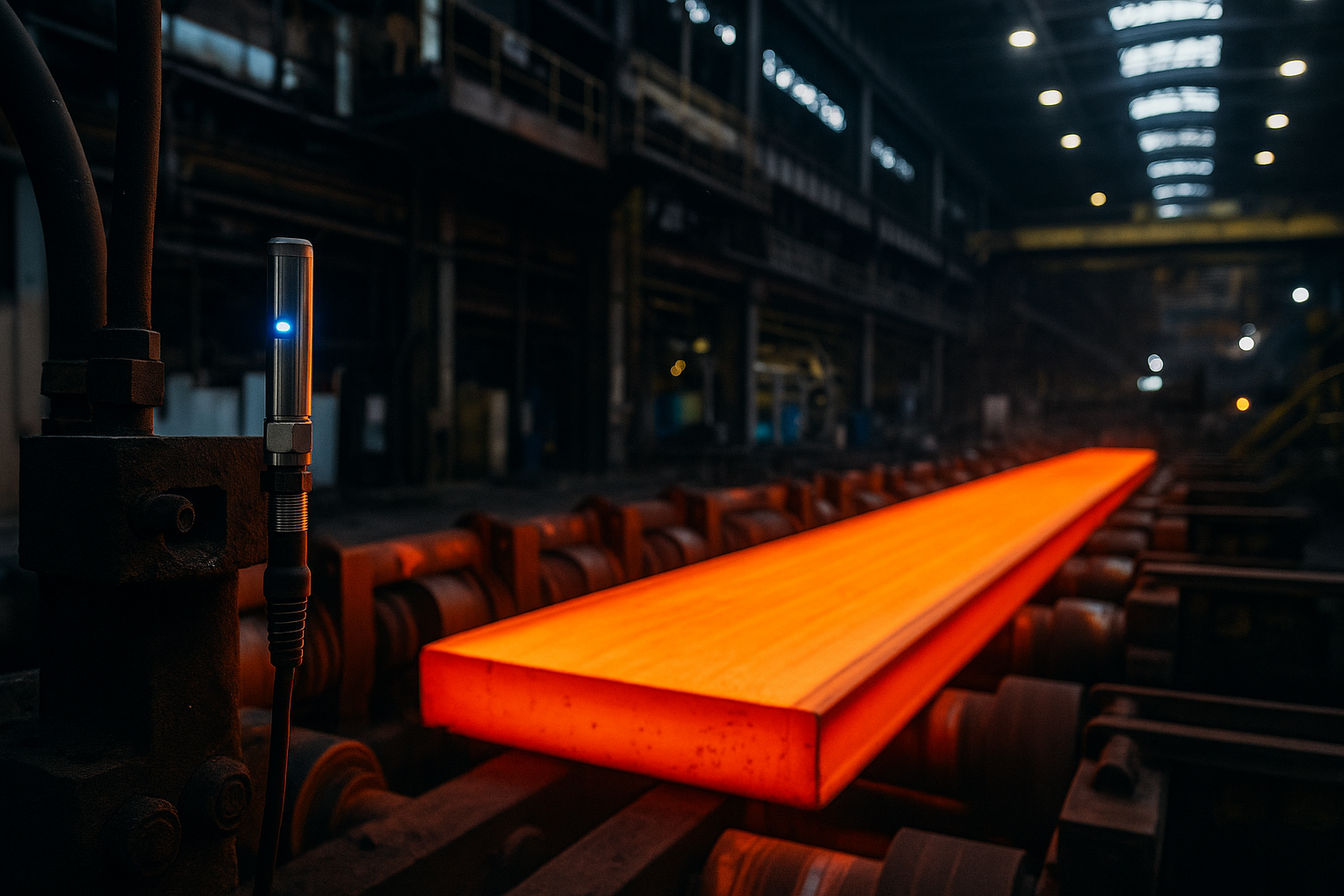
Steelmaking has always depended on measurement.
Temperature, pressure, flow, chemical composition, dimensional accuracy, rolling force and equipment condition have been measured in steel plants for decades. What is changing is not the need for measurement, but the speed, density, connectivity and intelligence of industrial sensing.
Modern steel plants can generate enormous volumes of process data. Smart sensors, machine vision systems, industrial networks, edge computing and advanced analytics are increasingly connecting physical production processes to digital control environments.
The result is an important shift:
Measurement is no longer used only to tell operators what happened. It is increasingly used to predict what is happening next — and, in some applications, to automatically influence the process before quality or reliability deteriorates.
This is where smart sensors become strategically important.
They are not simply electronic replacements for conventional instruments. When integrated correctly with PLCs, DCS, SCADA, MES, condition-monitoring systems and analytical models, they become the first layer of a much broader industrial decision architecture.
For steelmakers, this can translate into tighter process control, lower variability, earlier defect detection, predictive maintenance, improved energy efficiency and better traceability.
But achieving those results requires more than installing additional sensors.
It requires understanding the complete chain:
Physical process → Sensor → Data acquisition → Analysis → Decision → Process adjustment → Verification
That closed-loop logic is where smart sensing creates real industrial value.
What Makes a Sensor “Smart”?
A conventional sensor primarily measures a physical variable and sends a signal to another system.
A smart sensor can add functions such as signal conditioning, local processing, diagnostics, digital communication, self-monitoring and, depending on the application, edge analytics.
In practical terms, smart sensing may combine:
- measurement;
- digital communication;
- timestamping;
- diagnostics;
- local signal processing;
- condition monitoring;
- anomaly detection;
- integration with industrial networks;
- data availability for higher-level analytics.
The distinction matters because a steel plant does not create value simply by collecting more data.
The objective is to transform measurements into actionable process information.
A temperature measurement that only appears on a screen has limited value.
The same measurement becomes much more powerful when it is automatically correlated with line speed, steel grade, thickness, cooling conditions and historical quality results — and then used to adjust process parameters or alert operators before a deviation becomes a defect.
From Measurement to Closed-Loop Process Control
The real value of smart sensing becomes clearer when viewed as part of a control architecture.
Consider a simplified industrial sequence:
Sensor → PLC/DCS → Process model or analytics → Control decision → Actuator → Process response → Sensor feedback
This is a closed-loop system.
Suppose a temperature sensor detects that strip temperature is moving outside the target range during rolling.
The measurement can be transmitted to the control system, compared with the target value and combined with information about steel grade, thickness, speed and cooling conditions.
The control system can then adjust cooling or another relevant process variable.
The sensor subsequently measures the new process condition.
The system therefore does more than observe production.
It continuously measures, compares, corrects and verifies.
This principle applies throughout steelmaking.
Where Smart Sensors Create Value in Steel Plants
Different steelmaking stages require different measurement technologies.
| Process Area | Typical Sensors / Measurement Systems | Main Variables | Primary Objective |
|---|---|---|---|
| Ironmaking | Temperature, pressure, gas composition, flow | Furnace conditions, gas distribution | Stability, efficiency, process control |
| EAF / BOF | Temperature, off-gas, pressure, flow | Melting/refining conditions | Energy and metallurgical control |
| Continuous casting | Mold level, temperature, fiber-optic sensing, optical measurement | Meniscus, solidification, strand geometry | Breakout prevention and quality |
| Hot rolling | Pyrometers, force sensors, thickness gauges, optical systems | Temperature, rolling force, thickness | Dimensional and process control |
| Cold rolling | Thickness, flatness, tension and force measurement | Gauge, shape, strip tension | Tight dimensional tolerances |
| Annealing | Temperature and atmosphere sensors | Thermal cycle and furnace atmosphere | Mechanical properties and surface quality |
| Pickling | Temperature, concentration, flow and pressure | Bath/process condition | Surface preparation and process stability |
| Galvanizing / coating | Temperature, line speed, coating measurement | Coating mass/thickness and process conditions | Coating consistency |
| Rotating equipment | Vibration, temperature, acoustic and electrical monitoring | Machine condition | Predictive maintenance |
| Utilities | Flow, pressure, temperature, gas and electrical measurements | Energy and resource consumption | Efficiency and reliability |
The important point is that sensors should not be selected independently of the process objective.
The question should not be:
“Which sensors should we install?”
A better question is:
“Which process variation, failure mode or quality characteristic are we trying to control?”
That distinction changes the entire investment logic.
Smart Sensors in Continuous Casting
Continuous casting is one of the clearest examples of why high-resolution sensing matters.
The mold is a critical process zone. Instability in mold level, heat transfer, solidification or lubrication can contribute to quality problems and, under severe conditions, breakouts.
Modern systems therefore combine multiple forms of sensing and process analytics.
Mold-level measurement provides continuous information that can be used to stabilize the steel level. Thermal monitoring can identify abnormal heat-transfer patterns. Advanced systems can also monitor mold behavior and detect conditions associated with stickers and other casting abnormalities.
Primetals Technologies, for example, describes its Mold Expert system as a continuous mold-monitoring and breakout-prevention platform. Its higher-resolution Mold Expert Fiber technology uses fiber-optic temperature measurement and can provide more than 10,000 measuring points per mold, with sensor spacing below 10 mm and update frequencies above 5 Hz.
That illustrates an important evolution in industrial sensing:
The value is moving from isolated measurements toward high-density process visibility.
Instead of knowing the temperature at a small number of locations, engineers can increasingly analyze a detailed thermal profile.
This improves the ability to identify abnormal events and understand what is actually happening inside a difficult-to-observe process.
Smart Sensors in Hot and Cold Rolling
Rolling mills operate at high speeds while demanding extremely tight dimensional and metallurgical control.
Several variables interact simultaneously:
- strip temperature;
- rolling force;
- roll gap;
- strip tension;
- speed;
- thickness;
- width;
- flatness;
- cooling conditions.
A variation in one parameter can influence several others.
This is why modern rolling control relies heavily on real-time measurement.
Radiometric, optical and laser-based systems can measure dimensions without contacting the moving strip. Force-measurement systems provide information required for roll-gap and force control. Pyrometers monitor thermal conditions before, during and after deformation.
The industrial scale of this data collection can be enormous.
thyssenkrupp Steel reports that hundreds of thousands of sensors support its production processes. At Hot Strip Mill 2 in Duisburg alone, more than 1.2 billion measurements are processed every day. The company also describes radiometric sensing capable of measuring sheet thickness down to micron-level accuracy while material moves through the process.
This example illustrates a fundamental characteristic of modern steelmaking:
Product quality is increasingly built through continuous measurement rather than inspected only after production.
That is a major conceptual change.
Traditional quality control asks:
“Does the finished product meet specification?”
Advanced process control increasingly asks:
“Is the process developing in a way that will produce a conforming product?”
The second question allows intervention before value is lost.
Machine Vision and Surface Inspection
Some steel defects are difficult to detect consistently through manual inspection, particularly when lines operate at high speed.
Machine vision changes this.
Industrial cameras combined with controlled illumination and image-processing algorithms can inspect surfaces continuously.
Depending on the process and system, they may help identify:
- scratches;
- cracks;
- scale-related defects;
- coating imperfections;
- surface contamination;
- edge defects;
- shape irregularities.
Artificial intelligence can further improve classification by learning patterns from historical defect images.
The objective is not simply to replace visual inspection.
It is to create a repeatable inspection system capable of connecting a detected defect with its location, process history and production parameters.
That opens a more powerful possibility.
Instead of asking only what defect occurred, engineers can investigate:
Which process conditions were present immediately before the defect appeared?
That is where sensor data and quality analytics begin to converge.
Predictive Maintenance: Listening to the Equipment Before It Fails
Process sensors monitor the steel.
Condition-monitoring sensors monitor the equipment producing the steel.
This distinction is important.
Rolling mills, fans, pumps, gearboxes, motors, conveyors and other rotating equipment produce physical signals that change as their mechanical condition deteriorates.
These signals may include:
- vibration;
- temperature;
- acoustic behavior;
- motor current;
- speed;
- lubrication condition.
Traditional maintenance often follows one of two approaches.
Corrective maintenance: repair the machine after failure.
Preventive maintenance: intervene according to a predefined time or operating interval.
Predictive maintenance introduces a third approach:
Monitor equipment condition and intervene when data indicates developing deterioration.
For a steel plant, this is particularly valuable because a relatively small component failure can stop a very expensive production line.
A current industrial example comes from JSW Steel. In its 2025–26 Integrated Annual Report, the company reports more than 20,000 sensors deployed under its Condition-based Monitoring Programme, supporting the transition from reactive to predictive maintenance. Combined with Digital Twins and advanced analytics, these initiatives helped save more than 37,000 operational hours, directly supporting production throughput and asset reliability.
The strategic objective is straightforward:
Move maintenance decisions from calendar-based assumptions toward evidence from actual equipment condition.
Edge Computing: Why Not Every Sensor Signal Should Go to the Cloud
Modern plants can generate extremely large volumes of data.
Sending every raw signal to a centralized cloud platform is not always practical — or desirable.
Some decisions require millisecond or near-real-time responses.
Others involve safety-critical or process-critical systems that must continue operating even if external connectivity is unavailable.
Edge computing addresses this problem by processing information closer to the equipment.
A simplified architecture may therefore look like:
Sensor → PLC/Edge Device → Local Decision → Control System
while selected information is simultaneously transmitted upward:
Edge Device → Historian/Data Platform → Analytics/AI → MES/Enterprise Systems
This creates two complementary layers.
The operational layer prioritizes speed, availability and deterministic control.
The analytical layer prioritizes historical analysis, optimization, machine learning and enterprise visibility.
This separation is especially important in steelmaking because not every digital application has the same latency, reliability or safety requirements.
Smart Sensors and Artificial Intelligence
Artificial intelligence does not eliminate the need for good sensing.
It makes good sensing more valuable.
AI and machine-learning models depend on data quality. Poor measurements, drifting sensors, missing timestamps or inconsistent calibration can produce misleading models.
The basic sequence remains:
Reliable measurement → Reliable data → Reliable model → Reliable decision
AI can be applied to sensor data for several purposes:
- anomaly detection;
- defect classification;
- remaining useful life estimation;
- predictive maintenance;
- process optimization;
- energy optimization;
- quality prediction;
- computer vision;
- digital twins.
ArcelorMittal’s 2026 collaboration with AWS illustrates this direction. The company describes plans to combine industrial IoT, real-time sensor data, edge technologies and machine learning for applications including predictive maintenance, computer-vision quality control, process optimization and digital twins.
This demonstrates that the emerging architecture of smart steelmaking is not simply “AI in the factory.”
It is:
Physical process + sensors + industrial control + data infrastructure + analytical intelligence.
Digital Twins Depend on Physical Data
A digital twin is often described as a virtual representation of a physical asset or process.
But a useful digital twin cannot remain disconnected from reality.
Sensors provide that connection.
Consider a rolling mill drive.
A digital representation might incorporate:
- motor load;
- vibration;
- bearing temperature;
- speed;
- torque;
- lubrication condition;
- maintenance history.
As operating data is continuously fed into the model, engineers can compare expected and actual behavior.
The same concept can be extended to production processes, furnaces, casting equipment, conveyors and other industrial assets.
The value of the digital twin therefore depends heavily on the quality and relevance of its sensor inputs.
A sophisticated model fed by unreliable data remains an unreliable model.
Smart Sensors in Energy and Environmental Performance
Steelmaking is energy intensive.
This makes measurement fundamental to efficiency.
Sensors can monitor:
- natural-gas consumption;
- oxygen flow;
- compressed air;
- electricity;
- steam;
- cooling water;
- furnace temperatures;
- combustion conditions;
- off-gas composition.
These measurements allow engineers to establish specific consumption indicators such as energy per tonne of steel produced.
Without sufficiently granular measurement, energy losses can remain hidden inside plant-wide averages.
Smart metering makes it possible to move from:
“How much energy did the plant consume?”
to:
“Which process, asset, shift or product consumed the energy — and why?”
That second question is much more useful for operational improvement.
The Sensor Itself Can Become a Failure Point
Adding more sensors does not automatically improve process control.
Sensors can fail.
They can drift.
They can become contaminated, damaged by heat or vibration, incorrectly calibrated or disconnected.
A sensor producing plausible but incorrect information may be more dangerous than a sensor producing no information at all.
For this reason, sensor-management strategy should include:
- calibration;
- verification;
- redundancy where justified;
- diagnostics;
- environmental protection;
- maintenance history;
- traceability;
- alarm rationalization.
The relevant engineering question is not merely:
“Do we have a sensor?”
It is:
“Can we trust this measurement enough to make a process decision from it?”
Cybersecurity Becomes Part of Process Reliability
Connectivity creates value, but it also expands the industrial attack surface.
As sensors, edge devices, PLCs, industrial networks and enterprise systems become more interconnected, cybersecurity becomes inseparable from operational reliability.
NIST specifically warns that increased IT/OT connectivity in manufacturing creates additional cybersecurity exposure and recommends measures including behavioral anomaly detection, application allowlisting, integrity checking, change management and authentication/authorization controls for industrial control environments.
Therefore, a smart-sensor strategy should consider cybersecurity from the design stage.
Relevant questions include:
- Who can access the device?
- Which network can communicate with it?
- Can firmware be updated securely?
- How are credentials managed?
- Is network segmentation implemented?
- Can abnormal communication be detected?
- What happens to the process if connectivity is lost?
In industrial environments, cybersecurity is not merely an IT issue.
It is a production, reliability and safety issue.
A Practical Framework for Selecting Smart-Sensor Projects
A common mistake in digital transformation is starting with the technology.
A company sees an interesting sensor, AI platform or dashboard and then searches for a problem to justify it.
The sequence should be reversed.
Start with the industrial problem.
A practical framework is:
| Step | Key Question |
|---|---|
| 1. Identify the problem | What loss, defect, failure or variability are we trying to reduce? |
| 2. Define the variable | Which physical variable indicates or influences the problem? |
| 3. Evaluate measurement | Can that variable be measured reliably under plant conditions? |
| 4. Establish baseline | What is the current defect, downtime, energy or yield performance? |
| 5. Define action | What decision will be taken when the measurement changes? |
| 6. Integrate systems | Where will the data go: PLC, DCS, SCADA, historian, MES or analytics platform? |
| 7. Validate economics | What financial benefit can reasonably result? |
| 8. Pilot | Can the concept be tested on one line or asset? |
| 9. Standardize | Can calibration, maintenance and cybersecurity be sustained? |
| 10. Scale | Should the solution be expanded to other processes? |
This prevents digitalization from becoming a collection of disconnected technology projects.
How to Calculate the ROI of a Smart-Sensor Project
Smart-sensor investments should ultimately compete for capital like any other industrial project.
Consider a simplified example.
A rolling line experiences recurring bearing failures.
Current annual impact:
Unplanned downtime: 20 hours/year
Estimated contribution margin lost during downtime:
USD 8,000/hour
Annual production loss:
20 × USD 8,000 = USD 160,000
Suppose a vibration and temperature condition-monitoring system costs:
USD 45,000 installed
and condition monitoring is expected to prevent only half of the historical downtime.
Potential avoided loss:
10 × USD 8,000 = USD 80,000/year
Simple payback:
USD 45,000 ÷ USD 80,000 ≈ 0.56 year
or approximately:
6.8 months
This is intentionally simplified. A real business case should also consider maintenance savings, false alarms, system maintenance, calibration, training, software costs and the probability that failures will actually be detected early.
But the principle is important:
The economic value of a sensor is not the data it produces. It is the industrial loss that the data helps prevent.
Common Mistakes When Implementing Smart Sensors
Mistake 1 — Installing sensors without defining the decision
Collecting data without defining what will be done with it creates dashboards, not necessarily value.
Mistake 2 — Ignoring sensor accuracy and repeatability
Analytics cannot compensate for fundamentally unreliable measurement.
Mistake 3 — Sending every signal to the cloud
Some control decisions belong at the PLC or edge level.
Mistake 4 — Neglecting calibration
Measurement drift can slowly corrupt process decisions and analytical models.
Mistake 5 — Starting with a plant-wide project
A focused pilot on a high-value process usually produces better learning and lower implementation risk.
Mistake 6 — Separating automation, maintenance, quality and IT teams
Smart manufacturing crosses traditional organizational boundaries.
Mistake 7 — Ignoring cybersecurity
Connected sensors become part of the operational technology architecture.
Mistake 8 — Measuring technology instead of business results
The number of installed sensors is not a KPI for industrial success.
Reduced scrap, downtime, energy consumption or process variability are.
What Comes Next?
Several technologies are likely to expand the role of industrial sensing.
Fiber-optic sensing can dramatically increase measurement density in difficult environments.
Wireless industrial sensors can simplify retrofit projects where new cabling is expensive.
Edge AI can move anomaly detection closer to the equipment.
Machine vision will continue improving automatic surface and dimensional inspection.
Digital twins will increasingly combine physical models with real-time sensor data.
Self-diagnostics will improve confidence in measurement quality.
But the most important development may be less visible:
Steel plants are moving from isolated measurements toward integrated process intelligence.
The competitive advantage will not belong to the plant with the largest number of sensors.
It will belong to the plant that best converts reliable measurements into better industrial decisions.
Frequently Asked Questions
What are smart sensors in steel manufacturing?
Smart sensors are measurement devices that combine sensing with functions such as digital communication, diagnostics, signal processing or local computation. They can be integrated with PLC, DCS, SCADA, condition-monitoring and analytical systems.
Where are smart sensors most useful in a steel plant?
High-value applications include continuous casting, rolling, furnace control, surface inspection, coating lines, rotating-equipment condition monitoring, utilities and emissions monitoring.
Can smart sensors reduce steel defects?
Yes, when the measured variable is meaningfully related to defect formation and the process can respond to the information. Measurement alone does not eliminate defects; effective process control does.
What is the difference between smart sensing and predictive maintenance?
Smart sensing is a measurement capability. Predictive maintenance is one application of sensor data, where equipment condition is monitored to identify deterioration before functional failure.
Do smart sensors require artificial intelligence?
No. Many valuable applications use conventional control logic, statistical analysis or condition thresholds. AI becomes useful when relationships are complex, nonlinear or difficult to model conventionally.
Can smart sensors be installed in older steel plants?
Yes. Retrofit projects can use gateways, edge devices, wireless systems and interfaces with legacy automation. However, integration, cybersecurity and maintainability must be evaluated carefully.
How should a steel plant start a smart-sensor project?
Start with a specific industrial problem with measurable economic impact. Identify the variable related to that problem, establish baseline performance and run a limited pilot before scaling.
Are more sensors always better?
No. Poorly selected, poorly maintained or unused sensors increase complexity without necessarily creating value. Measurement should be driven by process and business requirements.
What is the relationship between smart sensors and digital twins?
Sensors connect the physical asset or process with its digital representation. Without reliable operating data, a digital twin cannot accurately reflect changing real-world conditions.
What is the biggest risk in smart-sensor implementation?
One of the largest risks is treating sensor installation as the final objective. Successful projects require measurement reliability, system integration, clear decision logic, maintenance capability, cybersecurity and measurable operational results.
Conclusion: The Competitive Advantage Is Not the Sensor — It Is the Decision
Smart sensors are becoming fundamental components of modern steelmaking, but their importance should not be measured by how many devices are installed.
Their value comes from what happens after the measurement.
A temperature reading can help stabilize a thermal process.
A mold signal can help identify abnormal casting conditions.
A thickness measurement can support automatic gauge control.
A vibration signature can provide warning of developing equipment deterioration.
A camera can identify a surface anomaly before thousands of tonnes of material are produced under the same condition.
When these measurements are integrated with automation, analytics and engineering knowledge, the steel plant begins to move from reactive operation toward predictive and increasingly adaptive process control.
The real digital transformation sequence is therefore not:
More sensors → More data.
It is:
Better measurement → Better understanding → Better decisions → Better process performance.
For steelmakers operating under constant pressure to improve quality, productivity, energy efficiency and reliability, that distinction is crucial.
The future steel plant will undoubtedly be more connected.
But the plants that create the greatest competitive advantage will be those that understand a basic engineering principle:
Data has no industrial value until it improves a decision.
Sources and Further Reading
- thyssenkrupp Steel — Smart Factory and Smart Sensors
- Primetals Technologies — Continuous Casting Solutions
- Primetals Technologies — Mold Expert: Breakout Prevention and Mold Monitoring
- Primetals Technologies — Mold Expert Fiber: High-Resolution Mold Monitoring
- JSW Steel — Integrated Annual Report 2025–26: Investment Case
- ArcelorMittal — Industrial Automation, AI and Edge Technologies
- NIST — Cybersecurity for Industrial Control Systems in Manufacturing