
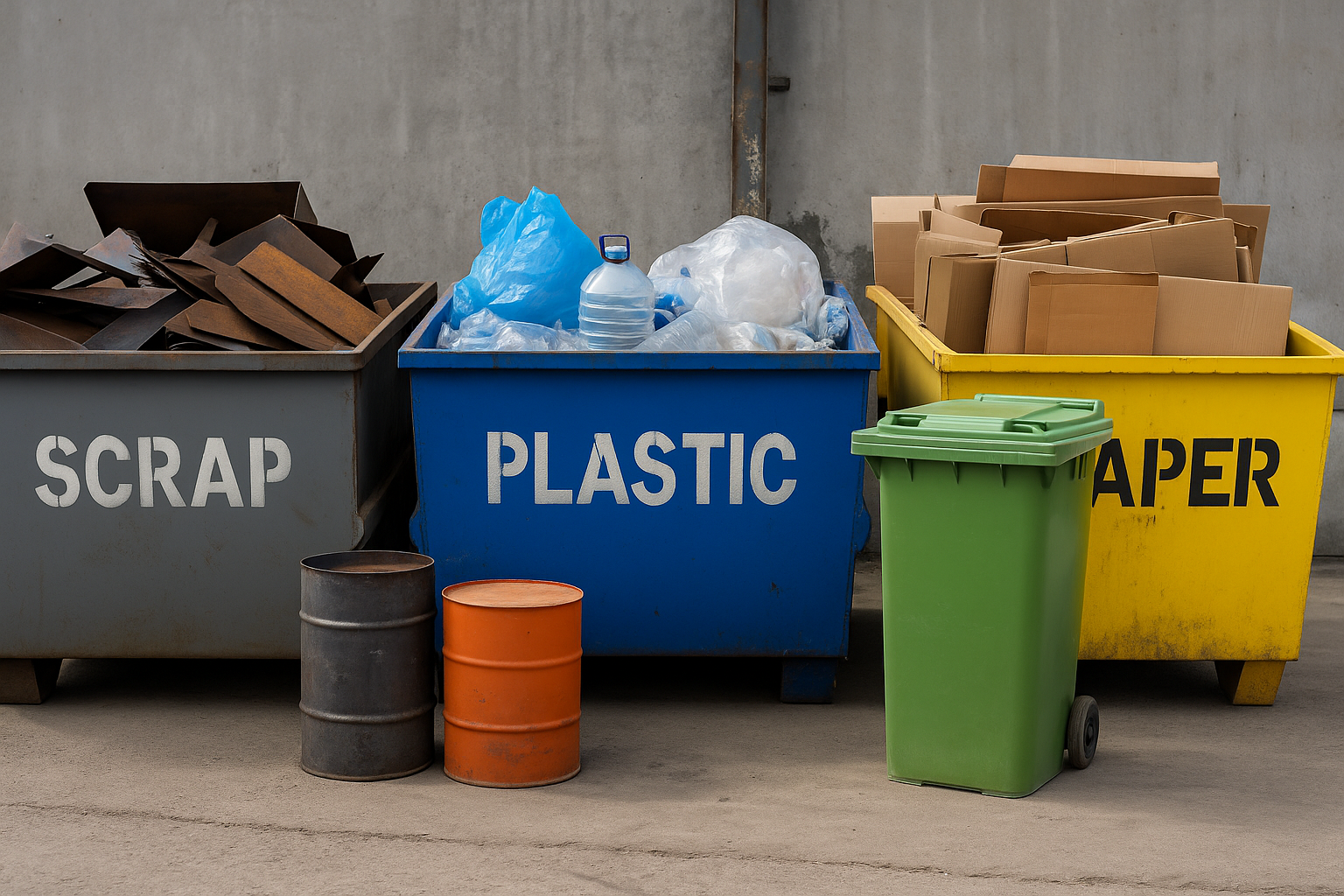
Steelmaking is a material-intensive industrial process. Large volumes of iron ore, scrap, coal, fluxes, alloys, refractories, lubricants, water, packaging materials and other inputs move through a steel plant every day.
But steel is not the only material leaving the production process.
Slag, mill scale, dust, sludge, metallic scrap, spent refractories, used oils, packaging materials and other streams are also generated throughout ironmaking, steelmaking, casting, rolling, finishing and maintenance operations.
The traditional approach is to treat these materials primarily as a waste-management problem.
A more competitive approach asks a different question:
How much economic value is being lost when potentially recoverable materials become contaminated, mixed or unnecessarily sent for disposal?
This distinction is fundamental.
Modern steel plant waste management is not simply about collecting waste and sending it to the correct destination. It is about preserving material value, recovering iron units, reducing raw-material consumption, minimizing disposal costs and transforming selected process outputs into useful co-products or secondary raw materials.
According to the World Steel Association, the main solid co-products from iron and crude steel production are slags, dust and sludge. On average, approximately 400 kg of co-products can be generated per tonne of crude steel through the BF-BOF route and around 200 kg/t through the EAF route. The actual quantities and compositions vary according to process configuration, raw materials and operating practices.
This means that even relatively small improvements in segregation and recovery can have significant financial consequences when multiplied by millions of tonnes of steel production.
Waste segregation, therefore, should not be considered merely an environmental housekeeping activity.
It is a material-efficiency and cost-reduction strategy.
Waste, Residue, By-Product or Co-Product? Why the Definition Matters
One of the first mistakes in industrial waste management is treating every material that is not the primary product as “waste.”
From an operational perspective, several different categories may exist:
| Classification | Practical Meaning |
|---|---|
| Waste | Material requiring treatment, recovery or disposal according to applicable regulation |
| Process residue | Material remaining from an industrial operation that requires technical evaluation |
| By-product | Secondary material generated together with the primary production process |
| Co-product | Material generated alongside the primary product that has potential value or application |
| Secondary raw material | Recovered material capable of replacing part of a virgin raw material in another process |
The terminology has regulatory implications that vary by jurisdiction, so legal classification must always follow applicable local legislation.
However, the industrial principle is universal:
A material should not automatically be treated as worthless simply because it is not steel.
The World Steel Association uses the term co-product for materials produced in parallel with, or as a consequence of, primary production and which have potential value.
Typical steelmaking co-products include:
- blast furnace slag;
- BOF slag;
- EAF slag;
- dust;
- sludge;
- mill scale;
- process gases.
Some can return to metallurgical processes. Others may find applications in cement, construction, aggregate production or metal recovery, provided technical, environmental and regulatory requirements are satisfied.
The first objective of an effective waste-management system is therefore correct characterization.
Where Residues and Co-Products Are Generated in a Steel Plant
Different production areas generate fundamentally different material streams.
A simplified map is:
| Production Area | Typical Material Streams |
|---|---|
| Raw-material handling | Fines, dust, spillages |
| Coke plant | Tar-related products, sludge, dust, process gases |
| Sinter plant | Dust, fines, return material |
| Blast furnace | BF slag, dust, sludge |
| BOF steelmaking | Steelmaking slag, dust, sludge, metallic skulls |
| EAF steelmaking | EAF slag, dust, metallic residues |
| Continuous casting | Mill scale, crop ends, metallic scrap |
| Hot rolling | Mill scale, sludge, scrap |
| Cold rolling | Oils, emulsions, sludge, scrap |
| Coating lines | Metallic residues, chemicals, treatment sludge |
| Maintenance | Used oils, filters, contaminated materials, scrap |
| Warehousing | Wood, plastic, paper and packaging |
The composition and recoverability of each stream can vary considerably.
For example, metallic scrap generated during cutting or trimming may be directly recyclable internally. A dust containing iron and zinc may require a completely different recovery route. Used oil may require specialized collection and treatment.
Therefore, segregation must begin where the material is generated, not at the final waste-storage area.
BF-BOF vs. EAF: Different Routes, Different Material Streams
Waste-management strategies cannot simply be copied from one steelmaking route to another.
BF-BOF route
Integrated steel plants typically generate substantial quantities of:
- blast furnace slag;
- BOF slag;
- iron-bearing dust;
- sludge;
- mill scale;
- coke-related materials;
- metallic scrap;
- process gases.
The World Steel Association reports an average generation of approximately 400 kg of solid co-products per tonne of crude steel for the BF-BOF route.
EAF route
Electric arc furnace operations generally have a different residue profile, commonly including:
- EAF slag;
- EAF dust;
- metallic scrap;
- refractory residues;
- mill scale from downstream operations;
- maintenance-related residues.
Average solid co-product generation is reported at approximately 200 kg per tonne of crude steel.
The difference matters economically.
A waste-management program must be designed according to:
steelmaking route → process stage → material composition → contamination → recovery potential → regulatory classification → destination.
A generic “recycling program” is insufficient.
The Economics of Poor Waste Segregation
Poor segregation destroys value in several ways.
Consider a clean metallic residue.
If properly segregated, it may represent a recoverable iron unit.
If mixed with:
- oil;
- refractory fragments;
- dirt;
- chemicals;
- general waste;
its recovery route may become more complex, more expensive or even technically impossible.
The economic loss is therefore not limited to disposal fees.
A more complete model is:
Net Waste Cost = Handling + Storage + Internal Transport + Treatment + External Transport + Disposal + Compliance Cost − Recovery Revenue − Avoided Raw-Material Cost
This formula reveals something important.
Two waste streams with identical disposal costs can have completely different economic consequences if one contains valuable recoverable material.
Contamination: How Valuable Material Becomes a Disposal Cost
Contamination is one of the most underestimated cost drivers in industrial waste management.
Imagine three containers:
Container A: clean ferrous scrap
Container B: mill scale with controlled composition
Container C: mixed metallic scrap, oily waste, plastics and refractory debris
Container A may have high internal or external recycling value.
Container B may have metallurgical or external recovery potential depending on its chemistry and physical characteristics.
Container C has become a separation and treatment problem.
This produces what can be called the contamination penalty:
Potential Material Value − Actual Recovered Value + Additional Treatment Cost
The most effective place to avoid this penalty is not the waste yard.
It is the point of generation.
Steel Scrap and Metallic Recovery
Metallic residues are among the most obvious sources of recoverable value in a steel plant.
They may include:
- crop ends;
- trimming scrap;
- rejected pieces;
- cutting remnants;
- steel skulls;
- metallic recoveries from slag;
- damaged products;
- obsolete internal steel stock.
However, even metallic scrap requires segregation.
Scrap chemistry can matter.
For certain grades, uncontrolled mixing of residual elements such as copper, tin, nickel, chromium or molybdenum may affect metallurgical control.
Therefore, high-quality internal scrap management can include segregation according to:
- steel family;
- alloy content;
- contamination;
- dimensions;
- density;
- origin;
- suitability for furnace charging.
This transforms scrap management from simple recycling into raw-material management.
Steelmaking Slag: From Disposal Liability to Industrial Raw Material
Slag represents the largest solid co-product stream in many steelmaking operations.
Potential applications vary according to slag type, composition, processing and applicable standards.
Examples can include:
- cementitious applications;
- road aggregates;
- construction materials;
- metallurgical recycling;
- soil-related applications where technically and legally permitted;
- recovery of metallic fractions.
But slag utilization should never be generalized.
Technical evaluation may involve:
- chemical composition;
- free lime;
- free MgO;
- volumetric stability;
- metallic content;
- particle-size distribution;
- leaching behavior;
- environmental requirements;
- intended application specifications.
Therefore:
slag is not automatically a waste, but neither is every slag automatically a marketable product.
Value comes from characterization, processing and development of a technically acceptable application.
Mill Scale, Dust and Sludge: Recovering Iron Units
Mill scale is generated by oxidation of the steel surface during high-temperature processing.
Because it can contain significant iron oxide content, it may have recovery potential.
Similarly, some dusts and sludges contain valuable iron units or other recoverable metals.
However, recovery decisions must consider contaminants.
For example, some dust streams may contain elevated concentrations of zinc or other elements that limit direct recycling into particular metallurgical processes.
A useful decision sequence is:
Characterize → Quantify → Identify valuable constituents → Identify contaminants → Evaluate internal recycling → Evaluate external recovery → Compare economics → Select destination.
European BAT conclusions for iron and steel production specifically recognize measures such as appropriate collection and storage, recycling certain BOF dusts and mill scale back into steelmaking where technically appropriate, and external recovery of iron and non-ferrous metals from selected dusts and sludges.
This reinforces a central principle:
segregation quality determines recovery options.
Refractories, Oils, Packaging and Maintenance Waste
Not every economically important waste stream comes directly from steelmaking.
Refractories
Spent refractory material may come from:
- furnaces;
- ladles;
- tundishes;
- converters;
- runners;
- other high-temperature equipment.
Potential recovery depends on refractory composition, contamination and the intended application.
Different refractory families should not automatically be mixed.
Used oils
Maintenance operations generate:
- lubricating oils;
- hydraulic fluids;
- oily filters;
- oily rags;
- contaminated absorbents.
These require controlled segregation and storage.
Mixing used oils with water, solvents or other chemicals can dramatically reduce recovery possibilities and increase treatment cost.
Packaging
Steel plants can also generate substantial volumes of:
- wood;
- cardboard;
- plastic film;
- steel straps;
- pallets;
- drums;
- containers.
Although their individual value per tonne may be lower than metallic residues, the cumulative cost becomes significant in large operations.
Hazardous Waste: Why Segregation Must Start at the Source
Hazardous and potentially hazardous materials require particularly strict control.
Depending on jurisdiction and process, these may include certain:
- oils;
- solvents;
- chemicals;
- filters;
- contaminated absorbents;
- treatment sludges;
- dusts;
- laboratory residues.
The critical rule is:
Do not allow a small hazardous stream to contaminate a much larger non-hazardous or recoverable stream.
For example, if 100 kg of incompatible contaminated material is mixed into several tonnes of otherwise recoverable material, the entire batch may require additional characterization or specialized treatment.
The financial consequence can be disproportionately large.
Segregation is therefore both an environmental-control mechanism and a form of cost containment.
From Prevention to Disposal: Internal Recycling and External Recovery
Once a material has been characterized and segregated, the next question is destination.
A practical hierarchy is:
1. Prevent generation
Can the process avoid producing the residue?
2. Reduce generation
Can yield, process control or maintenance practices reduce its volume?
3. Reuse directly
Can the material be reused without substantial processing?
4. Recycle internally
Can valuable constituents return to the steelmaking process?
5. Recover externally
Can another industry use the material?
6. Treat
Does the material require physical, chemical or thermal treatment?
7. Dispose
Only when technically, economically or legally appropriate recovery routes are unavailable.
The best alternative is not always internal recycling.
Reintroducing a material into steelmaking may introduce unwanted elements or create operational problems.
Therefore, recovery decisions must balance material value with process compatibility.
Waste Hierarchy and Circular Economy in Steelmaking
The steel industry has made substantial progress in material efficiency.
Worldsteel reports a global steel-industry material-efficiency rate of approximately 96.3%, based on crude steel and useful co-products relative to total solid and liquid output.
Its circular-economy publications also report that the industry has found markets for around 98% of its solid and liquid production, leaving approximately 2% as a waste stream in the dataset discussed.
These numbers illustrate an important change in industrial thinking.
The objective is moving from:
produce → use → discard
toward:
produce → segregate → characterize → recover → recirculate.
This is industrial circularity in practical terms.
The Steel in Focus Waste Value Matrix
A useful management tool is to classify material streams according to their economic and technical potential.
| Material Stream | Contamination Risk | Internal Recovery | External Value | Disposal Exposure |
|---|---|---|---|---|
| Clean ferrous scrap | Low | Very high | High | Low |
| Mill scale | Medium | High | Medium/High | Medium |
| BF slag | Medium | Process-dependent | High potential | Medium/High |
| BOF/EAF slag | Medium | Medium | Medium/High | High |
| Dust/sludge | High | Process-dependent | Process-dependent | High |
| Spent refractories | Medium | Limited/Medium | Process-dependent | Medium |
| Used oils | High | Specialized | Potential | High |
| Clean packaging | Low | Low | Medium | Low |
| Hazardous residues | Very high | Limited | Specialized | Very high |
This matrix should not be interpreted as a universal technical classification. Actual recovery routes depend on material characterization, plant technology, local markets and regulation.
Its purpose is managerial:
identify where contamination destroys the greatest amount of value.
A Practical Waste Cost Model for a Steel Plant
Consider a hypothetical plant generating three material streams.
| Parameter | Stream A | Stream B | Stream C |
|---|---|---|---|
| Annual generation | 10,000 t | 5,000 t | 2,000 t |
| Handling + treatment | $8/t | $20/t | $45/t |
| Disposal cost | $0/t | $15/t | $80/t |
| Recovery revenue | $40/t | $10/t | $0/t |
| Avoided raw-material value | $15/t | $5/t | $0/t |
The net annual result can be estimated as:
Net Cost = Volume × (Handling + Treatment + Disposal − Revenue − Avoided Raw-Material Value)
For Stream A:
10,000 × (8 − 40 − 15)
= −$470,000
The negative cost represents a net economic benefit.
For Stream B:
5,000 × (20 + 15 − 10 − 5)
= $100,000 cost
For Stream C:
2,000 × (45 + 80)
= $250,000 cost
Now suppose improved segregation enables part of Stream C to move into a recovery route.
The economic benefit can be substantial even if total waste generation does not change.
That distinction is critical:
Waste reduction and waste-cost reduction are related, but they are not the same thing.
A plant can reduce waste-management cost significantly by improving the quality and destination of material streams.
How to Calculate the True Cost per Tonne of Waste
A common KPI is:
Waste Management Cost ($/t waste) = Total Waste Management Cost / Total Waste Generated
Useful—but incomplete.
Steelmakers should also calculate:
Net Waste Cost ($/t steel) = Net Annual Waste Cost / Saleable Steel Production
This connects environmental performance directly to manufacturing economics.
Other useful calculations include:
Recovery Revenue ($/t steel)
Landfill Cost ($/t steel)
Recovered Material Value ($/t steel)
Avoided Raw-Material Cost ($/t steel)
These metrics allow waste-management initiatives to compete for capital using the same economic language as other productivity projects.
KPIs for Steel Plant Waste Management
What is not measured is difficult to improve.
A robust dashboard may include:
| Area | KPI |
|---|---|
| Generation | kg waste / tonne crude steel |
| Disposal | kg landfilled / tonne steel |
| Recovery | % material recovered |
| Segregation | contamination rate by stream |
| Economics | net waste cost / tonne steel |
| Revenue | co-product revenue / tonne steel |
| Scrap | internal scrap recovery rate |
| Slag | slag utilization rate |
| Hazardous waste | kg / tonne steel |
| Compliance | number of waste-management deviations |
| Contractors | traceability/documentation compliance |
| Improvement | annual avoided disposal cost |
A single recycling percentage does not provide enough information.
A plant can show a high recycling rate while still losing substantial value through poor segregation.
Digital Traceability: Weighing, QR Codes, ERP and Waste Dashboards
Digitalization can transform waste management from an administrative function into a measurable production system.
A modern architecture may include:
Generation point → identified container → weighing → QR/barcode → material classification → storage location → transporter → treatment/recovery destination → certificate/document → ERP/environmental database
Technologies can include:
- digital scales;
- barcode or QR identification;
- RFID;
- mobile inspection applications;
- automated weighing;
- GPS transport tracking;
- environmental-management software;
- ERP integration;
- BI dashboards.
Each movement can then generate data such as:
- material;
- source department;
- weight;
- date;
- destination;
- contractor;
- treatment;
- cost;
- revenue.
This makes it possible to calculate waste cost by:
plant → department → process → material → tonne of steel.
That level of visibility changes management behavior.
ISO 14001:2026 and Environmental Management
Environmental management is increasingly connected to measurable industrial performance.
In April 2026, ISO published ISO 14001:2026, replacing the 2015 edition as the current international standard for environmental management systems. ISO describes the new edition as strengthening alignment with areas including resource efficiency while emphasizing measurable environmental performance, leadership and governance.
For steel plants, a structured waste-management system can support broader EMS objectives through:
- identification of environmental aspects;
- operational controls;
- legal and compliance evaluation;
- defined responsibilities;
- monitoring;
- performance indicators;
- corrective actions;
- continual improvement.
But certification should not become the objective by itself.
The stronger question is:
Does the environmental management system actually reduce material loss, risk and cost?
That is where environmental management and operational excellence converge.
Case Study: Converting Steel Slag Into a Revenue Stream
A documented example illustrates the economic potential.
JSW Steel developed a process at its Vijayanagar Works in India to convert steel slag into construction sand.
Following laboratory and field studies, the company commissioned a facility in 2022 with a capacity of approximately 800 tonnes per day.
According to the case published by the World Steel Association, the project resulted in approximately:
- 270,000 tonnes/year of steel slag recycled;
- an equivalent amount diverted from local landfill;
- approximately 100 tCO₂e/year reduction associated with reduced internal slag-disposal vehicle activity;
- an estimated six-month return on investment;
- approximately ₹163.2 million in estimated annual revenue.
The project also reduced demand for natural river sand.
The most important lesson is not that every steel plant should convert slag into construction sand.
It is this:
A residue becomes an economic opportunity only when characterization, technology, market requirements and process control are connected.
That is the difference between waste disposal and co-product development.
A 10-Step Methodology for Implementing a Steel Waste Management Program
Step 1 — Map every generation point
Identify every production and maintenance area where material streams originate.
Step 2 — Quantify each stream
Measure tonnes per day, month and year.
Avoid relying only on estimates.
Step 3 — Characterize the material
Determine relevant:
- chemistry;
- physical properties;
- moisture;
- contamination;
- hazardous characteristics;
- metallic content.
Step 4 — Calculate current cost
Include:
- labor;
- internal transport;
- containers;
- storage;
- treatment;
- external freight;
- disposal;
- contractor costs.
Step 5 — Identify lost value
Determine whether the stream contains:
- iron units;
- alloying elements;
- minerals;
- reusable materials;
- recyclable packaging;
- recoverable oil.
Step 6 — Design segregation at source
Place the correct container and identification system where the residue originates.
Step 7 — Evaluate recovery routes
Compare:
- internal reuse;
- internal recycling;
- external recycling;
- industrial symbiosis;
- treatment;
- disposal.
Step 8 — Calculate the business case
For every improvement project:
Annual Benefit = Avoided Disposal + Recovery Revenue + Avoided Raw Materials − Additional Operating Cost
Then calculate:
Payback = Investment / Annual Net Benefit
Step 9 — Implement traceability
Connect generation, weight, transport and final destination.
Step 10 — Review continuously
Track KPIs and identify the next material stream with the greatest economic opportunity.
Common Mistakes in Steel Plant Waste Management
Mistake 1 — Calling everything waste
This hides potential material value.
Mistake 2 — Segregating only at the waste yard
By then, contamination may already have destroyed recovery potential.
Mistake 3 — Measuring tonnes but not dollars
Environmental quantities alone do not show economic performance.
Mistake 4 — Focusing only on disposal cost
Lost raw-material value can exceed disposal cost.
Mistake 5 — Mixing different metallic scrap qualities
This can reduce metallurgical flexibility and scrap value.
Mistake 6 — Assuming every slag has the same application
Slag properties depend on process and composition.
Mistake 7 — Recycling without considering contaminants
Internal recycling can create metallurgical or environmental problems if material chemistry is ignored.
Mistake 8 — Ignoring contractor performance
Traceability must continue beyond the plant gate.
Mistake 9 — Using recycling rate as the only KPI
High recycling does not necessarily mean high value recovery.
Mistake 10 — Treating waste management as an environmental department problem
Production, maintenance, purchasing, quality, metallurgy, logistics, finance and environmental teams all influence the result.
Frequently Asked Questions
What is the main objective of waste segregation in a steel plant?
The immediate objective is to prevent incompatible materials from being mixed. Economically, however, the broader objective is to preserve material value and enable the best technically and legally acceptable recovery route.
How much co-product does steelmaking generate?
Worldsteel reports averages of approximately 400 kg per tonne of crude steel for the BF-BOF route and around 200 kg/t for the EAF route. Actual values vary significantly by plant and process configuration.
Is steelmaking slag a waste?
Not necessarily. Its classification depends on jurisdiction and circumstances. Technically suitable slag can have several applications, but characterization, processing, environmental requirements and product specifications must be satisfied.
Can mill scale be recycled?
Often yes, because it contains iron oxides. However, its suitability for internal or external recovery depends on composition, contamination, moisture, process constraints and applicable regulation.
Why is source segregation important?
Because contamination can convert a recoverable material into a stream requiring expensive treatment or disposal.
Should all residues be recycled internally?
No. Internal recycling should only be adopted when the material is compatible with the receiving process. In some cases external recovery may be technically or economically superior.
How should waste-management savings be calculated?
Include avoided disposal, avoided treatment, recovery revenue and avoided raw-material purchases, then subtract any additional segregation, processing and logistics costs.
What is the best waste-management KPI for a steel plant?
There is no single KPI. A strong system combines waste generation, landfill intensity, recovery rate, contamination rate and net waste cost per tonne of steel.
Does ISO 14001 require waste segregation?
ISO 14001 provides a management-system framework rather than prescribing one universal segregation configuration. Organizations must establish appropriate controls according to their environmental aspects, obligations, objectives and operational context. The current edition is ISO 14001:2026.
Can waste management become a profit center?
Certain co-product streams can generate revenue or avoided raw-material costs. Whether the overall function becomes a profit center depends on plant configuration, material quality, local markets, treatment costs and regulation.
Conclusion: Waste Segregation Is Material Value Management
Waste segregation in a steel plant should not be reduced to colored containers, environmental compliance or housekeeping.
Its real industrial significance is much larger.
Every process stream carries a combination of:
material value + recovery potential + treatment cost + environmental risk + disposal exposure.
When different streams are mixed, value can disappear while cost and risk increase.
When they are correctly characterized, segregated and managed, the opposite can occur.
Scrap can become raw material.
Iron-bearing residues can become recoverable iron units.
Slag can become an industrial co-product.
Packaging can return to recycling streams.
Used materials can find specialized recovery routes.
And disposal can increasingly become the last option rather than the default one.
For steel producers, the strategic question is therefore no longer simply:
“How much waste do we generate?”
A better question is:
“How much material value are we recovering from every tonne of steel we produce?”
That shift—from waste disposal to material value management—connects environmental performance directly with productivity, cost reduction and competitiveness.
Sources and Further Reading
World Steel Association — Steel Industry Co-products
Definitions, co-product generation by production route, applications and material-efficiency data.
World Steel Association — Steel Industry Co-products
World Steel Association — Circular Economy
Material efficiency and circular use of steel-industry co-products.
World Steel Association — Circular Economy
World Steel Association — JSW Steel: Development of Construction Sand from Waste Steel Slag
Documented industrial case at Vijayanagar Works.
JSW Steel Slag-to-Sand Case Study
ISO — ISO 14001:2026 Environmental Management Systems
Current edition of the international EMS standard, published in April 2026.
ISO 14001:2026
European Commission — BAT Conclusions for Iron and Steel Production
Technical reference concerning collection, recycling and recovery of selected production residues.
EU BAT Conclusions for Iron and Steel Production