
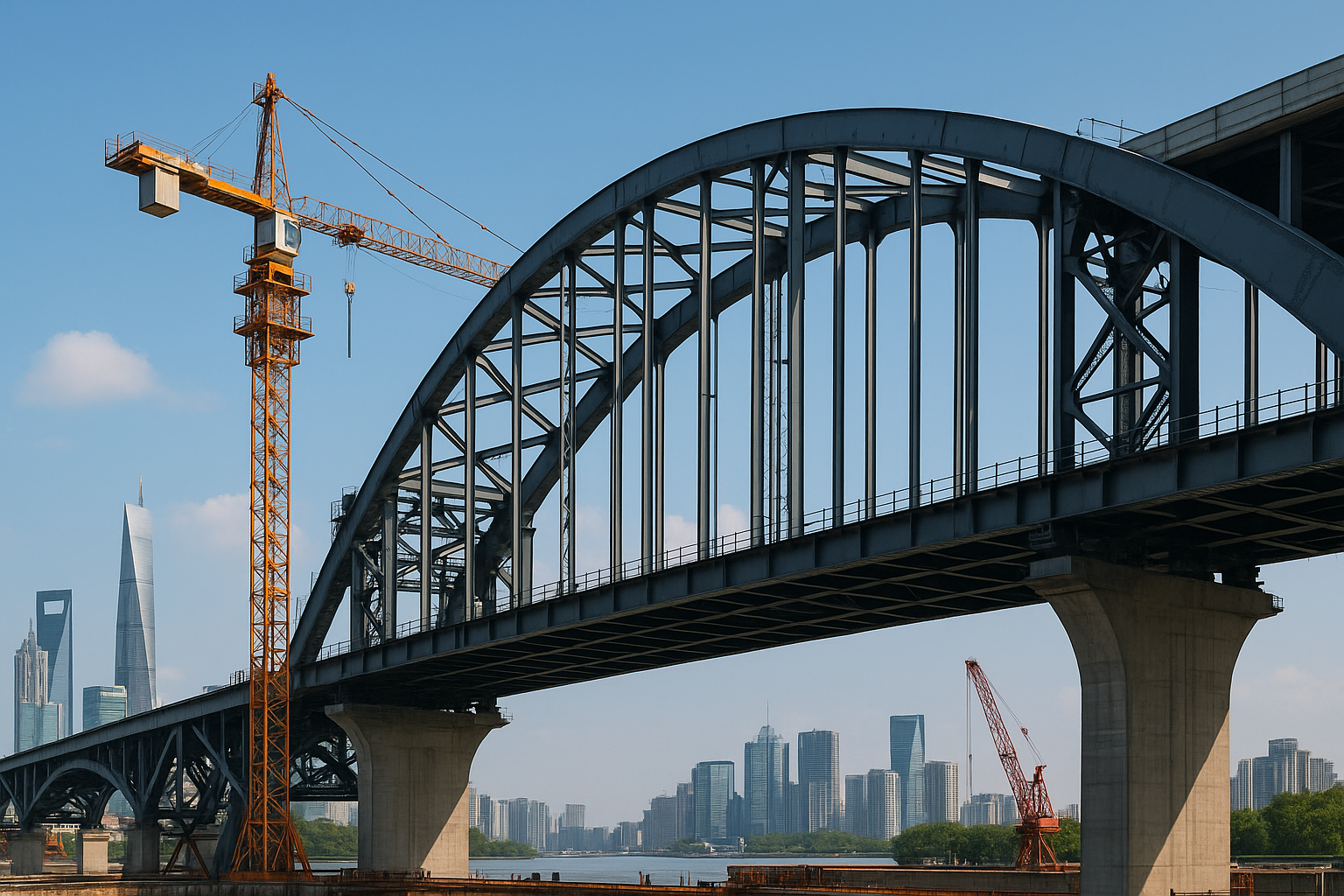
Steel is one of the fundamental materials behind modern infrastructure.
Bridges, railways, ports, airports, energy systems, transmission networks, industrial facilities, water infrastructure and large public structures all depend on steel in different forms.
But the strategic importance of steel goes far beyond the quantity of material used.
For infrastructure owners, engineers and governments, the real question is increasingly which steel should be used, where it should be used, and how that decision affects the asset throughout its entire service life.
A steel specification influences structural weight, fabrication, transportation, construction productivity, corrosion protection, inspection requirements, maintenance intervals, repair costs, embodied carbon and eventually recyclability or reuse.
This changes the engineering equation.
The lowest-cost steel at the procurement stage is not necessarily the steel that produces the lowest-cost infrastructure.
In major projects expected to remain in service for decades, material selection must therefore move from a purchase-price decision to a life-cycle value decision.
This article examines how steel supports global infrastructure and how better material engineering can reduce total project cost while improving durability, resilience and environmental performance.
Why Steel Remains Critical to Global Infrastructure
Infrastructure requires materials capable of performing under demanding combinations of load, environment, geometry and service life.
Steel provides several characteristics that make it particularly important:
- high strength;
- predictable mechanical properties;
- ductility and toughness;
- suitability for prefabrication;
- weldability and bolted construction;
- ability to span long distances;
- compatibility with modular construction;
- repairability;
- potential for disassembly and reuse;
- high recyclability.
These characteristics allow steel to perform simultaneously as a structural material and as an enabling material for other infrastructure systems.
A railway, for example, requires far more than rails. It may include steel bridges, reinforcing steel, stations, fasteners, electrical infrastructure, signaling structures, catenary supports and maintenance facilities.
Likewise, renewable-energy infrastructure requires steel for wind-turbine towers, foundations, substations, transmission towers and supporting structures.
The relationship between steel and infrastructure is therefore systemic rather than limited to individual structural components.
Infrastructure Is a Life-Cycle Engineering Problem
One of the most important changes in infrastructure engineering is the growing emphasis on the complete asset life cycle.
Traditional procurement can place excessive attention on initial construction cost.
But the economic performance of an infrastructure asset may extend over many decades.
A more complete model considers:
Life-Cycle Cost = Initial Investment + Operation + Inspection + Maintenance + Repair + Rehabilitation + Downtime + End-of-Life Costs − Residual Value
The steel specification can affect almost every component of this equation.
A more expensive steel grade may reduce structural weight.
A corrosion-resistant solution may reduce painting and maintenance.
A higher-strength grade may reduce section dimensions.
Improved toughness may increase reliability under demanding loading conditions.
Prefabricated steel components may reduce construction time.
And a design developed for disassembly may preserve material value at the end of the original asset’s service life.
This is why material optimization cannot be separated from infrastructure economics.
Where Steel Is Used in Infrastructure
The infrastructure market includes several distinct steel-consuming systems.
| Infrastructure Sector | Typical Steel Applications |
|---|---|
| Bridges | Girders, decks, cables, reinforcement, bearings |
| Railways | Rails, sleepers, bridges, stations, catenary structures |
| Ports | Piles, sheet piles, cranes, warehouses, offshore structures |
| Airports | Terminals, hangars, roofing, structural frames |
| Roads | Bridges, guardrails, reinforcement, signage structures |
| Energy | Transmission towers, substations, pipelines, generating facilities |
| Renewable energy | Wind towers, foundations, solar support structures |
| Water systems | Pipelines, tanks, treatment plants |
| Industrial infrastructure | Buildings, platforms, pipe racks, equipment structures |
| Urban infrastructure | Buildings, transit systems, pedestrian bridges, public structures |
Each application presents different mechanical, environmental and economic requirements.
Consequently, there is no universal “infrastructure steel.”
The correct material depends on the function of the component.
Structural Steel Selection: Strength Alone Is Not Enough
Engineers sometimes begin material selection with yield strength.
Strength is important, but it is only one variable.
Infrastructure steel may need to satisfy requirements involving:
- yield and tensile strength;
- toughness;
- fatigue resistance;
- weldability;
- formability;
- corrosion resistance;
- fracture behavior;
- thickness capability;
- dimensional tolerance;
- coating compatibility;
- fabrication route;
- inspection requirements;
- service temperature.
The optimum grade is therefore determined by the failure modes and service conditions of the structure, not simply by the maximum mechanical strength available.
This distinction becomes particularly important in bridges, offshore structures, rail systems and dynamically loaded infrastructure.
High-Strength Steel and Structural Weight Reduction
Higher-strength steels can create significant opportunities for infrastructure optimization.
If the governing design condition allows it, increased yield strength can reduce the amount of steel required for a structural member.
Potential consequences include:
Reduced structural weight
Less steel may be required to carry a given load.
Lower foundation loads
Reducing superstructure mass may reduce loads transferred to foundations.
Lower transportation requirements
Lighter structural elements can reduce logistics requirements.
Reduced lifting requirements
Installation may require smaller cranes or fewer lifting operations.
Greater design flexibility
Higher-strength materials can support longer spans or more slender structural solutions.
However, strength cannot be evaluated independently.
Fatigue, buckling, deflection, connection design, weldability and fracture toughness can become governing factors.
The objective is therefore not to specify the highest possible strength.
It is to specify the most economically efficient combination of strength, geometry, fabrication and durability.
Bridges: One of the Clearest Examples of Steel Life-Cycle Engineering
Bridges illustrate particularly well why infrastructure material selection should be based on life-cycle performance.
Steel bridge components may remain exposed to moisture, atmospheric pollutants, marine environments or deicing salts for decades.
Corrosion therefore becomes both an engineering and economic issue.
The U.S. Federal Highway Administration has extensively studied corrosion-resistant bridge steels and notes that bridge material decisions should consider long-term corrosion protection and life-cycle cost.
Weathering steels can eliminate conventional painting requirements in appropriate environments, potentially reducing maintenance requirements during the life of the bridge. However, they are not suitable for every exposure condition.
High chloride environments, persistent moisture and some coastal conditions can prevent the formation of the protective patina required for satisfactory weathering-steel performance.
This leads to an important engineering principle:
A corrosion-resistant steel is only corrosion-resistant within the environmental conditions for which its metallurgical and surface behavior are appropriate.
Material selection must therefore consider the actual microenvironment surrounding the structure.
Corrosion: The Hidden Infrastructure Cost
Corrosion is one of the largest long-term risks associated with steel infrastructure.
Its consequences extend far beyond material loss.
Corrosion may generate:
- inspection costs;
- surface preparation;
- repainting;
- traffic restrictions;
- repair work;
- component replacement;
- structural strengthening;
- environmental containment;
- service interruption.
For infrastructure located above roads, waterways or operating industrial facilities, access itself may become a major maintenance expense.
Consequently, corrosion protection should not be treated merely as a coating specification.
It should be treated as part of the asset’s economic design.
FHWA research has demonstrated why life-cycle cost analysis can materially change the comparison between conventional painted steels, weathering steels and more corrosion-resistant alternatives in bridge applications.
The Importance of Environmental Exposure
The same steel can perform very differently in different locations.
Important exposure variables include:
- relative humidity;
- time of wetness;
- chloride concentration;
- marine atmosphere;
- industrial pollutants;
- temperature;
- drainage;
- water retention;
- debris accumulation;
- accessibility for inspection.
Even structural detailing influences corrosion performance.
Poor drainage, crevices and areas that retain moisture can accelerate deterioration.
This means corrosion management begins during design, not after construction.
Steel in Rail Infrastructure
Railways represent another infrastructure system in which steel performance directly affects reliability.
Rails operate under repeated contact loads and severe cyclic loading.
Their engineering requirements may involve:
- wear resistance;
- rolling-contact fatigue resistance;
- fracture toughness;
- dimensional accuracy;
- weld performance;
- hardness control.
But steel requirements extend beyond the rail itself.
Modern rail systems also use steel in bridges, station structures, electrification systems, catenary supports, fasteners and maintenance infrastructure.
As passenger and freight networks expand, steel remains an enabling material for high-capacity transportation.
Ports and Marine Infrastructure
Marine infrastructure presents one of the most aggressive environments for metallic structures.
Steel may be used in:
- sheet piling;
- structural piles;
- quay structures;
- warehouses;
- cranes;
- loading systems;
- offshore structures.
Chloride exposure, continuous or cyclic wetting and difficult maintenance access can significantly affect asset economics.
Here, decisions involving steel chemistry, corrosion allowance, coatings, cathodic protection and inspection strategy must be evaluated together.
Selecting material purely by initial price can create a substantial long-term maintenance liability.
Steel and Energy Infrastructure
The energy transition does not eliminate the need for steel.
In many areas, it increases the strategic importance of steel.
Steel is required for:
- electricity transmission towers;
- substations;
- power-generation facilities;
- wind turbine towers;
- wind foundations;
- hydroelectric infrastructure;
- pipelines;
- energy-storage facilities;
- industrial decarbonization projects.
Expansion of renewable generation also requires expansion and modernization of electrical grids.
Consequently, the transition toward lower-carbon energy systems creates a dual challenge for the steel industry:
supply large quantities of material for new infrastructure while simultaneously reducing the emissions associated with producing that material.
Steel and the Infrastructure Required for Renewable Energy
A wind turbine may be viewed as an energy technology, but from a materials perspective it is also a major engineered structure.
Steel may be present in the tower, foundation, reinforcement, fasteners, drivetrain components and supporting electrical infrastructure.
Solar generation requires structural supports and grid connections.
Transmission expansion requires towers, poles, substations and associated equipment.
Hydrogen infrastructure may require storage, pipelines and industrial equipment.
Therefore, the decarbonization of the global economy creates an interesting paradox:
the world requires large quantities of industrial materials to build the infrastructure needed to reduce future emissions.
This makes material efficiency increasingly important.
Infrastructure Decarbonization Changes Steel Procurement
Historically, infrastructure procurement focused strongly on:
- technical specification;
- quantity;
- price;
- delivery;
- quality certification.
A new criterion is becoming increasingly relevant:
embodied carbon.
The International Energy Agency identifies steel and cement as major contributors to industrial emissions and argues that markets for near-zero-emission materials must expand substantially as global decarbonization progresses.
This means future infrastructure procurement may increasingly compare not only:
$/tonne
but also:
kg CO₂e/tonne
and eventually:
CO₂e per functional unit of infrastructure delivered.
That final distinction is particularly important.
Why Carbon per Tonne Can Be Misleading
Comparing two steels only by emissions per tonne can produce an incomplete conclusion.
Suppose Steel A has lower emissions per tonne but requires substantially more mass to perform the same structural function.
Steel B may have higher emissions per tonne but enable a lighter structure.
The correct comparison should therefore consider:
Total Structural Carbon = Steel Mass × Carbon Intensity of Steel
And an even more complete analysis may include:
- fabrication;
- transportation;
- coatings;
- construction;
- maintenance;
- replacement;
- recycling;
- potential reuse.
The correct environmental unit is ultimately the function performed by the structure throughout its life, not simply one tonne of material purchased.
The Material Efficiency Opportunity
Material efficiency is one of the most powerful links between steel engineering and infrastructure decarbonization.
Reducing unnecessary steel consumption can simultaneously reduce:
- material cost;
- transportation;
- handling;
- welding;
- fabrication time;
- structural dead load;
- embodied carbon.
This does not mean indiscriminately reducing thickness.
Material efficiency requires engineering.
Potential strategies include:
- optimized structural design;
- appropriate high-strength steels;
- tighter material tolerances where technically justified;
- improved nesting and fabrication yield;
- standardization;
- modular design;
- reduction of over-specification;
- better procurement control.
The objective is not “less steel at any cost.”
It is the minimum technically appropriate amount of steel required to deliver the intended structural performance and service life.
CAPEX vs. Life-Cycle Cost
Infrastructure procurement frequently encounters a conflict between CAPEX optimization and life-cycle optimization.
Consider two alternatives:
| Parameter | Option A | Option B |
|---|---|---|
| Initial steel cost | Lower | Higher |
| Corrosion resistance | Conventional | Enhanced |
| Painting | Required | Reduced/Not required* |
| Maintenance frequency | Higher | Lower |
| Traffic/service interruptions | More likely | Less likely |
| Initial CAPEX | Lower | Higher |
| Potential life-cycle cost | Higher | Lower |
*Depending on steel grade, design and environmental exposure.
A procurement process focused only on initial cost may select Option A.
An asset-management approach may select Option B.
Neither answer is automatically correct.
The correct decision depends on discounted life-cycle economics, service conditions, maintenance accessibility and expected asset life.
A Practical Steel in Focus Infrastructure Material Value Model
A useful way of evaluating infrastructure steel is to consider six dimensions simultaneously.
| Dimension | Engineering Question |
|---|---|
| Structural Performance | Does the steel provide the required strength, toughness and fatigue performance? |
| Material Efficiency | Can the grade reduce mass without compromising performance? |
| Fabrication | Can it be welded, formed, cut and inspected efficiently? |
| Durability | How will it perform in the actual service environment? |
| Life-Cycle Cost | What will the material cost throughout the asset’s life? |
| Environmental Performance | What are the embodied carbon, maintenance and end-of-life implications? |
A material that performs strongly in only one dimension may not be the optimum infrastructure solution.
The best result comes from balancing all six.
Resilient Infrastructure Requires Material Resilience
Climate change adds another variable to infrastructure design.
Assets may increasingly face:
- higher temperatures;
- flooding;
- stronger storms;
- coastal exposure;
- changing humidity;
- more severe rainfall;
- changing freeze-thaw conditions;
- unexpected combinations of environmental loading.
Resilience therefore includes not only structural capacity but also durability and recoverability.
The material system must be evaluated against the environment the asset may experience during its future life—not simply historical conditions.
Steel, Prefabrication and Construction Productivity
One of steel’s major infrastructure advantages is its compatibility with off-site fabrication.
Structural elements can be manufactured under controlled industrial conditions and transported to the construction site for assembly.
Potential advantages include:
- tighter dimensional control;
- improved quality consistency;
- reduced site labor;
- faster erection;
- fewer weather-related interruptions;
- improved repeatability;
- easier automation;
- shorter construction windows.
For infrastructure projects where shutdowns or traffic interruptions carry large economic costs, construction speed can become a significant component of the business case.
The economic value of steel therefore includes not only material performance but also construction productivity.
Design for Disassembly and Future Reuse
Traditional recycling melts steel scrap to create new steel.
But circular infrastructure can go further.
Some structural components may eventually be:
- inspected;
- documented;
- dismantled;
- requalified;
- reused.
Reuse preserves more of the energy and economic value already embedded in the component than remelting.
Achieving this at scale requires infrastructure designed with future disassembly in mind.
Important considerations include:
- bolted rather than irreversible connections where appropriate;
- material identification;
- traceability;
- dimensional standardization;
- accessible documentation;
- structural history;
- inspection records.
The future value of infrastructure steel may therefore depend increasingly on information attached to the material.
Digitalization and the Steel Infrastructure Life Cycle
Digital tools can connect steel production, fabrication, construction and asset management.
A future structural component may carry information relating to:
- producer;
- steel grade;
- heat number;
- chemical composition;
- mechanical properties;
- fabrication history;
- welding records;
- inspection;
- environmental data;
- maintenance history.
When integrated with BIM, digital twins and asset-management platforms, this information can remain associated with the structure throughout its life.
This creates the possibility of moving from infrastructure maintenance based primarily on fixed schedules toward increasingly condition-based asset management.
ISO 55000:2024 reinforces the importance of managing assets systematically throughout their life cycles to realize value, manage risk and support organizational objectives.
The Procurement Mistake: Buying Steel Instead of Buying Performance
One of the most important conceptual changes for infrastructure owners is moving away from material procurement based solely on commodity price.
The traditional question is:
What is the price per tonne?
The engineering question should be:
What is the cost of delivering the required structural function for the required service life?
Those are fundamentally different questions.
A lower $/tonne can coexist with:
- greater material consumption;
- higher fabrication cost;
- more coating;
- heavier foundations;
- greater transportation cost;
- increased maintenance;
- shorter service intervals.
Infrastructure procurement should therefore connect material specifications with total project economics.
A Practical Infrastructure Steel Selection Methodology
For major infrastructure projects, a structured material-selection process can follow ten steps.
Step 1 — Define the structural function
Identify loads, geometry, expected deformation and critical failure modes.
Step 2 — Define the service environment
Evaluate humidity, temperature, chlorides, marine exposure, pollutants and water retention.
Step 3 — Establish the required service life
A temporary industrial structure and a bridge designed for many decades should not necessarily use the same material strategy.
Step 4 — Identify candidate steel grades
Compare mechanical properties, toughness, weldability, corrosion behavior and availability.
Step 5 — Optimize structural mass
Evaluate whether higher-performance steels can reduce weight while respecting fatigue, buckling and deflection requirements.
Step 6 — Evaluate fabrication
Consider cutting, forming, welding, inspection, heat treatment and dimensional control.
Step 7 — Develop the corrosion strategy
Compare coatings, weathering steel, corrosion-resistant grades, corrosion allowances and other protection systems.
Step 8 — Calculate life-cycle cost
Include inspection, maintenance, repair, access, shutdown and replacement—not merely initial material cost.
Step 9 — Calculate environmental performance
Evaluate material quantity, production emissions, transportation, coatings, maintenance and end-of-life scenarios.
Step 10 — Select on total value
Choose the solution that produces the best combination of technical performance, cost, durability, risk and environmental impact.
Common Mistakes When Selecting Steel for Infrastructure
Mistake 1 — Selecting by price per tonne
Purchase price represents only one component of infrastructure economics.
Mistake 2 — Over-specifying steel
Unnecessary strength, alloying or tolerance requirements can increase cost without creating equivalent project value.
Mistake 3 — Under-specifying durability
A low initial material cost can produce decades of additional maintenance.
Mistake 4 — Ignoring the environment
Corrosion behavior depends strongly on exposure conditions.
Mistake 5 — Assuming higher strength automatically means lower weight
Fatigue, stiffness, buckling or connection design may govern instead.
Mistake 6 — Ignoring fabrication
An optimized material must also be practical to cut, form, weld and inspect.
Mistake 7 — Separating steel procurement from structural engineering
Procurement and engineering decisions should be connected.
Mistake 8 — Comparing carbon only per tonne
The functional quantity of steel required must also be considered.
Mistake 9 — Ignoring maintenance access
Maintenance performed above highways, railways or water can be extremely expensive.
Mistake 10 — Designing only for construction
Infrastructure should increasingly be designed for operation, maintenance and eventual end-of-life recovery.
Frequently Asked Questions
Why is steel so important to infrastructure?
Steel combines high strength, ductility, fabrication flexibility, durability and recyclability, allowing it to serve in bridges, railways, energy systems, ports, buildings and many other infrastructure applications.
Is higher-strength steel always better for infrastructure?
No. Higher strength can reduce structural weight in suitable applications, but fatigue, buckling, stiffness, weldability, toughness and fabrication must also be considered.
Is weathering steel always better than painted structural steel?
No. Weathering steel can provide excellent life-cycle performance in appropriate environments, but high chloride exposure, persistent moisture and unsuitable detailing can prevent satisfactory protective-patina development.
Why should infrastructure steel be evaluated using life-cycle cost?
Because the initial material price does not capture inspection, corrosion protection, maintenance, repairs, operational interruption and eventual replacement.
Can more expensive steel reduce total infrastructure cost?
Yes. Higher-performance steel may reduce structural weight, fabrication requirements or maintenance costs sufficiently to compensate for a higher initial material price.
How does steel affect infrastructure carbon emissions?
Emissions depend on the production route and material quantity, but structural optimization, durability, maintenance reduction, recycling and reuse can materially influence life-cycle emissions.
What is material efficiency?
Material efficiency means achieving the required engineering function using the technically appropriate quantity and specification of material rather than simply minimizing thickness or weight.
Can structural steel be reused?
Potentially, yes. Components that maintain adequate condition and traceability may be candidates for reuse after inspection and requalification, depending on applicable engineering requirements.
How will digitalization affect infrastructure steel?
Digital traceability can connect steel production records, fabrication data, construction documentation, inspection and maintenance history, supporting more effective life-cycle asset management.
What should infrastructure buyers compare besides steel price?
They should consider structural efficiency, fabrication, transportation, corrosion protection, maintenance, expected service life, reliability, embodied carbon and residual material value.
Conclusion: Infrastructure Should Be Designed Around Steel Performance, Not Steel Price
Steel will remain fundamental to bridges, railways, energy networks, ports, industrial facilities and the infrastructure required for the global energy transition.
But the strategic role of steel is changing.
The next generation of infrastructure will increasingly require materials to deliver not only structural strength, but also durability, lower life-cycle cost, lower embodied carbon, traceability, resilience and circularity.
This changes the definition of material optimization.
The objective is no longer simply to buy steel at the lowest possible price per tonne.
It is to select the steel solution that delivers the required infrastructure function with the lowest technically justified combination of material consumption, fabrication cost, maintenance exposure, environmental impact and life-cycle risk.
For infrastructure owners, designers and steel suppliers, that shift creates an important competitive opportunity.
The value of steel is not measured only by the tonne purchased. It is measured by the decades of reliable infrastructure performance that tonne helps deliver.
Sources and Further Reading
International Energy Agency — Demand- and Supply-Side Measures for the Industry Transition
Policy brief examining demand creation, industrial policy and market mechanisms supporting the transition toward near-zero and low-emissions steel and cement, illustrating how policy, market signals and industrial data increasingly interact in strategic decision-making.
IEA — Demand and Supply Measures for the Steel and Cement Transition
United Nations Environment Programme — Global Status Report for Buildings and Construction
Global reference covering energy use, emissions and decarbonization challenges associated with buildings, construction and construction materials.
UNEP — Global Status Report for Buildings and Construction
Federal Highway Administration — Improved Corrosion-Resistant Steel for Highway Bridge Construction
Technical reference covering structural bridge steels, corrosion, environmental exposure and life-cycle considerations.
FHWA — Improved Corrosion-Resistant Steel for Highway Bridge Construction
Federal Highway Administration — Uncoated Weathering Steel in Structures
Technical guidance regarding environmental suitability, detailing and maintenance of weathering steel in highway structures.
FHWA — Uncoated Weathering Steel in Structures
International Organization for Standardization — ISO 55000:2024
Asset management — Vocabulary, overview and principles. Provides the framework for systematic management of assets throughout their life cycles.
ISO 55000:2024