
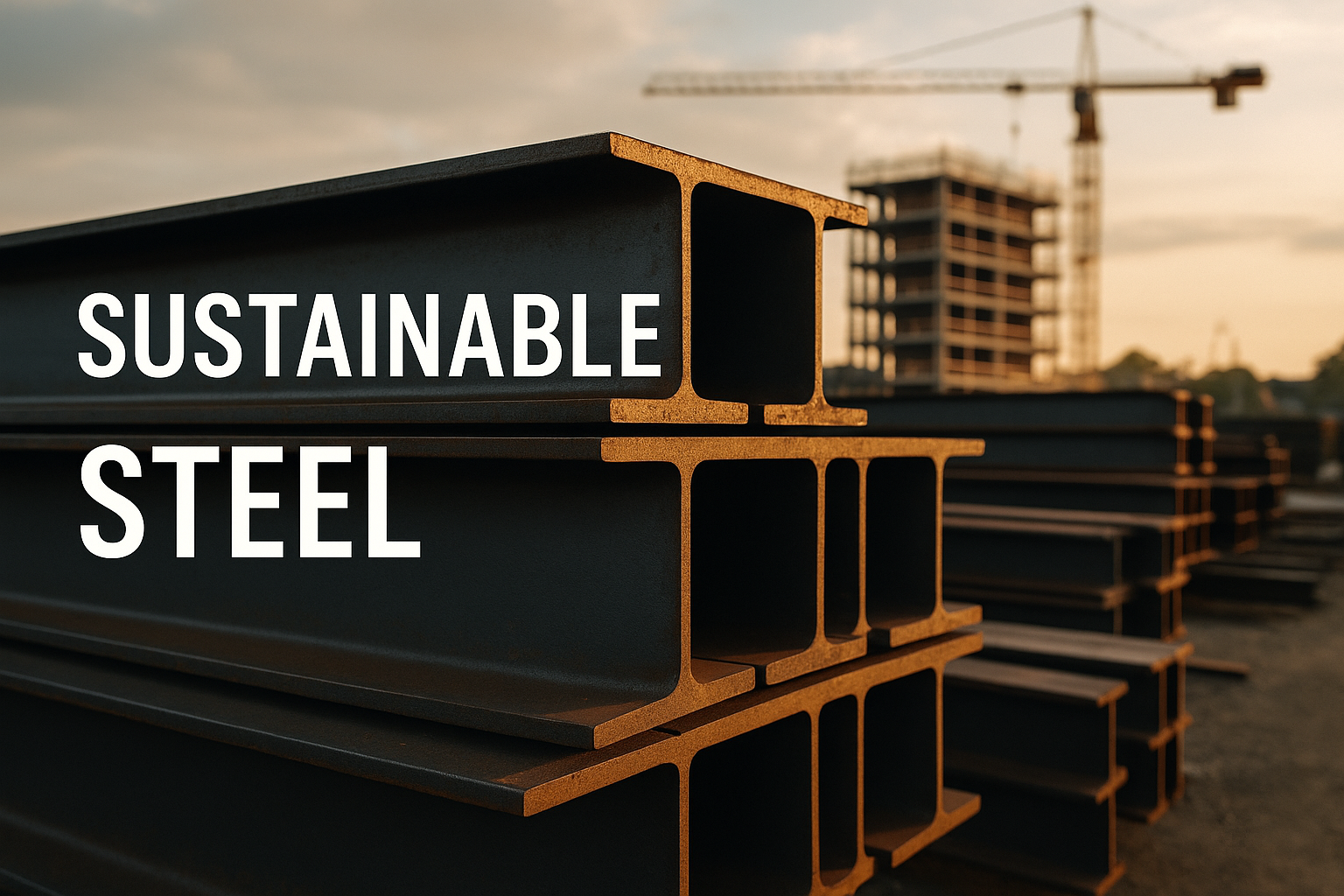
What Is Sustainable Steel and Why It Matters for Construction
Steel is one of the most important materials used in modern construction. Buildings, bridges, industrial facilities, railways, energy infrastructure, warehouses, and transportation systems depend on its strength, durability, versatility, and recyclability.
At the same time, steel production is a significant source of greenhouse gas emissions. This creates an important challenge for the construction industry: how can steel continue to support infrastructure and economic development while reducing its environmental impact?
The answer is not simply to replace conventional steel with a product labeled “green steel.”
Sustainable steel requires a broader approach involving production route, raw materials, energy sources, recycled content, emissions intensity, durability, material efficiency, traceability, circularity, and lifecycle performance.
For architects, engineers, contractors, developers, steel distributors, and procurement professionals, understanding these factors is becoming increasingly important as carbon requirements become part of material selection and construction strategy.
1. What Is Sustainable Steel?
There is no single universal steel grade called “sustainable steel.”
Instead, the term generally describes steel produced, specified, used, and recovered in ways that reduce environmental impacts while maintaining the technical performance required for its application.
Important factors can include:
- Greenhouse gas emissions associated with production
- Production route
- Electricity source
- Scrap utilization
- Raw material sourcing
- Energy efficiency
- Material efficiency
- Product durability
- Reusability
- Recyclability
- Environmental documentation
- Traceability
- Responsible production practices
This distinction is important.
Two steel products with similar mechanical properties may have very different environmental footprints depending on how and where they were produced.
Therefore, sustainable steel procurement increasingly requires both technical specifications and reliable environmental data.
2. Why Steel Decarbonization Matters
Steel production remains highly carbon-intensive because much of the world’s primary iron production depends on coal-based processes.
The conventional blast furnace-basic oxygen furnace route uses coke and other carbon-bearing materials not only as energy sources but also as reducing agents in the conversion of iron ore into metallic iron.
As a result, emissions reduction in steelmaking is considerably more complex than simply replacing electricity from fossil fuels with renewable electricity.
Different production routes have significantly different emissions profiles.
This is why decarbonization strategies increasingly focus on combinations of:
- Increased material efficiency
- Scrap recycling
- Electric Arc Furnaces
- Lower-carbon electricity
- Direct Reduced Iron
- Hydrogen-based ironmaking
- Carbon capture technologies
- Process optimization
- Improved energy efficiency
- Longer product life
- Reuse of structural components
The appropriate solution depends on regional energy systems, raw material availability, existing production assets, product quality requirements, economics, and technological maturity.
3. The Main Steel Production Routes
Understanding production routes is essential when evaluating steel sustainability.
Blast Furnace–Basic Oxygen Furnace (BF-BOF)
The BF-BOF route remains one of the dominant methods of global steel production.
Iron ore is reduced in a blast furnace, traditionally using coke and other carbon-bearing materials. The resulting hot metal is subsequently converted into steel in a basic oxygen furnace.
This route is highly productive and capable of producing a wide range of steel products, but its dependence on carbon for iron reduction creates significant CO₂ emissions.
Decarbonization options include:
- Improved energy efficiency
- Increased scrap use where technically possible
- Alternative reducing agents
- Biomass applications in certain processes
- Carbon capture, utilization and storage
- Process optimization
Electric Arc Furnace (EAF)
Electric Arc Furnaces use electricity to melt metallic inputs such as scrap, Direct Reduced Iron, and sometimes other iron-bearing materials.
EAF production can have substantially lower emissions than conventional integrated steelmaking under favorable conditions.
However, it is important to avoid the assumption that:
EAF = zero-carbon steel.
The actual emissions depend on factors including:
- Electricity generation mix
- Scrap content
- DRI or pig iron content
- Upstream emissions
- Alloying materials
- Plant efficiency
Therefore, the environmental performance of EAF steel should be evaluated using verified emissions data rather than production route alone.
4. Scrap and the Circular Economy
One of steel’s major sustainability advantages is its ability to remain within material cycles through recycling.
Steel scrap can be recovered from:
- Buildings
- Vehicles
- Machinery
- Appliances
- Industrial equipment
- Manufacturing processes
- Infrastructure
Recovered steel can return to steelmaking as metallic feedstock.
This reduces dependence on virgin iron ore and can significantly reduce emissions, particularly when scrap is processed using low-carbon electricity.
However, scrap availability is not unlimited.
The world’s demand for steel remains larger than the volume that can currently be supplied entirely through recycled material.
In addition, some applications require careful control of residual elements and chemical composition.
For these reasons, both primary iron production and scrap-based steelmaking will remain important.
The strategic objective is not simply to maximize recycled content in every product, but to optimize the entire steel material cycle.
5. Hydrogen-Based Steelmaking
Hydrogen-based Direct Reduced Iron is one of the most important emerging pathways for reducing emissions from primary steel production.
In conventional DRI production, natural gas is commonly used as the reducing agent.
In hydrogen-based DRI, hydrogen can replace much of the fossil-based reducing gas used to convert iron ore into metallic iron.
The resulting DRI can then be melted in an Electric Arc Furnace.
When hydrogen is produced using low-carbon electricity, this route has the potential to substantially reduce emissions associated with primary steelmaking.
However, several challenges remain:
- Availability of low-carbon hydrogen
- Cost of hydrogen production
- Renewable electricity requirements
- Infrastructure investment
- Availability of suitable iron ore
- Capital expenditure
- Commercial scale-up
- Regional competitiveness
Therefore, hydrogen-based steelmaking should be considered an important decarbonization pathway, but not yet a universal replacement for conventional steelmaking.
6. Carbon Capture, Utilization and Storage
Carbon Capture, Utilization and Storage (CCUS) is another potential pathway for reducing emissions from existing steelmaking assets.
The concept involves capturing CO₂ from industrial processes and either:
- Storing it permanently, or
- Using it in other industrial applications where technically and economically appropriate.
CCUS may be particularly relevant for existing integrated steel plants where complete replacement of production infrastructure would require very large investments.
Its effectiveness depends on capture rates, energy requirements, transportation infrastructure, storage availability, economics, and the emissions boundary considered.
7. Sustainable Steel Is More Than Production Emissions
A common mistake is evaluating steel sustainability only according to emissions per tonne produced.
For construction, the more appropriate question is often:
How much environmental impact does the steel solution generate over the entire life of the structure?
This introduces lifecycle considerations.
Important variables include:
- Quantity of steel required
- Structural efficiency
- Expected service life
- Maintenance requirements
- Corrosion protection
- Transportation
- Fabrication losses
- Construction waste
- Potential for reuse
- End-of-life recycling
For example, a higher-strength steel may have a higher production impact per tonne but allow a designer to use significantly less material.
Similarly, a corrosion-resistant solution may increase initial cost but substantially extend service life.
Therefore, sustainability should be evaluated at the system level, not simply by comparing tonnes of steel.
8. Material Efficiency in Construction
One of the most immediate ways to reduce the environmental impact of steel construction is to use less material while maintaining required performance and safety.
Material efficiency can involve:
- Structural optimization
- Higher-strength steels
- Improved design
- Reduced fabrication losses
- Optimized cutting plans
- Standardized dimensions
- Better nesting
- Improved tolerances
- Modular construction
- Design for disassembly
However, reducing steel quantity must always remain subordinate to engineering requirements.
Structural safety, fatigue, buckling, fire resistance, corrosion allowances, fabrication tolerances, connections, and applicable standards must be respected.
The objective is therefore not simply less steel.
It is:
the minimum technically appropriate quantity of steel required to achieve the required performance throughout the intended service life.
9. Durability as a Sustainability Strategy
Longer service life can significantly improve lifecycle environmental performance.
A steel structure that remains functional for many decades can avoid the environmental and economic costs associated with premature replacement.
Durability strategies may include:
- Appropriate steel grade selection
- Corrosion-resistant alloys
- Metallic coatings
- Protective coatings
- Proper drainage
- Avoidance of water traps
- Appropriate detailing
- Inspection programs
- Preventive maintenance
This illustrates why sustainability and engineering reliability should not be treated as separate objectives.
A poorly designed “low-carbon” structure requiring premature replacement may ultimately perform worse from a lifecycle perspective than a more durable alternative.
10. Environmental Product Declarations
Environmental Product Declarations (EPDs) are becoming increasingly important in construction material procurement.
An EPD provides quantified environmental information about a product based on a defined lifecycle assessment methodology.
Depending on the applicable Product Category Rules and declared lifecycle modules, an EPD may provide information relating to:
- Global warming potential
- Energy use
- Resource consumption
- Waste generation
- Other environmental impact categories
For steel buyers and construction professionals, EPDs can improve transparency.
However, EPDs must be compared carefully.
Before comparing two products, users should verify:
- Functional or declared unit
- System boundaries
- Lifecycle modules
- Product Category Rules
- Data period
- Production location
- Verification status
Two environmental declarations should not automatically be considered directly comparable simply because both contain a CO₂-equivalent figure.
11. ResponsibleSteel and Responsible Production
Environmental performance is only one dimension of responsible steel production.
ResponsibleSteel provides an international framework addressing environmental, social, governance, sourcing, climate, labor, human-rights and other aspects of steel production.
Certification can provide additional assurance regarding how a steelmaking site manages these issues.
However, buyers should distinguish between:
- Site certification
- Product-level environmental information
- Emissions intensity
- Chain-of-custody claims
- Environmental Product Declarations
These concepts are related but are not interchangeable.
A certification should therefore be interpreted according to precisely what it verifies.
12. Sustainable Steel and Green Building Certification
Steel can also contribute to broader sustainable-building strategies.
Building certification systems may consider factors such as:
- Environmental product transparency
- Responsible sourcing
- Lifecycle impacts
- Recycled materials
- Waste management
- Energy performance
- Material optimization
However, the contribution of a particular steel product depends on the rules of the applicable certification system.
Therefore, statements such as “this steel earns LEED points” should be verified against the specific project, credit category, documentation requirements, and current certification rules.
Material sustainability claims should always be supported by appropriate documentation.
13. Design for Disassembly and Steel Reuse
Recycling is important, but reuse can sometimes preserve even more of the value already embedded in a manufactured component.
Design for disassembly considers whether structural components can eventually be removed and reused rather than demolished and recycled.
Potential strategies include:
- Bolted connections
- Standardized structural elements
- Modular construction
- Material identification
- Digital material records
- Accessible connections
- Reversible assembly methods
Future buildings may increasingly function as material banks, where structural components retain technical and economic value after their first application.
This could create new opportunities for steel fabricators, service centers, contractors, demolition companies, and distributors.
14. Digital Traceability and Material Passports
Traceability is becoming increasingly important as construction companies demand more information about the origin and environmental characteristics of materials.
Digital systems can connect steel products with information such as:
- Manufacturer
- Production site
- Heat number
- Steel grade
- Mechanical properties
- Chemical composition
- Material certificates
- Environmental declarations
- Carbon footprint
- Recycled content
- Certification information
Material passports could eventually facilitate reuse, recycling, compliance verification, and lifecycle assessment.
For distributors and service centers, this creates an opportunity to provide not only steel but also verified material information.
15. Sustainable Steel Procurement
Purchasing sustainable steel requires more than requesting a product described as “green.”
A more robust procurement process should ask:
- What steel grade and standard are required?
- What production route was used?
- What is the declared emissions intensity?
- What emissions boundary was used?
- Is the information independently verified?
- Is an EPD available?
- What percentage of metallic input is scrap?
- What energy sources are used?
- What certifications apply?
- Is the material fully traceable?
- Does the product meet all mechanical and dimensional requirements?
- What is the total lifecycle cost?
This approach reduces the risk of making purchasing decisions based on marketing claims rather than technical evidence.
16. The Risk of Greenwashing
As demand for low-emissions materials increases, environmental claims are becoming commercially valuable.
This also increases the risk of vague or misleading terminology.
Terms such as:
- Green steel
- Clean steel
- Sustainable steel
- Low-carbon steel
- Fossil-free steel
- Climate-neutral steel
should not automatically be treated as equivalent.
A credible environmental claim should identify:
- Measurement methodology
- Emissions boundary
- Production route
- Verification method
- Reference period
- Carbon accounting approach
- Use of offsets, if applicable
Procurement teams should therefore focus on quantified, comparable and independently verified information.
17. Challenges Facing Sustainable Steel
The transition toward lower-emissions steel faces significant technical and economic challenges.
Capital investment
Steel plants are extremely capital-intensive assets. Replacing or modifying production routes requires major investment.
Electricity availability
Electrification and hydrogen production can require very large quantities of reliable low-carbon electricity.
Hydrogen cost and infrastructure
Hydrogen-based steelmaking requires competitive hydrogen supply, transportation, storage and production infrastructure.
Scrap availability and quality
Scrap is essential for circular steelmaking, but availability, quality and residual-element control can constrain its use.
Green premium
Lower-emissions steel may initially carry a price premium compared with conventional alternatives.
Measurement and comparability
Different carbon accounting methodologies can make product comparisons difficult.
These challenges explain why steel decarbonization will involve multiple technologies rather than a single universal solution.
18. Why Construction Can Accelerate Steel Decarbonization
Construction represents a major source of steel demand.
This gives developers, engineering companies, contractors, architects and public procurement agencies significant influence over the market.
Demand-side strategies can include:
- Specifying verified emissions information
- Requiring EPDs where appropriate
- Evaluating lifecycle carbon
- Optimizing structural design
- Encouraging material reuse
- Reducing fabrication waste
- Considering lower-emissions steel when technically and economically viable
- Incorporating sustainability criteria into procurement
As demand for transparent environmental performance increases, steel producers gain stronger commercial incentives to invest in lower-emissions technologies.
19. Cost Versus Carbon: Finding the Economic Balance
Sustainable steel procurement should not ignore economics.
Companies must evaluate both environmental performance and total cost.
Important variables include:
Material price + fabrication + transportation + installation + maintenance + service life + replacement + residual value
A lower-emissions steel product with a higher purchase price may still be economically competitive if it enables:
- Reduced material consumption
- Longer service life
- Lower maintenance
- Improved project certification
- Reduced carbon-related costs
- Better access to sustainable financing
- Compliance with customer requirements
The appropriate decision depends on the specific project.
20. The Future of Sustainable Steel
The steel industry’s transition is likely to involve several technologies operating simultaneously.
These include:
- Scrap-based EAF production
- Increased renewable electricity
- Natural-gas DRI transitioning toward hydrogen
- Hydrogen-based DRI
- CCUS
- Improved BF-BOF efficiency
- Higher scrap utilization
- Artificial intelligence and process optimization
- Material efficiency
- Steel reuse
- Digital traceability
There is unlikely to be one universal production route suitable for every region.
Energy availability, raw materials, infrastructure, existing steelmaking assets, product requirements and economics will determine which pathways develop most rapidly.
What is increasingly clear is that carbon performance is becoming another technical and commercial characteristic of steel, alongside strength, chemistry, dimensions, surface quality and price.
Frequently Asked Questions
Is sustainable steel the same as recycled steel?
No. Recycled content is one component of sustainability, but sustainable steel can also involve production emissions, energy sources, material efficiency, durability, responsible sourcing and lifecycle performance.
Is EAF steel always low-carbon?
Not necessarily. Its emissions depend significantly on electricity generation, metallic inputs, plant efficiency and the emissions boundary used.
Can steel be recycled repeatedly?
Steel is highly recyclable and can remain within material cycles through repeated recycling. However, metallurgy, scrap quality and residual-element control must still be managed according to the required application.
Is hydrogen steel already commercially available at large scale?
Hydrogen-based steelmaking is developing rapidly, but deployment remains limited relative to global steel production. Economics, hydrogen availability, renewable electricity and infrastructure remain important constraints. The IEA reports that near-zero-emissions iron capacity remains small relative to the scale of the global industry.
What should buyers request when purchasing lower-emissions steel?
Buyers should request quantified emissions information, methodology and boundary definitions, verification, relevant environmental declarations, certification information and full technical conformity documentation.
Conclusion: Sustainable Steel Is an Engineering and Procurement Strategy
Sustainable steel is not simply a new category of material.
It represents a change in how steel is produced, specified, purchased, used, maintained, recovered and evaluated throughout its lifecycle.
For the construction industry, the greatest opportunities may come from combining:
- Lower-emissions production
- Efficient structural design
- Reduced material consumption
- Durability
- Circularity
- Reuse
- Recycling
- Environmental transparency
- Technical traceability
The objective should not be to select steel based on an environmental label alone.
The objective is to achieve the required structural and technical performance with the lowest practical lifecycle environmental impact, acceptable cost and controlled technical risk.
As carbon performance becomes increasingly important in construction procurement, companies capable of integrating engineering, economics and environmental data into material decisions will be better prepared for the next phase of the global steel market.